Last Updated on April 25, 2026 by PostUpgrade
Why Your Content Looks Clear But Still Confuses Readers
Your content is not confusing — it loses meaning between sentences, and readers never recover it.
TL;DR: Your content looks clear, but readers stop understanding as they move forward. They drop off because meaning does not connect across sentences, even when each part is simple. This happens when ideas don’t build on each other and force reconstruction instead of continuation. When content restores meaning continuity, readers stay engaged and interpretation becomes stable across the entire page.
This is the exact point where most content loses readers without noticing it.
You think your content is clear — but readers stop understanding it long before they finish reading.
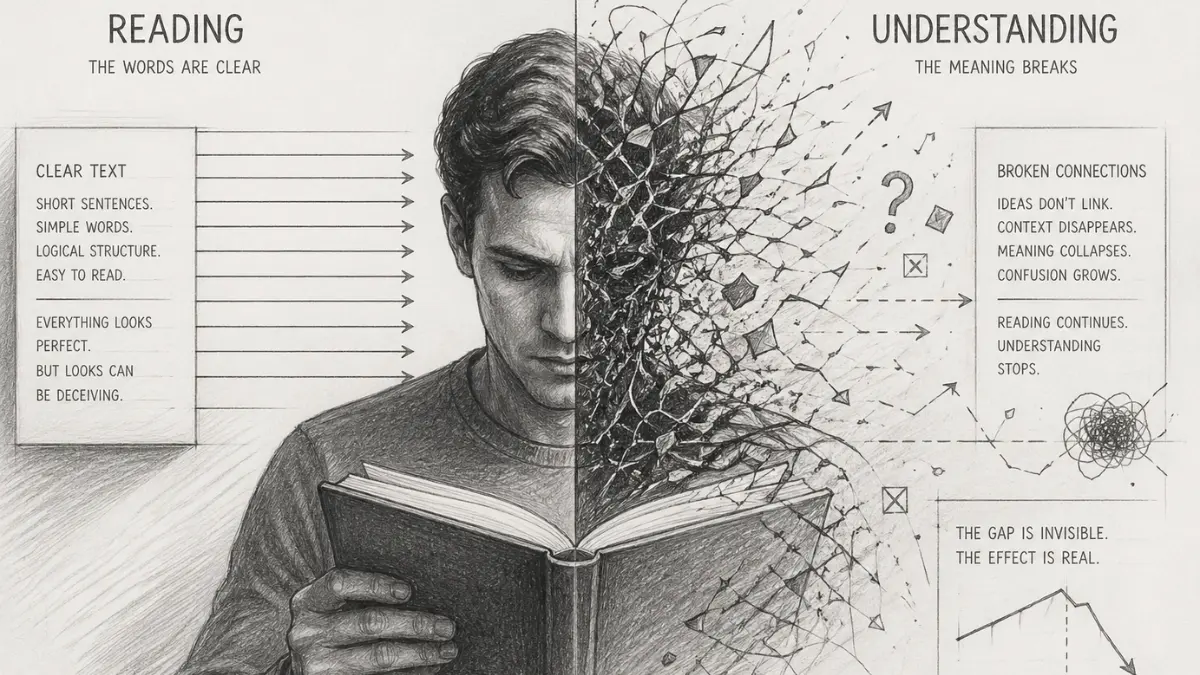
Your content is not failing because it is complex. It fails because readers lose the meaning as they move forward. Everything may look simple on the surface—short sentences, clean wording, logical structure—but understanding does not depend on how content looks. It depends on whether meaning continues to build from one idea to the next. The moment that continuity breaks, comprehension collapses, and once that happens, readers don’t try to recover. They leave.
In practical terms, this means your content can look simple and still fail to explain anything clearly.
Why Understanding Breaks Mid-Reading
This is where understanding doesn’t fail at the start — it breaks silently in the middle.
Understanding is not a static state. It is a process that must be sustained across every sentence. Each new idea must connect to the previous one while extending it forward. When this chain is intact, readers move smoothly. When it breaks, readers are forced to reconstruct meaning on their own, and most do not.
At this point, the reader doesn’t try to fix the meaning — they simply leave.
This is the exact moment where readers leave without realizing why.
Definition: Comprehension breakdown is the moment when readers can no longer maintain meaning across sentences, forcing them to reconstruct understanding instead of continuing it.
Comprehension breakdown occurs when readers cannot maintain meaning across sentences. This is not caused by difficult words or long paragraphs. It happens when the transition between ideas is missing or unclear. The structure still exists, but the logic between elements disappears.
The mechanism is simple: an idea appears, another follows, the connection is weak or absent, confusion begins, and the reader disengages. This process is rarely noticed consciously. The reader does not stop and analyze the failure. They simply feel that the content no longer makes sense and lose interest.
The most common mistake is focusing on simplifying sentences instead of connecting them. Content becomes fragmented. Each sentence is understandable in isolation, but together they do not form a continuous meaning.
This is also where another hidden effect begins to build. When readers are forced to reconnect ideas instead of following them naturally, the mental effort required to process each sentence increases. Even if the content looks simple, reading starts to feel heavier with every step because the brain is doing the work the structure should have done. This is why reading can feel hard even when the text is simple — not because of the words themselves, but because of the effort required to hold and reconnect meaning across sentences.
The Hidden Gap Between Reading and Understanding
The most dangerous part is that readers don’t notice this gap — they only feel that something is off.
This gap is invisible — readers keep moving forward even when understanding has already stopped.
Reading and understanding are not the same process. A reader can move through text quickly and still fail to build a clear interpretation. This is where most content breaks.
In practical terms, this means your content can feel easy to read while failing to communicate anything clearly.
Principle: Content feels clear only when each idea extends the previous one; when connections are implicit or missing, readers lose continuity and understanding collapses.
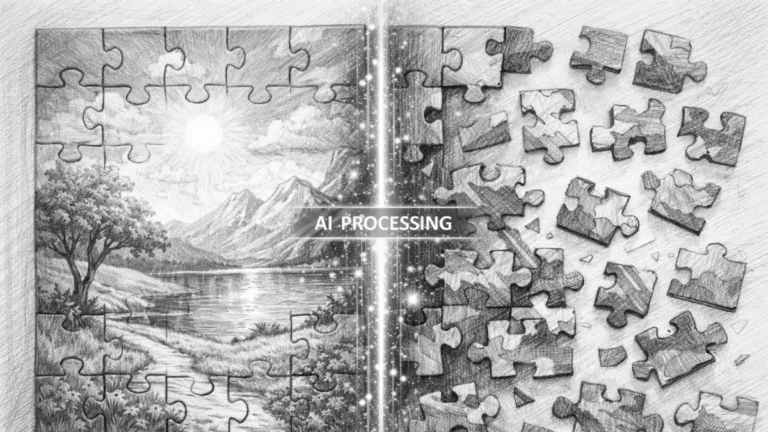
The gap appears when ideas are presented without explicit relationships. Concepts are introduced without being anchored to what came before. Progression is implied rather than guided. The reader continues reading, but meaning does not accumulate. Instead, it resets with each paragraph.
This is where reading continues, but understanding has already stopped.
This creates an illusion of clarity. The text feels easy to read, but nothing connects into a coherent structure. The reader cannot explain what they just read, even though they had no difficulty moving through the text.
What Happens When Meaning Stops Connecting
From this point forward, every new idea becomes harder to follow.
Once this break happens, everything that follows becomes harder to understand.
Once meaning stops connecting, the entire structure begins to collapse. Understanding depends on accumulation. Each idea builds on the previous one. When that sequence is interrupted, everything that follows becomes unstable.
The reader loses context. New information appears without a foundation. Interpretation turns into guesswork. Confidence drops, and engagement disappears. At this point, the content is no longer usable—not because it is incorrect, but because it cannot be followed.
This is the moment where most articles lose readers. The failure is not visible on the surface, but it is decisive in practice.
Example: A text with short, simple sentences may still confuse readers if each idea resets instead of building forward, forcing them to guess how concepts relate.
To understand what actually defines real understanding, you need to move beyond surface readability and evaluate how meaning is constructed and sustained across the text. This is explained in detail in what actually defines real understanding.
This is how a small disconnect turns into a complete loss of understanding.
This is how a small break turns into complete confusion.
Why Most Content Fails Without Obvious Errors
This is why most content looks correct but still doesn’t work in practice.
The most damaging problems are the ones you don’t see — everything looks correct, but meaning is already breaking.
The most dangerous failures are invisible. There are no grammar mistakes, no complex language, no obvious structural problems. Everything appears correct. But meaning does not survive as the reader moves forward.
This happens because most content is optimized for appearance rather than interpretation. Writers focus on making sentences clear, shortening paragraphs, and improving visual structure. These changes improve readability on the surface, but they do not guarantee understanding.
For your content, this means readers can finish reading without understanding anything clearly.
Meaning continuity is rarely considered. The connection between ideas is assumed rather than constructed. As a result, content becomes readable but not comprehensible. Readers can process it, but they cannot retain or explain it.
A simple way to detect this problem is to check whether meaning builds over time. If each sentence feels like a new starting point instead of a continuation, the structure is already broken. If a reader cannot easily explain what they just read, comprehension has failed, even if the text appears clear.
Meaning continuity is the ability of ideas to connect without forcing the reader to rebuild context at each step.
Checklist:
- Does each sentence clearly connect to the next idea?
- Can a reader explain the previous sentence without confusion?
- Does meaning build continuously instead of restarting?
- Are transitions explicit rather than implied?
- Does the text avoid forcing readers to reconstruct meaning?
- Does the structure support uninterrupted understanding?
Conclusion
Content does not fail at the level of writing. It fails at the level of meaning continuity. Clarity is not about simplicity. It is about connection.
If this connection breaks even once, the rest of the content loses its value.
If ideas do not link, readers do not understand. If readers do not understand, they do not continue.
If meaning does not connect, everything else in the content stops mattering.
Interpretive Logic of Meaning Continuity in Content
- Sequential meaning dependency. Each sentence relies on the previous one to preserve interpretive continuity, forming a chain rather than isolated units.
- Context accumulation stability. Meaning is maintained when each new idea extends existing context instead of forcing reconstruction or resetting interpretation.
These elements define how meaning is preserved across a page, shaping whether content remains interpretable as a continuous structure rather than fragmented information.
Meaning Continuity Interpretation Flow
Readers interpret content through a sequential meaning flow where each idea must connect to the previous one. This diagram represents how meaning builds step by step and where disconnection breaks comprehension.
[Initial Idea]
↓
[Sentence Connection]
↓
[Context Accumulation]
↓
[Logical Continuity]
↓
[Meaning Reinforcement]
↓
─────────────────────────
↓
[Comprehension Layer]
↓
[Stable Understanding]
↓
[Reader Retention]
Failure Principle: When meaning stops connecting at any point, comprehension collapses. Readers do not reconstruct missing links—they stop reading.
FAQ: Why Content Feels Clear But Confuses Readers
Why does content look clear but still confuse readers?
Content can appear simple, but meaning breaks between sentences, preventing readers from building a continuous understanding.
Why do readers stop reading articles halfway?
Readers stop when they lose connection between ideas and cannot follow how each part relates to the next.
What is comprehension breakdown in content?
Comprehension breakdown occurs when readers cannot maintain meaning across sentences and are forced to reconstruct understanding.
Why doesn’t simple writing guarantee understanding?
Short sentences and simple words do not ensure clarity if ideas fail to connect into a consistent and logical flow.
How can you tell if content is hard to understand?
If readers cannot easily explain what they just read or feel lost mid-text, meaning continuity is already broken.
Glossary: Key Terms in Content Understanding
This glossary defines the core concepts used in the article to explain why content appears clear but fails during reading.
Comprehension Breakdown
A point where readers can no longer maintain meaning across sentences and lose the ability to follow the text.
Meaning Continuity
The ongoing connection between ideas that allows readers to build understanding without restarting interpretation.
Comprehension Gap
The difference between reading text easily and actually understanding how ideas connect and form meaning.
Logical Connection
The relationship between ideas that ensures each sentence builds on the previous one in a clear sequence.
Reader Drop-off
The moment when readers stop reading because they lose track of meaning and cannot continue understanding the content.

Author Sergey Kuchinskiy
Founder of PostUpgrade. Researcher in Generative Engine Optimization (GEO), semantic structuring, and machine reasoning systems. Focuses on AI-readable content architecture, computational interpretation, and scalable knowledge retrieval. Author of 200+ analytical publications on generative visibility, semantic mapping, and AI-first information design.
Verified Expertise
- Generative Engine Optimization (GEO)
- AI Content Engineering & Semantic Structuring
- Computational Linguistics & Machine Reasoning
- Large-Scale Content Architecture
Research Focus
AI Search · Generative Visibility · Semantic Mapping · Machine Sentence Design · Reasoning Stability · Knowledge Extraction Models
Academic Contributions
- 200+ analytical research publications
- AI-first page architecture methodologies
- Semantic Frameworks for Machine Interpretation (SFMI)
- Generative Visibility Standards 2024–2025
Citation Metrics
AI-model reuse rate (GEO-Score): 92/100 · Cross-model consistency: 87% · Reasoning chain stability: 91%
Researcher ID: PU-ORCID-7421-9912
View all publications →Connect on LinkedIn →