Last Updated on April 25, 2026 by PostUpgrade
Why Reading Feels Hard Even When Text Is Simple
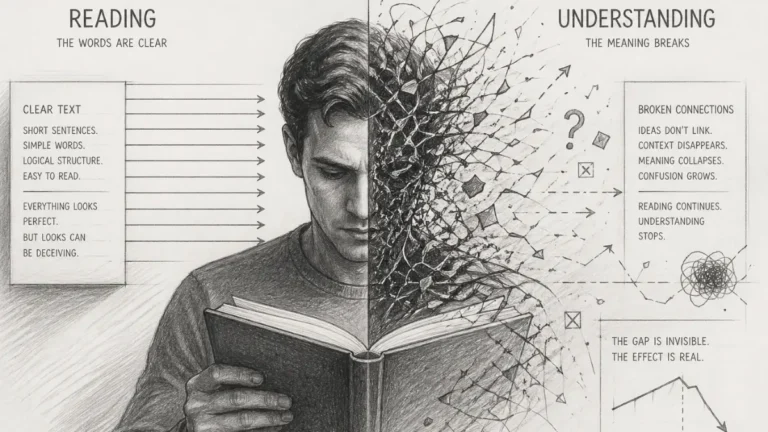
Reading doesn’t feel hard because of the words — it feels hard because your brain is overloaded trying to connect them.
TL;DR: Text looks simple, but reading becomes tiring as mental effort builds with every sentence. You slow down and drop off because your brain has to hold and connect too many ideas at once. This happens when information is not structured for step-by-step processing. When mental load is controlled, understanding becomes smooth and content stays readable from start to finish.
This is the exact point where readers lose energy and stop before understanding anything.
You’re not struggling with reading — your brain is overloaded before you even realize it.
Some content looks easy, but still feels heavy to read. The problem is not the words — it is the mental effort required to connect them.
This is why you stop reading before understanding — not because the text is hard, but because the effort becomes too high.
In practical terms, this means your content can feel simple but still drain the reader’s attention and energy.
What Mental Effort Really Means in Reading
This is not about difficulty — it’s about how much work the reader has to do to keep up.
What feels like “difficulty” is not complexity in language, but the amount of mental work needed to process and connect ideas. This is why even simple text can feel exhausting when understanding does not build smoothly.
This is why reading can feel frustrating even when nothing seems difficult.
Definition: Cognitive load is the mental effort required to process, connect, and retain meaning as a reader moves through text.
Reading is not passive. Each sentence must be decoded, linked to previous context, and integrate into a growing understanding. When this process flows naturally, reading feels easy, but when it slows down, effort becomes visible.
In practical terms, cognitive load increases when the reader has to stop and think about how ideas relate instead of simply following them.
This is where reading stops feeling natural and starts feeling like work.
This is part of a broader pattern — content fails not only because of meaning breakdown, but because the effort required to process it becomes unsustainable.
How Cognitive Load Builds While You Read
The problem doesn’t appear at once — it builds quietly with every sentence.
Mental effort does not appear instantly. It builds step by step as the reader moves through the text, and small disruptions accumulate into noticeable strain.
Principle: Reading becomes harder not when text is complex, but when mental effort accumulates faster than the reader can process it.
Mechanism:
input → decode → connect → overload → breakdown
This leads to a gradual increase in effort, even when each individual sentence feels simple.
First, the reader receives information and decodes the words. Then, they try to connect this idea with previous ones, and this is where effort begins to grow. If connections are unclear or missing, the reader must hold multiple interpretations in mind, increasing cognitive pressure.
Next: this pressure compounds across sentences, making each new idea harder to process than the previous one. This leads to a point where reading no longer feels smooth, even though the text itself appears simple.
Why Simple Text Can Still Be Hard
This is why simplicity on the surface often hides deeper difficulty.
Short sentences and simple vocabulary do not guarantee easy reading. When ideas are not structured clearly, simplicity at the surface level hides deeper processing problems.
The most common issue is not complexity, but density without guidance. When multiple ideas are introduced without clear relationships, the reader must organize them mentally, which increases effort.
Failure pattern:
Too much information without structure forces the reader to reconstruct meaning instead of following it.
Example: A short paragraph with multiple loosely connected ideas can feel harder to read than a longer one with clear, step-by-step flow.
This is why some texts feel heavier than they look. The reader is doing the work that the content should have done.
This is the point where the problem stops being about reading and becomes a problem of structure. When content forces the reader to organize and connect ideas manually, mental effort increases even if the text looks simple. The only way to reduce this effort is not by simplifying the wording, but by controlling how meaning is carried forward through the structure itself. This is exactly what determines how to make your content easy to understand — not by reducing complexity, but by removing the need for the reader to reconstruct connections.
What Happens When Mental Load Is Too High
Once the load crosses a certain point, understanding begins to collapse.
When cognitive load exceeds what the reader can comfortably handle, understanding begins to break down. At this point, the reader is no longer building meaning but trying to recover it.
The effect is gradual. First, reading slows down, then connections become unclear, and finally, the reader stops engaging altogether.
At this point, the reader doesn’t lose interest — they lose the ability to continue.
This is where readers slow down, lose focus, and eventually stop reading.
This is the same point where comprehension collapses in practice, which is why understanding how mental effort actually affects understanding is critical for diagnosing content performance.
This leads to a clear outcome: when mental load is too high, readers do not adapt. They disengage.
Checklist:
- Is information introduced in small, manageable steps?
- Do ideas connect clearly from one sentence to the next?
- Is the reader able to follow without holding multiple ideas at once?
- Are concepts grouped instead of scattered across the text?
- Does the content reduce the need for mental reconstruction?
- Does the reading flow feel smooth rather than effortful?
Conclusion
Reading feels hard not because the text is complex, but because the mental effort required to process it becomes too high. When cognitive load increases beyond a certain point, understanding slows down and eventually stops.
Clear content is not defined by simple words, but by how easily the reader can connect ideas without additional effort.
If the mental effort becomes too high, the reader stops before the meaning is fully formed.
Interpretive Structure of Cognitive Load in Text
- Sequential processing dependency. Each idea requires integration with prior context, forming a cumulative chain where meaning depends on continuous mental alignment.
- Information density distribution. Uneven grouping of concepts increases processing strain, as interpretive load shifts from content structure to reader cognition.
These properties describe how cognitive load emerges from structural arrangement, determining whether meaning remains continuous or becomes fragmented during interpretation.
Cognitive Load Processing Flow
Reading unfolds as a layered processing flow where mental effort accumulates across steps. This diagram shows how information is handled and where overload disrupts understanding.
[Input Information]
↓
[Word Decoding]
↓
[Idea Connection]
↓
[Context Accumulation]
↓
[Mental Load Increase]
↓
─────────────────────────
↓
[Cognitive Overload]
↓
[Comprehension Breakdown]
↓
[Reader Drop-off]
Failure Principle: When mental load exceeds processing capacity, understanding collapses. Readers do not adapt to overload—they disengage.
FAQ: Why Reading Feels Hard Even When Text Is Simple
What is cognitive load in reading?
Cognitive load is the mental effort required to process, connect, and understand ideas while reading text.
Why does reading feel mentally hard?
Reading feels hard when the brain must hold and connect too many ideas at once without clear structure.
Why can simple text still feel heavy?
Even simple text feels heavy when ideas are not clearly linked, forcing extra effort to build understanding.
What makes text difficult to process?
Text becomes difficult when information is dense, poorly grouped, or requires the reader to organize ideas mentally.
Why does reading become tiring over time?
Reading becomes tiring as mental effort builds with each sentence, eventually exceeding the reader’s ability to process it smoothly.
Glossary: Key Terms in Cognitive Load
This glossary defines the core concepts used to explain why reading feels difficult even when text appears simple.
Cognitive Load
The mental effort required to process, connect, and understand ideas while reading text continuously.
Mental Effort
The amount of thinking needed to follow, interpret, and connect information during the reading process.
Information Density
The amount of information packed into a small section, increasing the effort required to process it.
Comprehension Breakdown
The point where understanding stops because the reader cannot process or connect ideas effectively.
Reader Fatigue
The loss of focus and energy that occurs when mental effort becomes too high during reading.

Author Sergey Kuchinskiy
Founder of PostUpgrade. Researcher in Generative Engine Optimization (GEO), semantic structuring, and machine reasoning systems. Focuses on AI-readable content architecture, computational interpretation, and scalable knowledge retrieval. Author of 200+ analytical publications on generative visibility, semantic mapping, and AI-first information design.
Verified Expertise
- Generative Engine Optimization (GEO)
- AI Content Engineering & Semantic Structuring
- Computational Linguistics & Machine Reasoning
- Large-Scale Content Architecture
Research Focus
AI Search · Generative Visibility · Semantic Mapping · Machine Sentence Design · Reasoning Stability · Knowledge Extraction Models
Academic Contributions
- 200+ analytical research publications
- AI-first page architecture methodologies
- Semantic Frameworks for Machine Interpretation (SFMI)
- Generative Visibility Standards 2024–2025
Citation Metrics
AI-model reuse rate (GEO-Score): 92/100 · Cross-model consistency: 87% · Reasoning chain stability: 91%
Researcher ID: PU-ORCID-7421-9912
View all publications →Connect on LinkedIn →