Last Updated on April 25, 2026 by PostUpgrade
How to Make Your Content Easy to Understand
Your content is not hard to understand — it breaks because meaning doesn’t stay connected from one sentence to the next.
TL;DR: Content looks clear, but readers still lose track and stop following the idea. This happens when meaning resets between sentences instead of building forward. When structure guides each transition, understanding stays continuous and the content becomes easier to follow. As a result, readers keep reading and the message is fully delivered.
This is the point where most content fails, even when it looks simple.
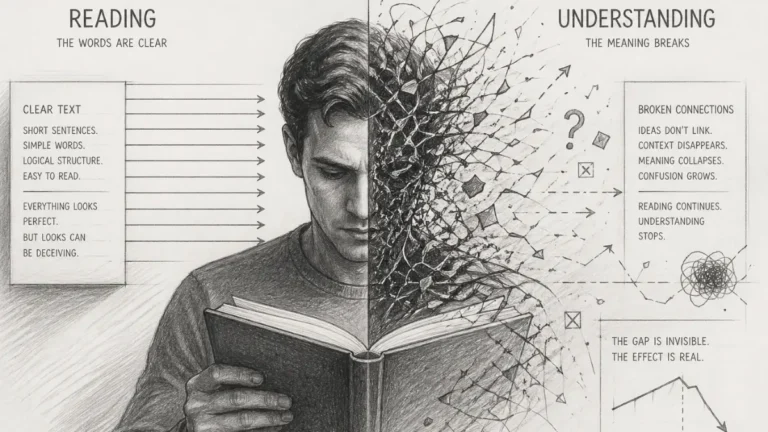
Most content looks clear at first, but readers still lose track within seconds. The problem is not complexity — it is how meaning is carried forward.
Making content simple is not enough. You need to make sure meaning stays clear from start to finish. That is what actually improves understanding.
Why Structure Matters More Than Simplicity
This is where most content fails — not at the sentence level, but at the connection level between ideas.
Clarity does not come from shorter sentences or simpler words. It comes from how ideas are arranged so the reader can follow them without interruption.
Definition: Stable meaning is the ability of content to preserve understanding as ideas move forward without forcing the reader to reconnect them.
Structure determines whether ideas connect automatically or require effort. This is why improving readability of content depends more on organization than on rewriting sentences.
At this point, readers either follow the flow — or start reconstructing meaning on their own.
This becomes clear when looking at how how structure actually supports understanding. The structure either carries meaning forward or forces the reader to rebuild it.
How to Keep Meaning Stable Across Sections
Understanding does not depend on individual sentences — it depends on whether meaning survives between them.
Understanding continues only when each idea connects cleanly to the next. The goal is not to simplify content, but to control how meaning flows across sections.
Mechanism:
idea → structured transition → reinforcement → continuity
In practical terms, stable meaning means the reader does not need to stop, rethink, or reconnect ideas manually.
Principle: Content becomes easier to follow when transitions consistently carry meaning forward instead of forcing the reader to rebuild connections.
Each idea introduces a point. The transition explains how it relates to what came before, and reinforcement confirms the connection. This leads to a continuous reading experience where meaning accumulates instead of resetting.
Next: if transitions are weak or missing, the reader must create connections manually. This increases effort and slows down understanding even if the text itself looks clear.
This leads directly to confusion, even when the content itself appears simple.
How to Reduce Confusion Without Simplifying Content
Simplifying words does not fix confusion if the structure still breaks meaning.
Simplifying language does not solve confusion when the problem is structural. The real issue appears when ideas are presented without clear relationships.
Failure pattern:
Jumping between ideas without guidance breaks the reader’s ability to follow the logic.
This is the exact moment when readers stop trusting the direction of the content.
Example: A paragraph that introduces one idea and clearly connects it to the next feels easier to follow than scattered ideas without guidance.
Confusion happens when the reader cannot predict where the text is going. This leads to hesitation, re-reading, and eventually disengagement.
This leads to a key shift: instead of removing complexity, content must guide the reader through it. When structure does this work, the same ideas become easier to process without being simplified.
How to Build Content That Flows Naturally
Flow is not created by style — it is created by structure that removes the need for interpretation.
Natural flow is not a stylistic feature. It is the result of consistent structure that supports understanding at every step.
Each paragraph should carry one idea forward. Terms should remain consistent so the reader does not have to reinterpret meaning. Sections should follow a predictable pattern so the reader knows how information will develop.
This leads to content that feels easy to read because the reader is not solving the structure. Instead, they are following it.
For your content, this means the reader should never need to pause to understand how ideas are connected.
Checklist:
- Does each idea connect clearly to the next one?
- Are transitions guiding the reader instead of forcing interpretation?
- Is meaning preserved across sections without resetting?
- Are concepts introduced in a predictable order?
- Does the structure reduce the need for mental reconstruction?
- Does the content maintain continuous understanding from start to finish?
Conclusion
Making content easier to understand is not about simplifying language. It is about structuring ideas so meaning remains stable from beginning to end.
When structure supports understanding, readers move forward without effort. When it does not, even simple content becomes difficult to follow.
Continuity Patterns in Content Interpretation
- Sequential meaning continuity. Interpretation depends on how consistently ideas connect across sections, forming an uninterrupted chain of understanding.
- Transition stability. Predictable transitions between concepts reduce interpretive gaps, allowing meaning to persist without requiring reconstruction.
These properties define how content maintains interpretive coherence, ensuring that meaning is preserved rather than repeatedly rebuilt during reading.
Meaning Continuity Flow Model
Reading depends on a continuous flow of connected ideas, where each step reinforces the next. This diagram shows how meaning is maintained and where breaks interrupt understanding.
[Idea Introduction]
↓
[Structured Transition]
↓
[Context Reinforcement]
↓
[Meaning Continuity]
↓
[Reading Flow Stability]
↓
─────────────────────────
↓
[Connection Breakdown]
↓
[Meaning Reset]
↓
[Reader Confusion]
Failure Principle: When transitions fail to preserve meaning, understanding resets. Readers do not rebuild connections—they lose track.
FAQ: How to Make Content Easy to Understand
Why does clear content still confuse readers?
Content looks clear when sentences are simple, but confusion appears when ideas are not connected consistently across the text.
How does structure improve readability?
Structure guides how ideas connect, helping readers follow meaning step by step without needing to rebuild context.
What makes content easier to follow?
Content becomes easier to follow when each idea leads naturally to the next and relationships between ideas are clear.
Why do readers lose track while reading?
Readers lose track when transitions between ideas are weak, forcing them to guess how information is connected.
How can you explain ideas clearly without simplifying them?
Clear explanation comes from guiding the reader through structured connections, not from removing complexity from the ideas.
Glossary: Key Terms in Content Clarity
This glossary explains the core concepts used to make content easier to follow and understand. :contentReference[oaicite:0]{index=0}
Stable Meaning
A state where understanding continues smoothly without forcing the reader to stop or reconnect ideas.
Structured Transition
A clear connection between ideas that helps the reader follow meaning without confusion or extra effort.
Meaning Continuity
The ability of content to carry understanding forward from one sentence to the next without breaks.
Logical Progression
A predictable order of ideas that allows the reader to follow the direction of the content naturally.
Reader Flow
A smooth reading experience where ideas connect easily and the reader does not need to pause or rethink meaning.

Author Sergey Kuchinskiy
Founder of PostUpgrade. Researcher in Generative Engine Optimization (GEO), semantic structuring, and machine reasoning systems. Focuses on AI-readable content architecture, computational interpretation, and scalable knowledge retrieval. Author of 200+ analytical publications on generative visibility, semantic mapping, and AI-first information design.
Verified Expertise
- Generative Engine Optimization (GEO)
- AI Content Engineering & Semantic Structuring
- Computational Linguistics & Machine Reasoning
- Large-Scale Content Architecture
Research Focus
AI Search · Generative Visibility · Semantic Mapping · Machine Sentence Design · Reasoning Stability · Knowledge Extraction Models
Academic Contributions
- 200+ analytical research publications
- AI-first page architecture methodologies
- Semantic Frameworks for Machine Interpretation (SFMI)
- Generative Visibility Standards 2024–2025
Citation Metrics
AI-model reuse rate (GEO-Score): 92/100 · Cross-model consistency: 87% · Reasoning chain stability: 91%
Researcher ID: PU-ORCID-7421-9912
View all publications →Connect on LinkedIn →