Last Updated on April 5, 2026 by PostUpgrade
Fix Page Structure for AI or Your Content Becomes Unreadable
Your content is not misunderstood — it is structurally unrecoverable for AI systems.
TL;DR: Most pages fail not because of content quality, but because unstable structure prevents AI from reconstructing hierarchy, which breaks interpretation, extraction, and reuse. The cause is inconsistent signals — headings, spacing, grouping — that make structure ambiguous. Fixing this requires enforcing a stable hierarchy model through controlled layout signals. When structure becomes predictable, AI can reliably interpret and reuse your content, restoring visibility.
If your structure is not detectable, everything after this point silently fails.
If your page cannot produce a stable structure, AI will not interpret it at all — regardless of how strong the content is.
Fixing content quality will not fix AI visibility.
You must fix the structure that AI uses to interpret meaning.
If your layout does not produce stable structural signals, AI cannot reconstruct your page — and everything downstream fails: extraction, ranking, reuse.
This is not optimization.
This is structural correction.
Definition: AI-readable structure is a layout that produces stable hierarchy signals, allowing systems to reconstruct relationships between sections before assigning meaning.
A stable structure is not a visual preference — it is a prerequisite for machine interpretation.
The Principle of Structural Stability
If this layer breaks, every downstream process — interpretation, extraction, ranking — collapses instantly.
Principle: Interpretation becomes possible only when structural signals remain consistent enough for AI to detect hierarchy without relying on text meaning.
If structure is unstable at this level, every interpretation that follows becomes unreliable.
AI does not interpret your page directly.
It reconstructs a structural model first — and only then assigns meaning.
If that structure is unstable, interpretation becomes unreliable.
And unreliable interpretation is treated as failure — not partial success.
This means:
- consistent heading relationships
- predictable grouping of content
- uniform spacing patterns
- no contradictions between visual and semantic signals
If any of these break, the hierarchy becomes ambiguous.
This leads directly to how AI evaluates consistency across the entire page.
Why Stability Matters
This is the point where most pages silently fail — without any visible signal to the author.
If patterns cannot be detected, AI does not approximate meaning — it stops interpreting entirely.
Structural instability does not degrade interpretation — it destroys it.
AI systems depend on pattern recognition.
They do not “figure things out” like humans.
They detect:
- repetition
- consistency
- structural patterns
If your layout changes unpredictably, the model cannot generalize structure.
At this point, even correctly written content becomes structurally unusable.
Failure Pattern
These failures are not design issues — they are interpretation blockers at the structural level.
Most pages fail here:
- headings visually styled but not hierarchical
- inconsistent spacing between sections
- mixed container logic
- layout decisions driven by design, not structure
Result:
AI cannot determine:
When this happens, the page is not misinterpreted — it is ignored.
- what belongs together
- what is a section
- what is a subsection
This is where structural correction becomes necessary, not optional.
Once failure patterns are identified, the only path forward is enforcing a detectable hierarchy model — this is where structure becomes a controlled system.
How to Build a Detectable Hierarchy
If hierarchy cannot be detected instantly, AI does not attempt to interpret your page at all.
Example: A page with consistent heading levels, aligned spacing, and isolated semantic blocks allows AI to detect structure visually, enabling accurate hierarchy reconstruction and reliable interpretation.
If hierarchy is not detectable without reading, AI cannot reliably interpret your page.
Hierarchy must be detectable without text meaning.
AI should be able to infer structure from layout alone.
Detectable hierarchy means structure can be recognized through layout signals alone, without semantic interpretation.
To achieve this, structure must be enforced systematically.
Mechanism
To build detectable hierarchy, you must enforce:
- heading hierarchy
- spacing consistency
- semantic grouping
- visual signal alignment
1. Enforce Heading Hierarchy
Strict structure:
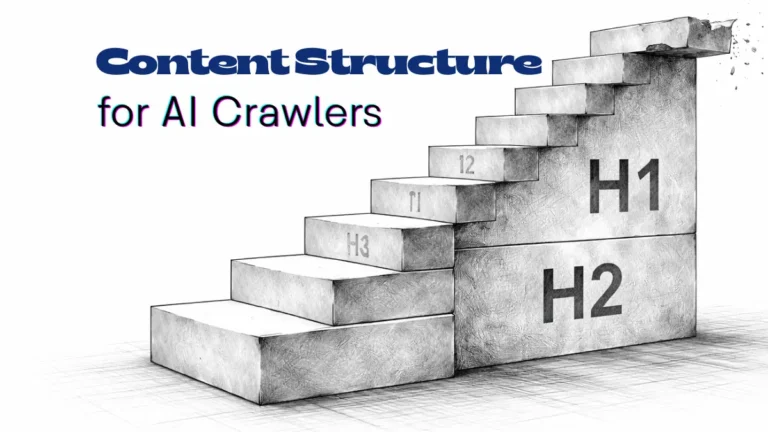
- H1 → H2 → H3
- no skipping levels
- no styling fake headings
Each heading must represent:
- a new semantic scope
- a clear boundary
2. Align Spacing Patterns
Spacing is a structural signal.
You must standardize:
- distance before H2
- distance before H3
- paragraph spacing
- block spacing
If spacing varies → hierarchy becomes invisible.
3. Group Semantic Blocks
Each section must behave like a container:
- one idea = one block
- no mixing concepts inside the same visual group
- no overlapping meaning boundaries
AI interprets grouping as:
→ semantic cohesion
4. Stabilize Visual Signals
All hierarchy cues must align:
- font size
- spacing
- indentation
- container structure
If visual signals contradict each other:
AI chooses incorrectly.
Structural Signals You Must Control
Building hierarchy is not enough — it must be stabilized through controlled signals.
Uncontrolled signals do not degrade structure — they erase it from AI interpretation.
AI does not use “design.”
It uses signals.
You must control these signals explicitly.
Uncontrolled variation at this level silently breaks hierarchy detection.
Next, this must be validated as a complete system, not as isolated fixes.
Core Signals
- Heading levels
- Spacing patterns
- Block grouping
- Container consistency
- Visual hierarchy alignment
What Breaks Signals
Structural failure happens when:
- over-design introduces noise
- inconsistent formatting appears across sections
- visual styles change unpredictably
- containers are reused inconsistently
- spacing does not reflect hierarchy
Failure Example
A typical broken layout:
- H2 followed by text
- next section uses a styled paragraph instead of H3
- spacing differs between sections
- lists appear without structural context
Result:
AI cannot build a hierarchy tree.
Without validation, even correctly structured signals remain unverified — and hidden structural failures persist.
A Practical System to Validate Layout
If validation is skipped, structural errors remain invisible and continue to block interpretation.
Fixing structure requires validation.
You must test whether your layout produces a stable hierarchy model.
This process ensures structure is not assumed, but verified.
System-Level Validation
Run this process:
Step 1 — Remove Text Meaning
Ignore content meaning.
Ask:
→ can structure be understood visually?
If the answer is no, the entire hierarchy model is already broken.
Step 2 — Check Hierarchy Flow
Verify:
- H2 → H3 relationships are consistent
- no skipped levels
- no fake headings
Step 3 — Validate Spacing Logic
Ensure:
- identical spacing between same-level elements
- consistent separation of sections
- no visual ambiguity
Step 4 — Inspect Grouping
Check:
- each block represents one concept
- no mixed topics inside one container
- lists belong to the correct section
Step 5 — Detect Contradictions
Look for:
- same visual style used for different hierarchy levels
- different styles used for same level
- containers behaving inconsistently
Mechanism Summary
To fix structure, you must:
- enforce heading hierarchy
- align spacing patterns
- group semantic blocks
- stabilize visual signals
- validate hierarchy consistency
Failure Reminder
If you skip validation:
- structure may look correct
- but remain invisible to AI
Structural System → Hub Connection
This is where structure scales from a page-level fix to a system-level architecture.
Once the system is applied, structure becomes predictable.
At this stage, your layout is no longer design — it is an interpretation system.
This directly connects to a broader principle explained in the hub:
AI layout hierarchy detectionThis section expands the system into full content architecture and scalable design logic.
If these conditions are not met simultaneously, structure remains partially invisible to AI systems and cannot be reliably interpreted.
Checklist:
- Are heading levels strictly hierarchical (H1→H2→H3)?
- Is spacing consistent across identical structural levels?
- Does each section represent a single semantic unit?
- Are visual signals aligned with hierarchy (no contradictions)?
- Can structure be understood without reading the text?
- Does the layout produce a stable hierarchy model for AI?
Final Insight
At this stage, visibility is no longer a content problem — it is purely structural.
If structure fails, content never reaches interpretation — it is filtered out before meaning is assigned.
AI visibility is not a content problem.
It is a structure problem.
If hierarchy is unstable:
- meaning cannot be reconstructed
- extraction fails
- ranking collapses
Fix the structure — and interpretation becomes possible.
Ignore it — and content disappears before it is even read.
This is the boundary between visible content and invisible content in AI systems.
Structural Logic of AI-First Page Architecture
- Structural hierarchy mapping. Clear H2→H3→H4 depth layers allow AI systems to isolate semantic units and resolve context boundaries with minimal ambiguity.
- Layout signal consistency. Stable patterns in spacing, grouping, and visual hierarchy enable predictable segmentation and reliable interpretation across the page.
These structural signals define whether a page can be reconstructed into a stable hierarchy model for interpretation in AI-driven systems.
Structural Interpretation Flow Model
AI systems do not read content directly. They reconstruct a hierarchy model from structural signals, where each layer transforms layout into interpretable meaning. This flow shows how structure becomes interpretation — and where instability breaks the process.
[Structural Skeleton — headings, spacing, containers]
↓
[Semantic Segmentation — grouping content into units]
↓
[Hierarchy Inference — detecting H2→H3 relationships]
↓
[Signal Alignment — visual and structural consistency]
↓
[Structural Stability — repeatable layout patterns]
↓
─────────────────────────
↓
[Interpretation Layer — building meaning from structure]
↓
[Meaning Extraction — isolating reusable knowledge]
↓
[Content Reuse in AI Systems]
Failure Principle: If hierarchy signals are unstable or inconsistent, reconstruction fails at early layers. AI does not recover structure later — it abandons interpretation and ignores the page.
These failures are not edge cases — they represent the default outcome when structural signals are inconsistent.
FAQ: AI Page Structure Interpretation
Why does page structure matter for AI interpretation?
AI systems reconstruct a hierarchy model before assigning meaning. If structural signals are unstable, interpretation fails regardless of content quality.
What causes structure to become invisible to AI?
Inconsistent headings, spacing, and grouping create ambiguous signals, preventing AI from detecting hierarchy and segmenting content correctly.
How does AI detect hierarchy on a page?
AI analyzes heading levels, spacing patterns, and content grouping to infer relationships between sections without relying on text meaning.
What is a detectable hierarchy?
A detectable hierarchy is a layout where structure can be inferred from visual and structural signals alone, without semantic interpretation.
What happens if structure is not validated?
Unvalidated layouts may appear correct to humans but remain structurally unstable, causing AI to fail at reconstruction and ignore the content.
These definitions establish the minimum structural conditions required for AI interpretation to occur.
Glossary: Key Terms in AI Page Structure
This glossary defines the core structural concepts required for AI systems to detect hierarchy, interpret layout, and reconstruct meaning reliably.
Structural Stability
The consistency of layout signals such as headings, spacing, and grouping that allows AI systems to reconstruct a reliable hierarchy model.
Detectable Hierarchy
A structural state where relationships between sections can be inferred from layout signals alone, without relying on text meaning.
Semantic Grouping
The organization of related content into isolated blocks, enabling AI to detect boundaries between ideas and interpret sections correctly.
Hierarchy Inference
The process by which AI determines relationships between headings and sections using structural and visual signals.
Structural Signals
Observable layout cues such as heading levels, spacing patterns, and container logic that guide AI interpretation of page structure.

Author Sergey Kuchinskiy
Founder of PostUpgrade. Researcher in Generative Engine Optimization (GEO), semantic structuring, and machine reasoning systems. Focuses on AI-readable content architecture, computational interpretation, and scalable knowledge retrieval. Author of 200+ analytical publications on generative visibility, semantic mapping, and AI-first information design.
Verified Expertise
- Generative Engine Optimization (GEO)
- AI Content Engineering & Semantic Structuring
- Computational Linguistics & Machine Reasoning
- Large-Scale Content Architecture
Research Focus
AI Search · Generative Visibility · Semantic Mapping · Machine Sentence Design · Reasoning Stability · Knowledge Extraction Models
Academic Contributions
- 200+ analytical research publications
- AI-first page architecture methodologies
- Semantic Frameworks for Machine Interpretation (SFMI)
- Generative Visibility Standards 2024–2025
Citation Metrics
AI-model reuse rate (GEO-Score): 92/100 · Cross-model consistency: 87% · Reasoning chain stability: 91%
Researcher ID: PU-ORCID-7421-9912
View all publications →Connect on LinkedIn →