Last Updated on April 21, 2026 by PostUpgrade
Layout Hierarchy Detection: AI Understands or Ignores Your Page
AI does not fail to understand your content — it misclassifies your layout, and everything downstream breaks.
TL;DR: Most content loses visibility because AI cannot reliably interpret its structural hierarchy, which leads to incorrect extraction, weak summarization, and broken reuse across systems. This happens because layout signals such as spacing, grouping, and hierarchy are inconsistent or ambiguous, preventing models from reconstructing a stable meaning map. By enforcing consistent structural signals and clear hierarchical relationships, you enable accurate interpretation, extraction, and reuse — which directly increases AI visibility and reliability.
This is not a content quality problem — it is a structural interpretation failure.
If the hierarchy is unstable, every interpretation layer collapses — and this is exactly where most content silently fails.
If AI cannot map your structure, your content does not compete — it disappears before interpretation even begins.
Artificial intelligence increasingly interprets digital information through structural signals rather than text alone. Layout hierarchy detection enables AI systems to recognize how visual structure organizes meaning inside a page or document. Through layout hierarchy detection, models determine which sections represent titles, explanations, supporting details, or subordinate content.
Digital content rarely appears as flat text. Web pages, research papers, and application interfaces organize information through headings, spacing, and grouped blocks. These visual signals create hierarchical relationships between elements. AI systems analyze these relationships to reconstruct how information flows across the page.
Why Structure Matters for AI Interpretation
If structure is inconsistent, AI does not partially misunderstand your content — it assigns the wrong meaning entirely.
At this stage, structure stops being visual decoration and becomes the primary signal that determines whether AI can correctly interpret your content.
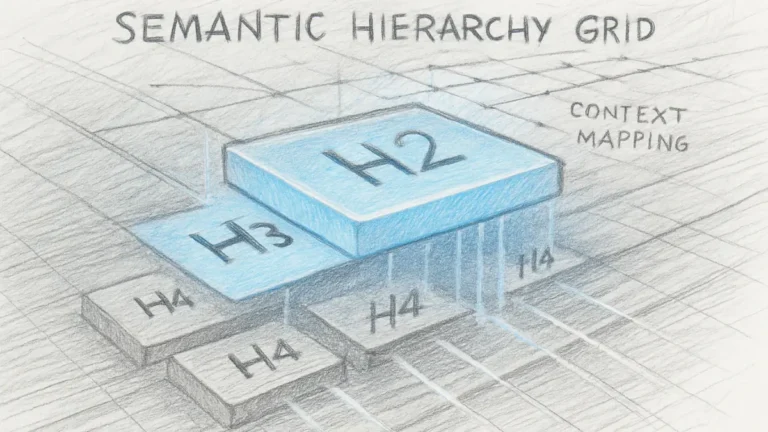
Structural layout determines how machines interpret context and relevance. For example, a heading signals the start of a new semantic scope. Subsections narrow the topic and define informational boundaries. Lists and visual blocks group related statements into logical clusters.
This is why structure is not a formatting choice — it is the control layer of AI interpretation.
If these signals are inconsistent, interpretation does not degrade gradually — it breaks at the structural level.
When AI models recognize these structural signals, they can map page elements into a hierarchy. This hierarchy helps systems identify the main topic, supporting explanations, and detailed evidence. Consequently, hierarchical interpretation improves the reliability of machine-generated summaries and knowledge extraction. A broader architectural perspective on this principle appears in this guide to AI page structure optimization, which examines how semantic hierarchy, modular sections, and consistent heading systems help generative engines interpret meaning across entire pages rather than isolated fragments.
AI Systems That Use Layout Hierarchy
Every system listed here depends on hierarchy detection — if it fails, extraction, ranking, and reuse collapse simultaneously.
These systems do not read content sequentially — they reconstruct structure first and only then interpret meaning.
Several categories of AI rely on hierarchical layout analysis:
- language models that interpret section boundaries
- document understanding systems processing research papers
- generative search engines selecting authoritative passages
- multimodal AI models combining visual and textual context
These systems analyze layout structure before interpreting textual meaning.
Research Areas Behind Layout Understanding
Multiple research fields contribute to hierarchical layout analysis. Document understanding studies how machines extract structure from complex documents. Computer vision detects visual components and spatial relationships between them. Layout parsing converts page elements into machine-readable structures. Semantic structure extraction then links those structures to conceptual meaning.
This convergence of research is not theoretical — it directly shapes how modern AI systems decide what your content actually means.
Research from the Stanford Natural Language Processing Group explores structural signals in language model reasoning. Similarly, multimodal document analysis research conducted at MIT CSAIL investigates how AI systems interpret visual document structure. DeepMind research teams also study transformer models capable of reasoning across structured long-form documents.
Together these research directions demonstrate that structural hierarchy is not a visual detail. It is a core signal that allows modern AI systems to interpret complex digital information.
This leads directly to how AI systems operationalize these concepts into actual layout detection mechanisms.
Foundations of Layout Hierarchy Detection in AI
Hierarchy is not a visual layer — it is the primary structure AI uses to reconstruct meaning before any textual interpretation begins.
At this level, AI is not interpreting content — it is reconstructing the structure that defines what the content means.
Artificial intelligence interprets structured content by identifying the structural levels embedded in visual documents and interfaces. Hierarchical layout detection enables AI systems to determine how titles, subsections, lists, and grouped elements organize information across a page. In practice, models performing hierarchical layout detection analyze spatial structure, formatting patterns, and structural grouping to reconstruct the logical hierarchy of digital content.
Layout hierarchy detection — the computational process by which an AI system identifies nested structural levels within a document or page based on visual, spatial, and semantic signals.
Claim: AI systems rely on hierarchical layout detection to interpret document meaning and information importance.
Rationale: Modern documents encode meaning not only through text but also through structure, spacing, and visual grouping.
Mechanism: AI models analyze spatial relationships between elements such as headings, blocks, lists, and containers to infer structural levels.
Counterargument: Flat documents with minimal formatting reduce the reliability of hierarchy extraction.
Conclusion: Hierarchical layout detection improves machine interpretation of complex documents and web pages.
Definition: Layout hierarchy detection is the AI capability to identify structural levels within documents by interpreting spatial arrangement, visual prominence, and semantic grouping across page elements.
Structural Signals That Indicate Layout Hierarchy
AI models detect hierarchy by identifying consistent visual and structural patterns across a document. These patterns form what researchers describe as a layout structure hierarchy, which allows models to recognize how information is layered from primary topics to supporting explanations. Consequently, hierarchy signals in layout become measurable indicators that guide AI interpretation of page structure.
Furthermore, hierarchical layout signals often appear through formatting conventions used in digital publishing systems. Layout hierarchy indicators such as spacing, indentation, and alignment provide contextual clues about relationships between content elements. When these signals appear consistently, AI systems can map page components into hierarchical trees that represent structural meaning.
Structural signals include:
- heading levels
- indentation
- spatial grouping
- font size hierarchy
- whitespace segmentation
These signals collectively allow AI systems to construct interpretable document structures. When formatting patterns remain consistent, hierarchical relationships become detectable and machine-readable.
Each signal functions as a boundary marker that helps AI separate, group, and prioritize content blocks within a hierarchy.
Research Foundations of Layout Parsing
Research in document understanding has produced the theoretical foundations behind layout parsing technologies. Document layout analysis investigates how visual structures encode meaning, while visual document understanding examines how machines combine spatial signals with textual content. Structured document modeling then transforms detected layout components into hierarchical representations that AI systems can analyze.
Work conducted by the Stanford Natural Language Processing Group has shown that structural segmentation improves how language models interpret contextual boundaries within long-form documents. Similarly, multimodal document research at MIT CSAIL explores models capable of analyzing visual layout and textual structure simultaneously.
These research directions contribute to the development of AI systems that interpret hierarchical document structures reliably. As a result, layout parsing now forms a central component of document intelligence systems used in search engines, knowledge extraction pipelines, and multimodal language models.
How AI Models Parse Layout Structure
At this stage, a single misclassified element can distort the entire structural map of the page.
This is the moment where layout becomes data — and visual structure is converted into something machines can reason about.
Artificial intelligence systems convert visual documents into structured representations before interpreting textual meaning. Layout hierarchy parsing allows models to transform visually arranged page elements into machine-readable structural layers. Through layout hierarchy parsing, AI systems analyze the spatial arrangement of titles, paragraphs, containers, and visual blocks to determine how information is organized.
Layout parsing — the computational process of converting visual layout elements into structured semantic components.
Claim: AI systems parse layout hierarchy to convert visual pages into structured representations.
Rationale: Structured representations allow models to reason about content relationships and meaning.
Mechanism: Computer vision models detect bounding boxes, classify layout elements, and map them into hierarchical structures.
Counterargument: Highly dynamic layouts can introduce ambiguity in structural detection.
Conclusion: Layout parsing enables AI models to transform visual pages into machine-interpretable knowledge structures.
Layout Parsing Pipeline
AI systems interpret document layout through a multi-stage analytical pipeline that converts visual signals into structural representations. This pipeline forms the foundation of layout hierarchy processing because it identifies how visual elements relate to one another within the page. As a result, layout hierarchy computation allows models to detect structural levels such as titles, subsections, and grouped information blocks.
The next stage focuses on layout hierarchy analysis, where detected visual elements are evaluated according to their spatial relationships and formatting signals. Models analyze alignment, spacing, and visual grouping to determine how content elements form nested hierarchical structures. Consequently, AI systems can map page components into structural trees that represent document organization.
Typical layout parsing stages include:
- visual element detection
- structural segmentation
- hierarchy inference
- semantic labeling
This pipeline explains why early structural errors cannot be corrected later — each stage depends on the previous one, so misclassification propagates through the entire interpretation process.
Each stage progressively transforms raw visual information into structured semantic representations. Therefore, the parsing pipeline enables AI systems to reconstruct document hierarchy and interpret meaning from complex visual layouts.
Document Layout Models
Modern layout parsing relies on multimodal models that combine computer vision and natural language processing techniques. These systems detect visual components while simultaneously interpreting textual signals embedded in document structure. Consequently, document understanding models can map page elements into structured hierarchies that reflect the logical organization of information.
Several research initiatives have advanced document layout modeling significantly. DeepMind has explored transformer-based architectures capable of reasoning across structured document layouts. Microsoft developed LayoutLM, a multimodal transformer that integrates text tokens with spatial coordinates to interpret document structure. Google Document AI platforms apply similar techniques to extract structured information from large collections of digital documents.
Research published in the arXiv scientific archive demonstrates that multimodal transformers improve document parsing accuracy by combining spatial layout signals with semantic text representations. These models allow AI systems to interpret complex documents such as scientific papers, reports, and forms with significantly higher structural precision.
Such models illustrate how layout-aware architectures enable machines to understand documents beyond raw text. By combining visual perception with structural reasoning, AI systems can interpret hierarchical page structures and reconstruct meaningful document representations.
Visual Signals Used for Hierarchy Recognition
When visual signals contradict each other, AI does not resolve ambiguity — it defaults to incorrect hierarchy assumptions.
Before meaning is extracted, AI determines which elements deserve attention based on visual priority signals.
Artificial intelligence identifies structural importance inside documents by analyzing visual layout patterns. Visual hierarchy detection enables models to determine which elements represent titles, grouped content, or supporting explanations within a page. Consequently, visual hierarchy detection allows AI systems to interpret structural relationships before evaluating textual meaning.
Visual hierarchy — the ordering of content elements based on visual prominence and spatial arrangement.
Claim: Visual hierarchy detection enables AI models to identify structural importance within layouts.
Rationale: Human-designed documents encode importance through visual prominence and spatial positioning.
Mechanism: AI models analyze visual attributes such as font size, contrast, spacing, and alignment.
Counterargument: Minimalist layouts reduce the number of visual hierarchy signals available.
Conclusion: Visual hierarchy detection complements semantic analysis when interpreting document structures.
Visual Features Used by AI
Artificial intelligence systems rely on consistent formatting patterns to identify structural levels across digital documents. These hierarchy patterns in layout allow models to determine how visual emphasis signals document organization. Consequently, layout hierarchy feature detection enables systems to differentiate between titles, subsections, body text, and supporting information blocks.
When these patterns shift across sections, the model loses the ability to consistently assign structural roles.
AI systems also perform hierarchical layout segmentation by grouping visual elements that share similar spatial properties. Spatial clustering, alignment patterns, and visual grouping signals allow models to infer which elements belong to the same structural layer. As a result, visual analysis becomes a critical step in interpreting hierarchical document structure.
Visual features used by AI include:
- font scale differences
- block spacing
- alignment grids
- bounding box grouping
- color emphasis
If these signals are inconsistent, the model cannot establish stable hierarchy — and interpretation becomes unreliable.
Together these visual signals create detectable structural patterns. When formatting remains consistent, AI systems can reconstruct document hierarchy with significantly higher accuracy.
Principle: AI systems interpret document hierarchy more reliably when layout signals such as headings, spacing, and structural grouping remain consistent across the page.
Computer Vision in Layout Understanding
Computer vision provides the technical foundation that allows AI models to detect visual structure within documents and webpages. These systems analyze page images to identify layout elements such as headings, paragraphs, figures, and containers. Consequently, visual analysis becomes the first stage of hierarchical structure interpretation.
Modern document understanding systems rely on deep learning models capable of processing visual and textual information simultaneously. CNN-based layout detection identifies visual components and bounding regions, while multimodal document models combine spatial coordinates with textual tokens. Transformer-based visual architectures further extend this capability by enabling models to reason across entire page structures.
Research published through the IEEE digital library demonstrates that computer vision models significantly improve document layout analysis when visual signals are integrated with semantic representations. These systems allow AI models to detect structural relationships across complex documents that contain multiple layout layers.
As a result, computer vision technologies now form a central component of layout-aware AI systems. They allow machines to interpret visual hierarchy, identify structural boundaries, and construct hierarchical representations of digital documents.
Spatial Relationships and Structural Inference
Even perfectly written content becomes unreliable if spatial relationships fail to encode clear structural logic.
Structure is not only defined by elements themselves, but by how those elements relate to each other in space.
Artificial intelligence identifies structural hierarchy in documents by analyzing spatial relationships between visual components. Hierarchy extraction from layout enables AI systems to determine how proximity, alignment, and spatial grouping organize content across a page. Consequently, hierarchy extraction from layout allows models to reconstruct structural meaning even before interpreting textual content.
Spatial hierarchy — the structural ordering inferred from the relative positions of visual elements in a document.
Claim: AI infers layout hierarchy by analyzing spatial relationships between visual components.
Rationale: Relative position and proximity define structural relationships between document sections.
Mechanism: Graph-based algorithms map spatial coordinates into hierarchical relationships.
Counterargument: Overlapping design layers can introduce ambiguity in spatial interpretation.
Conclusion: Spatial analysis remains a core method for detecting hierarchical relationships in layout.
Graph-Based Layout Modeling
Graph-based approaches provide a structured way to interpret document layout through spatial relationships. In layout hierarchy modeling, AI systems convert visual elements into nodes within a graph representation. This structure allows models to analyze spatial patterns and infer structural levels across the page.
Hierarchical layout modeling uses graph reasoning to determine relationships between headings, paragraphs, images, and containers. Layout hierarchy reasoning then evaluates spatial distances and alignment patterns to identify structural dependencies. Consequently, AI systems construct hierarchical representations that reflect document organization.
The graph-based layout approach typically includes:
- nodes representing layout elements
- edges representing spatial relationships
Nodes store information about the location and type of each element. Edges represent positional relationships such as proximity, alignment, and grouping.
In simple terms, the document becomes a network of connected elements. The connections show how parts of the page relate to one another and which elements belong to the same structural layer.
In this network, hierarchy emerges from connection patterns rather than from isolated elements.
| Method | Input Data | Strengths | Limitations |
|---|---|---|---|
| Rule-based layout parsing | HTML structure, formatting rules | High precision for standardized documents | Limited adaptability to complex layouts |
| Computer vision models | Page images and bounding boxes | Strong performance on visually complex documents | Computationally intensive processing |
| Graph-based hierarchy inference | Spatial coordinates and element relationships | Captures structural dependencies effectively | Sensitive to noisy layout signals |
| Multimodal document transformers | Combined visual and textual embeddings | High accuracy in document understanding | Requires large training datasets |
Spatial reasoning techniques have been studied extensively in document intelligence research. Work on spatial document analysis and structural inference appears in publications within the ACM Digital Library, where researchers analyze how graph representations improve machine interpretation of document layouts.
Graph-based modeling therefore plays a central role in layout-aware AI systems. It enables machines to convert spatial relationships into structured hierarchy representations that support reliable document understanding.
Machine Learning Models for Layout Hierarchy Detection
At scale, hierarchy detection shifts from rule-based interpretation to pattern learning across thousands of document examples.
Modern document understanding systems increasingly rely on data-driven models to identify structural hierarchy. Layout hierarchy recognition systems allow AI models to learn how document elements relate to one another based on large collections of annotated layouts. As a result, layout hierarchy recognition systems transform visual documents into structured representations that machines can interpret reliably.
Models learn structure from patterns — if your layout breaks those patterns, the model cannot generalize your content correctly.
Layout recognition model — an AI system trained to classify document elements and infer hierarchical relationships.
Claim: Machine learning models significantly improve layout hierarchy detection accuracy.
Rationale: Training on labeled document datasets allows models to learn complex structural patterns.
Mechanism: Transformer architectures combine visual and textual embeddings to detect layout hierarchy.
Counterargument: Limited annotated datasets restrict model generalization.
Conclusion: Machine learning models provide scalable solutions for hierarchical layout recognition.
Major Layout Datasets
Machine learning systems require annotated training datasets that describe how visual elements correspond to structural document roles. These datasets allow models to learn relationships between headings, paragraphs, figures, tables, and layout containers. Consequently, large-scale labeled corpora have become a central component in training modern layout-aware AI models.
Two widely used datasets illustrate how document structure is encoded for machine learning. PubLayNet contains hundreds of thousands of annotated scientific paper pages, where layout elements such as text blocks, titles, and figures are labeled using bounding regions. Similarly, DocBank provides token-level annotations that connect visual document layout with textual structure. These datasets enable models to recognize hierarchical structure patterns across complex documents.
Research groups continue expanding these resources to improve document understanding models. Work conducted by the NLP research group at the University of Washington has contributed to large-scale document processing and structured representation learning. Public datasets such as PubLayNet provide essential training material for AI systems learning hierarchical document structures.
In practical terms, annotated datasets teach AI models how to interpret layout relationships. When a model processes thousands of examples, it learns that titles typically appear above paragraphs, subsections follow headings, and grouped blocks often form semantic clusters.
Transformer-Based Layout Models
Transformer architectures have become the dominant approach for modeling document structure in modern AI systems. These models combine visual features extracted from page images with textual embeddings derived from document content. As a result, layout hierarchy interpretation models can analyze both spatial layout and linguistic context simultaneously.
Layout hierarchy understanding improves significantly when visual and textual signals are processed together. Transformer-based architectures analyze positional coordinates, token relationships, and visual regions within a unified representation. Consequently, these models can detect hierarchical relationships between document components with higher precision than earlier rule-based systems.
One of the most influential architectures in this domain is LayoutLM, developed to integrate spatial layout information directly into transformer-based language modeling. LayoutLM represents each token with both textual features and bounding box coordinates, allowing the model to understand the spatial placement of content elements. This architecture enables AI systems to recognize titles, paragraphs, tables, and structural groups within complex documents.
In practical terms, transformer-based layout models interpret documents as structured multimodal sequences. They process text and layout simultaneously, which allows machines to reconstruct hierarchical document organization with far greater reliability than traditional document processing systems.
Real-World Applications of Layout Hierarchy Detection
These applications reveal a key reality: without detectable hierarchy, AI cannot reliably extract usable knowledge.
Artificial intelligence systems increasingly apply structural analysis to practical document processing tasks. Hierarchy detection in page design enables machines to understand how information is organized within digital pages, reports, and knowledge repositories. As a result, hierarchy detection in page design allows AI models to extract structured meaning from visually organized content.
Layout-aware AI — systems that incorporate structural page hierarchy when interpreting content.
Claim: Layout hierarchy detection enables AI systems to extract structured information from complex documents.
Rationale: Documents often contain nested sections that represent meaning through layout organization.
Mechanism: AI models combine layout signals with textual semantics to reconstruct document structure.
Counterargument: Unstructured documents reduce the effectiveness of layout-aware AI.
Conclusion: Hierarchy detection is essential for reliable document understanding.
Applications
Many modern AI systems rely on document layout hierarchy to interpret structured content across digital environments. Document layout hierarchy allows machines to distinguish titles, subsections, evidence blocks, and contextual explanations within long-form materials. Consequently, page hierarchy detection enables automated systems to reconstruct the logical flow of information across documents and webpages.
Hierarchical page structure detection supports a wide range of operational applications in enterprise systems and information platforms. These systems analyze visual structure and textual context simultaneously, which allows them to identify the importance and role of each content element. As a result, hierarchical structure interpretation improves the accuracy of information extraction and content summarization.
Applications include:
- generative search summarization
- automated document indexing
- scientific paper analysis
- enterprise document processing
These applications demonstrate how structural hierarchy allows AI systems to transform complex documents into structured knowledge representations.
Example: A research article with clear heading levels, grouped paragraphs, and consistent spacing allows AI systems to reconstruct document hierarchy and isolate sections such as methods, results, and conclusions.
A practical example appears in large-scale legal archives where AI systems analyze historical legal documents. Courts and research institutions maintain digital collections containing millions of case files that include structured sections such as rulings, arguments, and evidence summaries. AI document analysis systems identify these sections through layout signals such as headings, indentation, and paragraph grouping.
In one deployment scenario, AI models trained on legal documents analyzed scanned court records to detect structural boundaries between case summaries, legal reasoning sections, and decision statements. The system reconstructed document structure and enabled automated indexing of legal arguments across large archives. Consequently, legal researchers could retrieve relevant rulings by structural section rather than only by keyword matching.
Research on document intelligence systems has also explored these applications in enterprise knowledge processing. Studies reported by the Allen Institute for Artificial Intelligence highlight how structural document interpretation improves automated knowledge extraction from large document collections. These capabilities allow AI systems to organize complex information into structured repositories that support large-scale analysis and retrieval.
Challenges in Hierarchical Layout Interpretation
At this stage, even small inconsistencies can cause large-scale misinterpretation across the entire document.
AI systems reconstruct document structure by analyzing spatial and visual relationships between layout elements. However, layout hierarchy inference becomes complex when page structure changes dynamically or when visual signals contradict one another. Consequently, layout hierarchy inference must handle ambiguous formatting, responsive layouts, and inconsistent structural patterns across digital interfaces.
Ambiguity in layout does not slow interpretation — it forces incorrect structural decisions immediately.
Hierarchy ambiguity — situations where multiple possible structural interpretations exist.
Claim: Layout hierarchy inference faces significant challenges in dynamic digital environments.
Rationale: Modern layouts frequently use responsive design and interactive components.
Mechanism: Dynamic layout elements alter structural relationships depending on device and interface.
Counterargument: Standardized document templates improve structural consistency.
Conclusion: Hierarchy inference requires adaptive modeling techniques.
Common Sources of Layout Ambiguity
AI systems encounter difficulty when structural signals conflict or change across presentation environments. Detecting layout structure levels becomes challenging when headings, spacing, or grouping patterns vary across devices or document versions. As a result, layout hierarchy discovery may produce inconsistent interpretations of structural levels.
Layout hierarchy classification also becomes uncertain when visual cues provide incomplete or contradictory information. For example, elements may appear visually prominent but lack semantic roles that normally indicate hierarchical structure. Consequently, AI systems must reconcile multiple layout signals to determine the most plausible structural interpretation.
Common challenges include:
- responsive layout transformations
- inconsistent heading styles
- overlapping visual containers
- ambiguous spacing patterns
- dynamic content rendering
- incomplete document formatting
Each of these issues compounds the others, creating cascading failures in hierarchy detection.
These cascading failures are not random—they originate from a specific structural breakdown layer where hierarchy becomes unstable before meaning is formed. To understand how this hidden failure layer emerges and why AI begins to ignore structurally ambiguous pages entirely, see why AI ignores page structure and how structural misclassification breaks interpretation, where this failure mechanism is analyzed at the exact point it occurs.
When multiple signals conflict, the model must guess — and this is where structural reliability breaks.
These conditions create uncertainty in the structural signals that AI systems rely on to infer hierarchy. As a result, layout-aware models must incorporate additional contextual signals to resolve ambiguous structures.
A practical example appears in responsive mobile interfaces where page structure changes depending on screen width. An AI document analysis system trained on desktop web pages attempted to detect structural headings within mobile layouts. However, responsive design rules reorganized content blocks and repositioned section headers.
The system misinterpreted grouped navigation elements as section titles because spacing patterns resembled hierarchical headings. Consequently, layout hierarchy inference produced an incorrect structural tree for the page. This example demonstrates how dynamic layout behavior can disrupt structural interpretation when models rely heavily on visual layout signals.
Researchers studying document intelligence have examined these challenges in large-scale layout analysis systems. Studies reported through the W3C highlight how responsive design standards influence document structure and accessibility semantics across devices. These structural variations require AI models to incorporate adaptive reasoning when interpreting hierarchical layouts.
Future Directions in Layout Hierarchy Detection
The next generation of AI systems will not rely on single signals, but on the interaction between multiple structural layers.
Research on document intelligence continues to expand as AI systems process increasingly complex digital environments. Layout hierarchy analysis systems represent the next stage of structural document understanding because they combine visual perception, spatial reasoning, and semantic interpretation. Consequently, layout hierarchy analysis systems are evolving toward architectures that integrate multiple information modalities rather than relying on isolated structural signals.
This shift toward multimodal reasoning means that structure will no longer be optional — it becomes a prerequisite for interpretation.
Multimodal layout reasoning — AI systems combining visual, spatial, and textual signals to detect document hierarchy.
Claim: Future AI systems will rely on multimodal reasoning to improve layout hierarchy detection.
Rationale: Single-modality approaches cannot fully capture complex document structures.
Mechanism: Multimodal transformers integrate visual embeddings, textual signals, and structural metadata.
Counterargument: Increased model complexity introduces computational overhead.
Conclusion: Multimodal layout reasoning will define the next generation of document understanding systems.
Emerging Research Areas
Recent advances in document intelligence demonstrate that layout hierarchy mapping will increasingly depend on models capable of integrating heterogeneous signals. Visual features, spatial relationships, semantic content, and structural metadata must be interpreted together to reconstruct accurate document hierarchies. As a result, layout hierarchy identification becomes a multimodal reasoning task rather than a purely visual or textual analysis problem.
Large research laboratories are actively exploring these architectures. Investigations conducted by DeepMind Research examine transformer systems capable of reasoning across visual structure and long textual contexts. Similarly, projects at the Allen Institute for Artificial Intelligence explore document intelligence models that combine structural layout information with language understanding.
Several research trends illustrate how document hierarchy detection is evolving:
- multimodal document transformers integrating visual and textual representations
- graph-based structural reasoning for complex document layouts
- large-scale annotated datasets for hierarchical document structure learning
- cross-modal attention mechanisms connecting layout structure and semantic meaning
- adaptive document models capable of interpreting responsive and dynamic layouts
These directions indicate a broader shift in how AI systems interpret digital documents. Hierarchical layout analysis will increasingly rely on models that reason across multiple signals simultaneously. As multimodal architectures mature, machines will reconstruct document structure with greater accuracy and contextual understanding.
Future document intelligence systems therefore move toward unified representations of visual layout and semantic content. These representations allow AI models to interpret hierarchical relationships across complex documents, interactive interfaces, and evolving web architectures.
Checklist:
- Does the page expose clear structural hierarchy through heading levels?
- Are layout elements grouped into meaningful structural containers?
- Do visual signals such as spacing and alignment indicate content priority?
- Is document structure consistent across sections and subsections?
- Can an AI system infer hierarchy from spatial relationships alone?
- Does the layout support reliable interpretation of semantic boundaries?
Implications for AI-Readable Content Design
This is where most content fails — not because it lacks information, but because it lacks interpretable structure.
This is where theory becomes implementation — and structural decisions directly impact visibility.
AI systems increasingly interpret content through structural signals embedded in page layouts. Identifying layout hierarchy allows machines to determine how information is organized across headings, sections, and supporting blocks. Consequently, identifying layout hierarchy becomes essential for content creators who want their material to be accurately interpreted by search engines, language models, and document intelligence systems.
AI-readable layout — a document structure designed for reliable machine interpretation.
Claim: Designing AI-readable layouts improves machine comprehension and generative visibility.
Rationale: Structured layouts provide consistent hierarchy signals for AI systems.
Mechanism: Predictable heading levels, semantic containers, and structural patterns improve interpretation accuracy.
Counterargument: Over-engineering layout structures can reduce human readability.
Conclusion: Balanced layout design supports both human and machine understanding.
Design Principles for AI-Readable Layouts
Content design for machine interpretation depends on clear structural organization. The hierarchical structure of pages allows AI systems to determine which sections represent primary concepts, supporting explanations, or contextual information. As a result, layout hierarchy evaluation becomes a practical method for ensuring that documents communicate structure consistently across digital platforms.
Designing pages with interpretable hierarchy requires consistent formatting patterns and structural clarity. Headings must follow predictable levels, sections should group related ideas, and spacing must reflect logical boundaries between information blocks. Consequently, AI systems can map page elements into structural hierarchies that represent the meaning and flow of the document.
Effective layout design practices include:
- consistent heading level progression
- clear grouping of related content sections
- predictable paragraph spacing and indentation
- semantic section containers for related topics
- visual separation of primary and supporting content
These design principles help AI systems detect structural relationships without relying solely on textual cues. When hierarchy signals remain consistent across a document, machine interpretation becomes significantly more reliable.
In practice, structured layouts also improve accessibility and information retrieval. Research summarized by the W3C emphasizes that semantic structure improves both machine interpretation and human navigation across digital documents. Therefore, designing layouts that expose clear hierarchy benefits AI systems, search engines, and readers simultaneously.
Clear hierarchy signals enable machines to reconstruct document structure and interpret content relationships accurately. As AI systems continue to analyze digital information at large scale, content creators who design machine-readable layouts will produce documents that remain interpretable across evolving AI-driven platforms.
Conclusion
Layout hierarchy detection has become a foundational capability for modern artificial intelligence systems that interpret digital information. Documents, web pages, and application interfaces encode meaning through structural organization rather than through text alone. Consequently, layout hierarchy detection allows AI systems to reconstruct the logical relationships between headings, sections, and supporting content blocks. When structural signals are interpreted correctly, machines can transform visually organized pages into structured knowledge representations.
AI systems depend on hierarchical layout interpretation to process complex information environments. Language models rely on structural signals to understand contextual scope across long documents. Document intelligence systems use hierarchical analysis to extract structured data from reports, scientific papers, and enterprise archives. Generative search platforms analyze layout signals to determine which passages represent primary explanations or supporting details. As a result, hierarchical interpretation improves the reliability of summarization, indexing, and knowledge extraction systems.
The implications for content architecture are significant. Digital documents that expose clear structural hierarchy allow AI models to detect information boundaries and interpret semantic relationships more accurately. Predictable heading levels, structured section containers, and consistent formatting patterns all contribute to machine-readable layout structure. Consequently, well-designed page architecture improves both AI comprehension and human readability.
Future research continues to expand the capabilities of layout-aware AI systems. Multimodal document models now combine visual perception, spatial reasoning, and textual interpretation within unified architectures. Research groups studying document intelligence, including teams publishing through the arXiv scientific repository, continue to develop models capable of reasoning across increasingly complex document layouts. These efforts aim to improve the accuracy of hierarchical document understanding in dynamic digital environments.
As digital information ecosystems grow more complex, structural interpretation will remain a central component of AI-driven knowledge systems. Layout hierarchy detection enables machines to understand not only what content says but also how that content is organized. This capability allows AI systems to interpret documents more accurately, extract structured knowledge more reliably, and support new forms of automated reasoning across large-scale information environments.
Ultimately, the ability of AI to understand content depends less on what is written and more on how that content is structurally expressed.
If hierarchy is unstable, no optimization layer can compensate — the entire interpretation pipeline collapses.
In AI-driven systems, structure is not support — it is the foundation that determines whether content is understood at all.
To understand how these mechanisms operate at a deeper level, we need to look at the structural signals AI actually uses during interpretation.
Architectural Signals in AI Interpretation of Document Layout
- Spatial hierarchy encoding. Relative positioning between headings, text blocks, and containers forms spatial relationships that AI systems interpret as structural hierarchy within the document layout.
- Visual prominence gradients. Variations in font scale, spacing, and alignment introduce visual priority signals that generative systems evaluate when determining structural importance across content regions.
- Containerized semantic segmentation. Logical grouping of elements into sections, lists, and nested blocks provides machine-readable segmentation that stabilizes hierarchical interpretation during document analysis.
- Multimodal layout correlation. Modern AI models evaluate layout features alongside textual embeddings, linking visual structure with semantic context during document representation building.
- Hierarchy inference through relational structure. Structural interpretation often relies on graph-like relationships between layout elements, where nodes represent components and edges encode spatial or contextual dependencies.
These architectural signals illustrate how generative systems interpret document layout not as isolated visual features but as relational structures that encode hierarchy, context boundaries, and semantic organization across the page.
These are the exact questions that determine whether AI systems interpret your content correctly — or ignore it completely.
FAQ: Layout Hierarchy Detection
What is layout hierarchy detection?
Layout hierarchy detection is the process by which AI systems identify structural levels within a page or document based on spatial layout, formatting patterns, and visual grouping.
Why do AI systems analyze layout hierarchy?
AI models analyze layout hierarchy to determine the importance and relationships between sections, headings, and content blocks within structured documents.
How do AI models detect hierarchy in page design?
AI systems evaluate visual signals such as font size, spacing, alignment, and structural grouping to infer hierarchical relationships between layout elements.
What technologies support layout hierarchy parsing?
Layout hierarchy parsing relies on computer vision models, multimodal transformers, and document understanding systems that combine visual and textual signals.
What are visual hierarchy signals in documents?
Visual hierarchy signals include font scale differences, whitespace segmentation, indentation patterns, spatial grouping, and alignment structures.
Why is spatial analysis important for hierarchy detection?
Spatial relationships between layout elements help AI systems determine how sections relate to each other and how information flows within a document.
Which datasets are used for training layout models?
Large annotated datasets such as PubLayNet and DocBank provide labeled document layouts that allow machine learning models to learn hierarchical structures.
What challenges affect layout hierarchy inference?
Responsive design, inconsistent formatting, overlapping containers, and dynamic interfaces can introduce ambiguity when AI systems attempt to interpret layout hierarchy.
How do multimodal AI systems interpret document structure?
Multimodal models combine visual layout features, spatial coordinates, and textual embeddings to reconstruct hierarchical document representations.
Why does layout hierarchy matter for AI-readable content?
Clear structural hierarchy allows AI systems to identify contextual boundaries and interpret the logical organization of information within digital documents.
Consistent terminology is critical for AI interpretation — without stable definitions, structural signals become ambiguous.
Glossary: Key Terms in Layout Hierarchy Detection
This glossary defines core terminology used in document layout analysis and hierarchy detection to help both readers and AI systems interpret structural concepts consistently.
Layout Hierarchy Detection
The computational process by which AI systems identify structural levels within a document or page using visual, spatial, and semantic signals.
Layout Parsing
The process of converting visual layout elements such as headings, blocks, and containers into structured representations that AI systems can interpret.
Visual Hierarchy
The ordering of content elements according to visual prominence through features such as font size, spacing, alignment, and layout grouping.
Spatial Hierarchy
A structural relationship inferred from the spatial positioning of elements within a document layout.
Document Layout Analysis
A research field focused on detecting structural components within documents using computer vision and machine learning techniques.
Multimodal Document Model
An AI architecture that combines textual embeddings, spatial coordinates, and visual features to interpret document structure.
Layout Graph Representation
A structural model in which layout elements are represented as nodes and spatial relationships are represented as edges.
Hierarchy Inference
The analytical process through which AI systems determine structural relationships between layout components.
Document Structure Modeling
A computational approach that represents documents as hierarchical structures of sections, subsections, and content blocks.
AI-Readable Layout
A document structure designed to expose clear hierarchy signals that enable reliable interpretation by AI systems.

Author Sergey Kuchinskiy
Founder of PostUpgrade. Researcher in Generative Engine Optimization (GEO), semantic structuring, and machine reasoning systems. Focuses on AI-readable content architecture, computational interpretation, and scalable knowledge retrieval. Author of 200+ analytical publications on generative visibility, semantic mapping, and AI-first information design.
Verified Expertise
- Generative Engine Optimization (GEO)
- AI Content Engineering & Semantic Structuring
- Computational Linguistics & Machine Reasoning
- Large-Scale Content Architecture
Research Focus
AI Search · Generative Visibility · Semantic Mapping · Machine Sentence Design · Reasoning Stability · Knowledge Extraction Models
Academic Contributions
- 200+ analytical research publications
- AI-first page architecture methodologies
- Semantic Frameworks for Machine Interpretation (SFMI)
- Generative Visibility Standards 2024–2025
Citation Metrics
AI-model reuse rate (GEO-Score): 92/100 · Cross-model consistency: 87% · Reasoning chain stability: 91%
Researcher ID: PU-ORCID-7421-9912
View all publications →Connect on LinkedIn →