Last Updated on April 25, 2026 by PostUpgrade
How to Fix Your Content Structure for AI Crawlers
Your content is not underperforming — it is structurally unreadable for AI, so meaning never stabilizes.
TL;DR: Content fails not because of quality, but because AI cannot interpret unstable hierarchy and mixed concepts, which breaks extraction and reuse. When structure lacks alignment and boundaries, AI compresses meaning into vague signals, reducing visibility. The mechanism is structural instability across hierarchy, segmentation, and metadata mismatch. Fixing this requires aligning hierarchy, isolating concepts, synchronizing metadata, and building directional links. The result is predictable interpretation, clean extraction, and scalable visibility in AI systems.
This guide focuses on fixing structural failures that prevent AI from interpreting content reliably. It does not explain the full system architecture of AI crawling, but isolates the repair layer required for stable interpretation.
Structural instability creates a threshold where AI does not gradually degrade interpretation — it stops processing the page as a reliable source entirely.
If this structure is wrong, every section below becomes invisible to AI systems.
Critical insight: Most content does not fail because of weak information. It fails because structure blocks AI from accessing that information at all.
Fixing AI visibility is not about rewriting content. It is about rebuilding structure. When structure becomes stable, AI systems stop guessing and start interpreting reliably.
Stabilizing Structural Hierarchy
Most pages appear structured, yet fail because hierarchy does not encode meaning in a way AI can interpret. This is where interpretation begins to break.
Failure impact: When hierarchy breaks, AI does not partially misinterpret content — it ignores entire sections as unreliable.
Structure breaks when hierarchy does not reflect meaning, even if the content itself is strong. AI models depend on consistent structural patterns to understand relationships between sections and determine importance.
Definition: AI interpretation is the system’s ability to reconstruct meaning from structural hierarchy, semantic boundaries, and aligned signals without resolving ambiguity or guessing relationships.
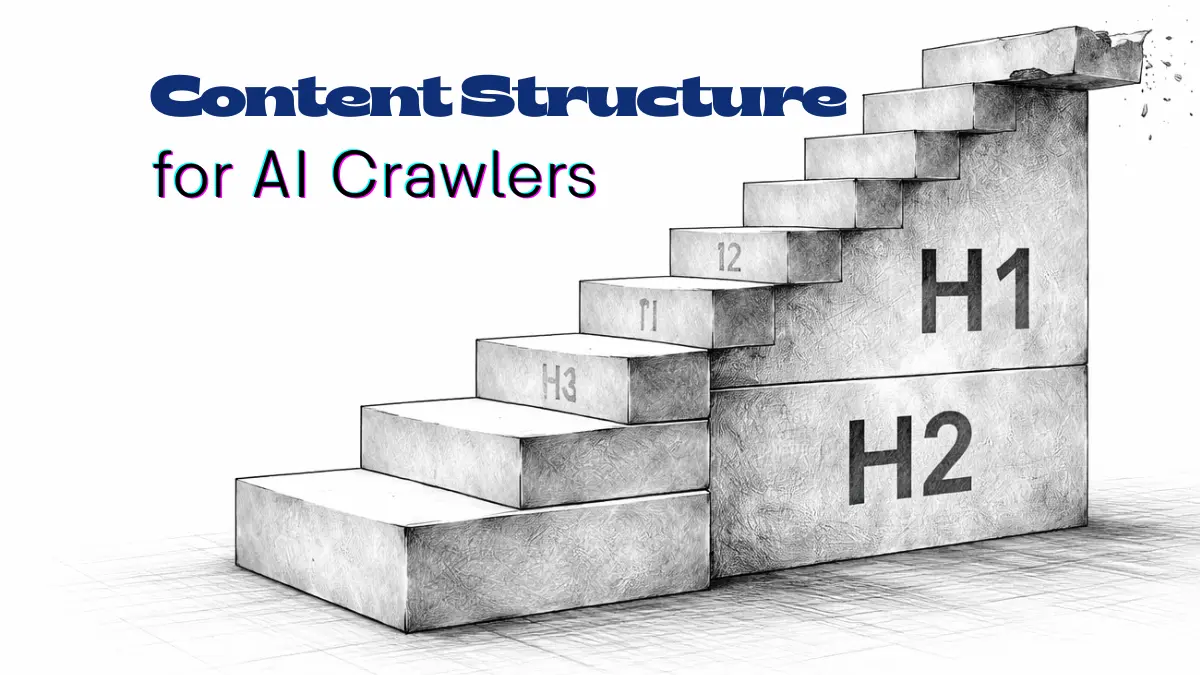
A stable hierarchy means each level has a clear role. H2 introduces core concepts, H3 expands them logically, and H4 clarifies details without shifting scope or jumping levels.
Definition: Stable structure is a consistent alignment between heading levels, content depth, and conceptual importance that allows AI systems to interpret hierarchy without ambiguity.
When this alignment exists, the page becomes a layered system instead of fragmented content blocks. AI can reconstruct meaning step-by-step, which improves extraction and reuse across generative systems.
If alignment fails here, AI cannot reconstruct meaning and defaults to lower-confidence interpretation paths.
To understand how hierarchy influences full-site interpretation, see AI crawler structure framework.
Without stable hierarchy, semantic boundaries collapse, making segmentation unreliable and forcing AI to discard structural signals.
Structure: Hierarchy misalignment → interpretation failure → role-based structural correction
Creating Clean Semantic Boundaries
Even with correct hierarchy, interpretation fails when concepts blend together. This is where most structured content collapses.
Failure impact: When concepts overlap, AI compresses multiple meanings into unstable signals, reducing extraction accuracy.
Hierarchy alone is not enough if concepts overlap inside sections. AI crawlers rely on clear segmentation to detect where one idea ends and another begins.
Semantic boundaries are created through controlled focus, not visual formatting. Each section must carry one idea, one function, and one direction without blending explanations or conclusions.
Failure Pattern: Pages often combine multiple concepts inside a single section, which forces AI to compress meaning into a vague or unstable interpretation.
Once compression begins, the original meaning is lost and cannot be reliably reconstructed.
To fix this, each paragraph must serve a single role and connect directly to its heading. This creates clean extraction units that AI systems can interpret without reconstructing missing logic.
As a result, interpretation becomes predictable because boundaries eliminate ambiguity between concepts. AI no longer guesses transitions because boundaries define them explicitly.
This segmentation logic is part of a broader system explained in AI crawler site structure guide.
Without structural alignment at this layer, the next system component cannot stabilize interpretation.
Structure: Concept overlap → meaning compression → segmentation isolation
Principle: AI systems do not interpret blended concepts. Visibility depends on whether each section maintains a single idea with clear boundaries that eliminate the need for compression.
Aligning Metadata With Structure
Structure alone is not trusted unless metadata confirms it. This is where many otherwise well-structured pages fail.
Metadata is not an external SEO layer but part of the structural system. Interpretation systems use titles, descriptions, and schema as confirmation signals for interpreting content.
When metadata aligns with visible structure, AI receives consistent signals. When it conflicts, interpretation becomes unstable and reduces trust in the page.
At this point, AI begins to deprioritize the page in favor of more consistent sources.
Failure impact: Conflicting metadata signals force AI to lower trust, even if the visible content is structurally correct.
The alignment process requires strict consistency. The page title defines the core concept, the meta description reflects the same structure, and headings expand it without deviation.
Mechanism Breakdown:
- Define the single primary concept of the page.
- Align H1 directly with that concept.
- Structure H2 sections as logical expansions of that concept.
- Match meta description with actual section flow.
- Remove sections that introduce unrelated ideas.
This creates a closed structural loop where all signals reinforce each other. AI does not need to resolve contradictions and can process the page with higher confidence.
This alignment removes the need for interpretation correction and stabilizes how the page is processed.
Structure: Signal conflict → trust reduction → metadata alignment enforcement
Example: When metadata reflects the same structure as visible content, AI systems confirm interpretation instead of resolving conflicts, allowing stable extraction and higher trust in the page.
Without metadata alignment, even correctly structured content becomes untrustworthy, forcing AI to rely on external signals.
Building Internal Linking Pathways
Even perfectly structured pages fail if they remain isolated. Interpretation extends beyond a single page.
Structure does not end within the page. AI crawlers evaluate how pages connect to form a broader semantic system.
Internal links act as directional pathways. They guide AI through conceptual relationships and help build a map of meaning across the site.
Most sites fail because links are placed without structural logic. Random linking creates noise instead of reinforcing interpretation.
When links lack direction, they weaken interpretation instead of reinforcing it.
To fix this, links must follow conceptual continuation. Each link should extend the current idea into a deeper explanation, not distract with parallel topics.
A section should link only when the reader and AI naturally expect the next layer of meaning. This transforms links into structural signals instead of SEO artifacts.
You can see how this works in detail in the explanation of AI crawler navigation pathways
Once linking becomes directional, AI movement across the site becomes predictable because each link reinforces a specific interpretation path. The system shifts from isolated pages to a connected semantic structure.
At this stage, structure extends beyond the page, forming a connected interpretation system across multiple documents.
For a complete system-level model of how AI systems interpret structure and navigate across pages, see the main AI crawler structure guide.
Mechanism: Structural alignment → segmentation clarity → signal consistency → directional linking → stable AI interpretation
When all structural layers align, interpretation stabilizes and AI systems can extract meaning without reconstruction.
Without this structural alignment, even high-quality content remains invisible because AI cannot stabilize meaning for extraction and reuse.
Checklist:
- Does the hierarchy reflect conceptual importance without level conflicts?
- Are semantic boundaries preventing overlap between ideas inside sections?
- Is metadata aligned with the actual structure of the page?
- Do internal links extend meaning instead of introducing unrelated paths?
- Can each section be interpreted without requiring reconstruction by AI?
- Does the structure remain consistent across the entire page?
Interpretive Stability in AI Crawling Systems
- Hierarchy-role alignment. Structural levels reflect conceptual importance, allowing AI systems to reconstruct meaning without resolving conflicting depth signals.
- Semantic boundary isolation. Distinct conceptual separation within sections prevents overlap, enabling precise segmentation and reducing interpretive ambiguity during extraction.
These structural properties define how AI systems interpret, segment, and stabilize meaning during crawling and generative processing.
This simplified model shows how structural fixes influence interpretation. The complete system architecture is explained in the main guide.
Structural Interpretation Flow Model
This simplified flow shows how structural fixes enable stable interpretation and consistent meaning extraction across structural layers.
[Hierarchical Structure]
↓
[Semantic Boundaries]
↓
[Metadata Alignment]
↓
[Internal Linking Logic]
↓
[Structural Consistency]
↓
─────────────────────────
↓
[Interpretation Layer]
↓
[Meaning Extraction]
↓
[Content Reuse in AI Systems]
Failure Principle: If hierarchy becomes inconsistent, boundaries overlap, or metadata conflicts with structure, interpretation collapses before extraction. AI systems do not repair unstable structure—they abandon it and prioritize more coherent sources.
FAQ: AI Content Structure and Interpretation
Why does AI fail to understand content?
AI fails when structure is unstable, forcing systems to guess relationships instead of interpreting clear hierarchy and boundaries.
What causes structural instability?
Misaligned heading levels, mixed concepts inside sections, and conflicting metadata break the consistency required for reliable interpretation.
How do semantic boundaries affect AI interpretation?
Clear boundaries isolate concepts, allowing AI to extract meaning precisely instead of compressing multiple ideas into vague signals.
Why is metadata alignment critical?
When metadata conflicts with visible structure, AI receives contradictory signals and reduces trust in the page interpretation.
What role does internal linking play in structure?
Directional links extend meaning across pages, helping AI build a connected semantic model instead of isolated fragments.
Glossary: AI Content Structure Terms
This glossary defines structural concepts that determine how AI systems interpret, segment, and extract meaning from content without conflicting signals.
Structural Hierarchy
The ordered sequence of heading levels that defines conceptual importance and allows AI systems to reconstruct relationships without ambiguity.
Semantic Boundaries
The separation of concepts into distinct sections, preventing overlap and enabling precise segmentation during AI interpretation.
Metadata Alignment
The consistency between metadata signals and visible structure that reinforces interpretation and reduces conflicting meaning during processing.
Internal Linking Logic
Directional connections between pages that extend meaning and support the formation of a coherent multi-page semantic structure.
Structural Stability
The degree to which hierarchy, boundaries, and signals remain consistent, enabling reliable interpretation and preventing reconstruction failure.

Author Sergey Kuchinskiy
Founder of PostUpgrade. Researcher in Generative Engine Optimization (GEO), semantic structuring, and machine reasoning systems. Focuses on AI-readable content architecture, computational interpretation, and scalable knowledge retrieval. Author of 200+ analytical publications on generative visibility, semantic mapping, and AI-first information design.
Verified Expertise
- Generative Engine Optimization (GEO)
- AI Content Engineering & Semantic Structuring
- Computational Linguistics & Machine Reasoning
- Large-Scale Content Architecture
Research Focus
AI Search · Generative Visibility · Semantic Mapping · Machine Sentence Design · Reasoning Stability · Knowledge Extraction Models
Academic Contributions
- 200+ analytical research publications
- AI-first page architecture methodologies
- Semantic Frameworks for Machine Interpretation (SFMI)
- Generative Visibility Standards 2024–2025
Citation Metrics
AI-model reuse rate (GEO-Score): 92/100 · Cross-model consistency: 87% · Reasoning chain stability: 91%
Researcher ID: PU-ORCID-7421-9912
View all publications →Connect on LinkedIn →