Last Updated on March 28, 2026 by PostUpgrade
How AI Segments Your Page Structure (And Why It Fails)
This article explains how AI systems segment page structure into meaning units and why segmentation failure prevents interpretation entirely.
AI is not reading your page structure — it is deciding whether your layout can be reconstructed at all.
TL;DR: Most pages fail because AI cannot convert layout into stable meaning blocks, so interpretation stops and content is not reused. This happens when segmentation, hierarchy, and structural signals are inconsistent. AI parses HTML into boundaries, extracts units, and only processes what can be clearly reconstructed. Fixing segmentation and structure restores extraction and makes your content reusable across AI systems.
If segmentation cannot isolate independent meaning units, AI systems stop interpretation and discard the page regardless of content quality.
If segmentation breaks at this stage, everything below becomes invisible to AI systems.
AI systems segment page structure by reconstructing layout into structured meaning blocks. They do not process text sequentially but transform HTML layout into a hierarchy of segments, relationships, and extraction units. This reconstruction determines whether your content is understood or ignored.
AI does not read pages like humans. It reconstructs them into structured meaning blocks. This means every layout decision directly affects how meaning is extracted and reused.
From Layout to Meaning Units
A page without clear section boundaries causes AI to merge unrelated topics, making extraction impossible.
At this stage, AI decides whether your page can be segmented at all, and failure here stops interpretation completely.
AI crawlers begin by converting raw layout into discrete interpretation units. This process is not visual but structural, based entirely on how HTML elements define boundaries and relationships.
These structural boundaries are part of a broader system explained in AI crawler site structure architecture, where segmentation determines whether interpretation can begin at all.
Definition: AI understanding is the model’s ability to interpret meaning, structure, and conceptual boundaries in a way that enables accurate reasoning, reliable summarization, and consistent content reuse across generative discovery systems.
Segmentation rule: each block must have a clear boundary, single idea, and stable structural context.
Definition: Segmentation is the process by which AI divides a page into independent meaning units using headings, sections, and structural signals. These units become the foundation for interpretation and reuse.
The mechanism starts with parsing the DOM and identifying structural signals. Headings define scope, containers define grouping, and spacing reinforces separation. AI isolates each block and assigns it a meaning boundary before any semantic evaluation begins.
Next: the system evaluates how stable these boundaries are and whether each unit can stand independently. This is where the core structural logic becomes critical, as explained in core structural components analyzed by AI crawlers, which determine how reliably each segment is interpreted.
Failure appears when segmentation cannot stabilize. Missing headings, mixed topics, or inconsistent grouping cause blocks to merge, and meaning becomes ambiguous. When this happens, AI does not attempt recovery but stops interpretation.
This leads directly to how AI assigns meaning hierarchy, which depends entirely on heading structure.
Principle: Content becomes more visible in AI-driven environments when its structure, definitions, and conceptual boundaries remain stable enough for models to interpret without ambiguity.
How Headings Build a Meaning Map
If headings fail to define hierarchy, AI cannot determine what matters and what can be ignored.
Headings act as the primary system that organizes meaning across a page. They are not visual markers but structural signals that define how concepts relate and scale.
This hierarchy directly connects to the overall page structure model described in AI crawler site structure guide, where heading logic defines interpretation depth.
Definition: A meaning map is the hierarchical structure created by headings that allows AI to understand topic relationships and scope. It determines how each section connects to the overall context.
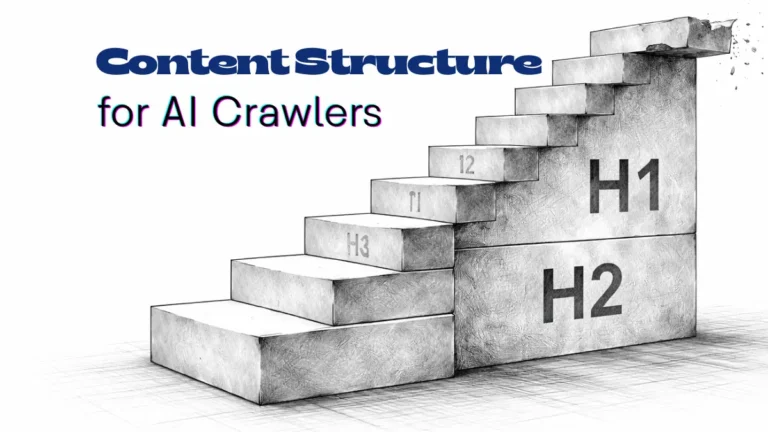
The mechanism relies on hierarchical parsing. AI reads H1 as the global context, H2 as primary divisions, and H3–H4 as deeper layers of explanation. This creates a nested structure that maps concepts into levels of importance and dependency.
This leads to a structured interpretation where each heading defines a new scope boundary. AI uses this map to assign relevance and determine how deeply each concept should be processed.
Failure occurs when hierarchy breaks. Skipped levels, multiple H1 elements, or visual styling without semantic tags collapse the map and remove clarity. As a result, AI cannot determine relationships between concepts.
Next, AI uses these hierarchical signals to group content into extraction-ready sections.
How Sections Become Extraction Blocks
If sections are unclear, AI cannot isolate meaning and will merge unrelated concepts into unusable output.
Sections define how grouped content is interpreted as a single unit. They provide the container logic that determines where meaning starts and ends.
Definition: An extraction block is a structurally defined section that AI processes as an independent unit of meaning. It contains a topic, explanation, and contextual signals.
The mechanism depends on semantic grouping. Tags like section, article, and logical containers signal where content belongs. AI combines the heading with its content and treats the entire block as one extraction entity.
Example: When multiple ideas are placed inside one section without clear boundaries, AI treats them as a single unit and loses the ability to extract precise meaning.
Extraction rule: each section must contain one topic, one boundary, and one interpretable unit.
This leads to a system where each section can be processed without dependency on surrounding content. AI isolates the block, evaluates clarity, and determines whether it can be reused independently.
Example: A page where each section contains a single clearly defined topic allows AI to isolate meaning units and reuse them without merging unrelated concepts.
Failure appears when sections are unclear. Overlapping content, fragmented structure, or missing containers prevent AI from isolating meaning. This results in incomplete or incorrect extraction.
This prepares the system for layered interpretation, where each block is evaluated in sequence.
Checklist:
- Does the page define its core concepts with precise terminology?
- Are sections organized with stable H2–H4 boundaries?
- Does each paragraph express one clear reasoning unit?
- Are examples used to reinforce abstract concepts?
- Is ambiguity eliminated through consistent transitions and local definitions?
- Does the structure support step-by-step AI interpretation?
Layered Interpretation Model
AI does not process everything at once, it validates each layer before allowing meaning to pass through.
AI does not interpret structure in a single step. It builds meaning through layered processing, where each layer reinforces or weakens the final result.
Definition: Layered interpretation is a multi-step process where structural, semantic, and relational signals are combined into a unified understanding of content.
The mechanism follows a sequence. First, structure defines boundaries. Then segmentation isolates units. Next, relationships between blocks are mapped. Finally, metadata and patterns reinforce meaning.
This layered model is part of a complete structural interpretation system outlined in AI crawler site structure framework, where each layer must stabilize before meaning is extracted.
This leads to a cumulative model where each layer depends on the previous one. If structure is unstable, segmentation fails. If segmentation fails, relationships cannot be formed.
When one layer fails, the entire interpretation chain collapses regardless of content quality.
At this stage, understanding failure is not enough — the system requires structural correction. Once segmentation becomes unstable, the only way to restore interpretation is to rebuild hierarchy alignment, isolate semantic boundaries, and eliminate conflicting signals across the page. This repair layer is explained in How to Fix Your Content Structure for AI Crawlers, where structural stabilization enables segmentation to produce reliable meaning units and restores content visibility in AI systems.
Failure occurs when one layer breaks. Even with strong content, missing structure or inconsistent patterns stop interpretation entirely. AI does not compensate for missing layers but replaces the content with more reliable sources.
This is the point where structure determines whether your content will be reused or ignored by AI systems.
Next step: Understanding segmentation alone is not enough. To see how structure, hierarchy, and signals combine into a complete system, refer to the full AI crawler site structure guide.
AI processes only those content blocks that can be segmented into independent and structurally stable units.
Final insight: AI visibility is not determined by content quality but by structural interpretability. If your page cannot be segmented into stable units, it does not exist for AI systems.
Interpretive Structure of Segmented Page Architectures
- Segmentation boundary detection. AI systems rely on explicit structural boundaries such as headings and sections to isolate discrete meaning units for interpretation.
- Hierarchical scope resolution. Heading depth establishes contextual scope, allowing systems to determine how concepts relate across layered semantic structures.
These signals define how segmented page structures are reconstructed into coherent meaning models, where boundaries and hierarchy determine interpretation stability.
Segmentation and Interpretation Flow Model
AI crawlers reconstruct page meaning by converting layout into segmented units and processing them through a layered interpretive sequence. This flow illustrates how structure is transformed into extraction-ready blocks and where breakdowns prevent interpretation.
[HTML Layout]
↓
[Structural Signals]
↓
[Segmentation Boundaries]
↓
[Meaning Units]
↓
[Hierarchy Mapping]
↓
─────────────────────────
↓
[Interpretation Layer]
↓
[Content Extraction]
↓
[Reuse in AI Systems]
Failure Principle: When segmentation or hierarchy becomes unstable, interpretation stops. AI systems do not infer missing structure and discard unreliable content blocks.
FAQ: AI Page Segmentation
How does AI segment page structure?
AI systems analyze HTML layout, detect structural signals, and divide content into independent meaning units for interpretation and reuse.
What is content segmentation?
Segmentation is the process of dividing a page into independent meaning units based on structural boundaries such as headings, sections, and containers.
How do headings affect segmentation?
Headings define structural hierarchy and scope, helping AI separate content into distinct segments and determine relationships between them.
Why does segmentation failure stop interpretation?
If segmentation cannot isolate independent meaning units, AI systems cannot reconstruct structure and stop interpretation completely.
Glossary: Core Terms in AI Page Segmentation
These terms define how AI systems segment page structure, isolate meaning, and determine whether content can be interpreted and reused.
Segmentation
The process of dividing a page into independent meaning units based on structural boundaries such as headings, sections, and containers.
Structural Signals
HTML elements that define boundaries and relationships, allowing AI to detect structure and organize content into interpretable segments.
Meaning Units
Independent content blocks that AI isolates and evaluates separately for extraction, interpretation, and reuse.
Extraction Block
A structurally defined section that AI processes as a complete unit of meaning, combining a heading, content, and contextual signals.

Author Sergey Kuchinskiy
Founder of PostUpgrade. Researcher in Generative Engine Optimization (GEO), semantic structuring, and machine reasoning systems. Focuses on AI-readable content architecture, computational interpretation, and scalable knowledge retrieval. Author of 200+ analytical publications on generative visibility, semantic mapping, and AI-first information design.
Verified Expertise
- Generative Engine Optimization (GEO)
- AI Content Engineering & Semantic Structuring
- Computational Linguistics & Machine Reasoning
- Large-Scale Content Architecture
Research Focus
AI Search · Generative Visibility · Semantic Mapping · Machine Sentence Design · Reasoning Stability · Knowledge Extraction Models
Academic Contributions
- 200+ analytical research publications
- AI-first page architecture methodologies
- Semantic Frameworks for Machine Interpretation (SFMI)
- Generative Visibility Standards 2024–2025
Citation Metrics
AI-model reuse rate (GEO-Score): 92/100 · Cross-model consistency: 87% · Reasoning chain stability: 91%
Researcher ID: PU-ORCID-7421-9912
View all publications →Connect on LinkedIn →