Last Updated on March 28, 2026 by PostUpgrade
Why AI Ignores Your Content Even When It Looks Good
AI does not read content. It reconstructs it.
AI ignores content when it cannot reconstruct meaning from structure.
TL;DR: Most content fails not because it is unclear, but because AI cannot reconstruct its structure. When segmentation, hierarchy, and boundaries break, interpretation stops and content is excluded from extraction and reuse. Stable structure restores interpretability, allowing AI systems to process, reuse, and surface your content reliably.
This article explains why AI rejects content when structure becomes unreconstructable, focusing on interpretation failure mechanisms.
If your structure breaks here, everything that follows becomes invisible to AI systems.
Your content can be clear, well-written, and still invisible to AI systems. The problem is not quality—it is structure. AI does not evaluate readability first, it evaluates whether meaning can be reconstructed from layout.
Definition: Reconstructable structure is a page layout where meaning can be reliably rebuilt from headings, sections, and boundaries, allowing AI systems to interpret content without ambiguity or inference.
Readable Does Not Mean Reconstructable
If structure cannot be rebuilt, meaning never reaches interpretation.
A page can feel smooth and logical to a human reader while remaining unusable for AI systems. Humans fill gaps automatically, but machines require explicit structural signals to connect ideas and interpret meaning. When those signals are weak or inconsistent, the content becomes fragmented from the system’s perspective.
This failure mechanism is part of a broader structural system explained in how AI crawlers interpret site structure, where layout signals define whether content becomes usable or ignored.
Definition: A reconstructable structure is a layout where every idea is clearly bounded, hierarchically placed, and connected through predictable patterns that allow machines to rebuild meaning step-by-step.
This leads to a fundamental mismatch between human perception and machine processing. You may believe your content is clear, but AI evaluates whether each part fits into a stable interpretive model. If the model cannot be formed, the content is treated as incomplete regardless of quality.
AI systems convert layout into discrete meaning units based on structural signals rather than narrative flow.
When structural signals stop aligning, AI systems cannot stabilize a reconstruction model, causing immediate interpretation failure.
AI does not interpret broken structure. It abandons it.
Where Structural Interpretation Breaks
Interpretation does not weaken gradually — it stops at the first structural inconsistency.
Structural failure does not happen gradually, it happens at specific breakpoints where signals stop aligning. These breakpoints appear when headings do not match section content, when sections overlap conceptually, or when formatting creates ambiguity about boundaries. At that moment, interpretation does not weaken—it collapses.
This is where most pages silently lose visibility without any visible error.
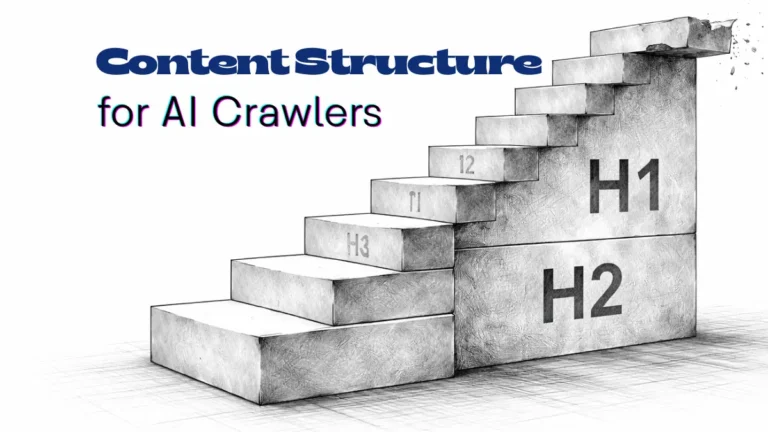
At this point, the failure is not about content quality but about segmentation breakdown. AI systems attempt to divide the page into independent meaning units before any interpretation begins. When this process fails, structure cannot be reconstructed, and the content becomes unusable. A detailed explanation of how this segmentation process works — and why it collapses — is covered in How AI Segments Your Page Structure (And Why It Fails), where segmentation boundaries and structural stability determine whether interpretation can even start.
These breakpoints emerge when structural alignment fails, a concept explored in AI crawler site structure principles, where segmentation consistency determines interpretability.
Mechanism Breakdown:
- The crawler scans structural signals such as headings, sections, and layout zones.
- It attempts to map these signals into a hierarchical model of meaning.
- It validates whether each segment has a clear role and boundary.
- If inconsistencies appear, the model becomes unstable.
- The system stops reconstruction and abandons interpretation.
This leads to a key insight: failure is deterministic. AI does not partially understand broken structure, it rejects it entirely. A deeper explanation of how structured layouts affect AI interpretation is outlined in how structured layouts affect AI interpretation, where stable segmentation is shown as the core requirement for extraction.
Principle: AI systems prioritize structural reliability over content quality, selecting only those pages whose layout enables consistent segmentation and predictable meaning reconstruction.
This leads to a system behavior that is often misunderstood.
If structure cannot be reconstructed, meaning does not exist for AI.
Why AI Does Not Infer Missing Meaning
This behavior reflects how AI systems operate under strict structural constraints, described in AI site structure models, where inference is replaced by deterministic interpretation.
AI does not fill gaps — it treats them as failure signals.
AI systems are not designed to guess intent when structure is unclear. They rely on explicit signals because inference introduces risk and reduces reliability at scale. When structure fails, the system prefers to discard the content rather than attempt reconstruction.
This leads to a strict rule in machine interpretation. Meaning must be explicitly encoded in layout, not implied through context or writing style. If a section lacks clear boundaries or hierarchical placement, it is treated as noise instead of information.
At this point, content is no longer interpreted as knowledge but as structural ambiguity.
Example: When a page mixes multiple ideas inside a single section without clear boundaries, AI systems fail to isolate meaning units and treat the entire block as unreliable, even if individual sentences are correct.
Failure Pattern:
Content often breaks when multiple ideas are compressed into a single block, when headings are used inconsistently, or when visual formatting replaces semantic structure. These patterns create ambiguity that prevents the system from assigning meaning reliably.
This explains why failure is not partial but absolute.
Structure determines interpretability, not readability.
Replacement Instead of Degradation
AI systems do not rank weak structure lower — they remove it from consideration.
When structure fails, AI systems do not downgrade the content—they replace it. The system selects alternative pages that provide cleaner structural signals and more predictable segmentation. This creates a binary outcome: either your content is usable or it is ignored.
There is no middle state where partially structured content survives.
This leads to a competitive dynamic where structure determines visibility more than writing quality. Even highly informative pages lose exposure if their layout cannot be reconstructed into stable meaning units. In contrast, structurally consistent pages gain preference because they reduce interpretive effort.
Next: this replacement behavior explains why improving content alone does not fix visibility issues. The underlying structure must support extraction, otherwise improvements remain invisible.
This is the point where structure becomes the primary visibility factor.
Related mechanisms such as structural signals, segmentation stability, and interpretation models are explained in other articles within this content cluster.
To understand how these failures connect to the full interpretation system, see how AI crawlers process and structure content, where stable layout enables consistent meaning reconstruction.
Checklist:
- Are concepts separated into clearly defined structural blocks?
- Does each section align with its heading without overlap?
- Is the hierarchy consistent across all sections?
- Do boundaries prevent mixing multiple ideas in one block?
- Can the page be segmented into independent meaning units?
- Would the structure remain interpretable without visual styling?
Why Boundaries Matter for Interpretation
- Boundary clarity. When sections do not clearly separate ideas, AI systems cannot isolate meaning.
- Segmentation stability. Inconsistent layout prevents systems from maintaining a stable interpretation model.
Structural Failure Conditions in AI Interpretation
AI systems rely on stable structural alignment to reconstruct meaning. When this alignment breaks, interpretation stops immediately instead of degrading.
Layer 1 — Boundary Definition:
If sections do not clearly define where ideas begin and end, meaning cannot be isolated into distinct units.
Layer 2 — Segmentation Coherence:
When content blocks mix multiple ideas or overlap, AI systems cannot assign stable meaning roles.
Layer 3 — Signal Alignment:
If headings, sections, and layout signals do not match, the reconstruction model becomes unstable and collapses.
Failure Insight: Interpretation fails when structural signals cannot align into a consistent model. AI systems do not compensate for this failure.
Where Interpretation Fails in AI Systems
AI systems attempt to reconstruct meaning step-by-step from structural signals. When alignment breaks, the process stops immediately.
[Structural Signals]
↓
[Segmentation Attempt]
↓
[Alignment Check]
↓
❌ FAILURE (signals do not match)
↓
[Reconstruction Stops]
↓
[Content Ignored]
Failure Principle: AI systems do not partially interpret broken structure. When alignment fails, reconstruction stops completely.
FAQ: Why AI Ignores Content
Why does AI ignore well-written content?
AI ignores content when structure is unstable, making it impossible to reconstruct meaning even if the writing itself is clear and accurate.
Why can’t AI understand website structure?
AI systems depend on consistent hierarchy and clear boundaries. When layout signals are inconsistent, interpretation fails before meaning is processed.
What causes AI interpretation failure?
Interpretation fails when segmentation is unclear, headings are misaligned, or content blocks overlap, preventing stable meaning reconstruction.
Does content quality matter if structure is broken?
Content quality does not compensate for structural issues. If the layout cannot be reconstructed, the system ignores the content entirely.
Why does AI replace content instead of ranking it lower?
AI systems operate on reliability thresholds. When structure fails, they select alternative sources with stable structural signals instead of degrading ranking.
What is reconstructable structure in AI systems?
Reconstructable structure refers to a layout where each concept is clearly separated, hierarchically defined, and connected through predictable patterns.
Glossary: Key Terms in AI Content Interpretation
This glossary defines core structural concepts that determine whether AI systems interpret or ignore content during processing.
Reconstructable Structure
A layout where each concept is clearly separated, hierarchically organized, and aligned with predictable structural patterns that enable AI interpretation.
Structural Segmentation
The division of content into distinct meaning units through headings, sections, and layout boundaries that allow AI systems to isolate concepts.
Interpretation Failure
A deterministic state where AI systems cannot reconstruct meaning due to inconsistent structure, leading to content being ignored.
Hierarchy Misalignment
A condition where heading levels and content relationships do not match, disrupting the logical mapping of meaning across sections.

Author Sergey Kuchinskiy
Founder of PostUpgrade. Researcher in Generative Engine Optimization (GEO), semantic structuring, and machine reasoning systems. Focuses on AI-readable content architecture, computational interpretation, and scalable knowledge retrieval. Author of 200+ analytical publications on generative visibility, semantic mapping, and AI-first information design.
Verified Expertise
- Generative Engine Optimization (GEO)
- AI Content Engineering & Semantic Structuring
- Computational Linguistics & Machine Reasoning
- Large-Scale Content Architecture
Research Focus
AI Search · Generative Visibility · Semantic Mapping · Machine Sentence Design · Reasoning Stability · Knowledge Extraction Models
Academic Contributions
- 200+ analytical research publications
- AI-first page architecture methodologies
- Semantic Frameworks for Machine Interpretation (SFMI)
- Generative Visibility Standards 2024–2025
Citation Metrics
AI-model reuse rate (GEO-Score): 92/100 · Cross-model consistency: 87% · Reasoning chain stability: 91%
Researcher ID: PU-ORCID-7421-9912
View all publications →Connect on LinkedIn →