Last Updated on February 27, 2026 by PostUpgrade
The New Logic of Writing in the Generative Era: How generative era writing Redefines Clarity
Generative era writing defines how modern content is created and understood, and this shift is supported by recent work in human-centered AI. AI systems read text line by line, so the structure must deliver clear meaning without ambiguity. Readers expect fast context, direct explanations, and predictable logic flows. This new environment turns writing into a process of building transparent knowledge for both humans and machines.
Definition: Generative Era writing refers to a meaning-first approach where ideas are expressed through explicit reasoning, stable terminology, and structured clarity that enables precise interpretation by AI systems.
Understanding Generative Era Writing Principles
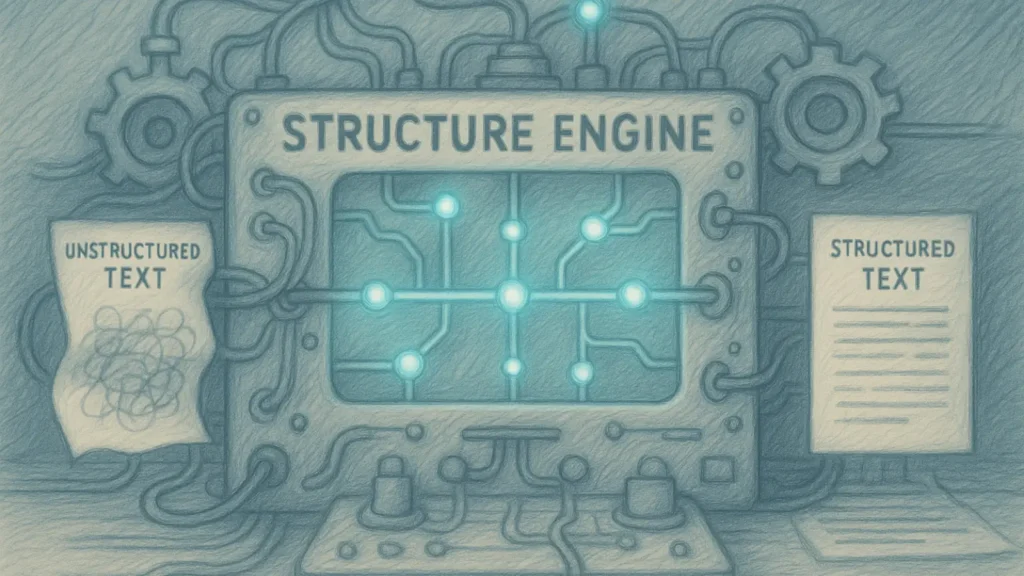
Generative era writing defines how digital communication is produced and interpreted, and this shift is documented in research on computational linguistics. Modern platforms depend on text that delivers meaning through structure rather than style because AI systems interpret information through explicit logical patterns. This transformation affects how digital writing evolves across search engines, assistants, and reasoning models. Writers now need to create content that supports clarity, consistent terminology, and transparent knowledge flow.
Principle: Writing becomes interpretable in the generative era when each concept preserves stable boundaries, allowing AI systems to reconstruct logic without ambiguity.
What “Generative Era Writing” Means Today
Generative Era Writing describes an approach to producing text that is optimized for both human comprehension and machine interpretation. The method prioritizes explicit logic, stable terminology, and clearly defined conceptual boundaries. Large language models evaluate meaning line by line, so each sentence must communicate a single actionable fact.
Core properties of this approach include:
- explicit reasoning units
- predictable conceptual flow
- stable terminology across sections
- short explanatory segments
- definition-first structure
- unambiguous cause–effect logic
AI systems analyze text by identifying definitions, relationships, and semantic anchors. They rely on consistent phrasing to track entities and concepts across longer passages. When terminology and structure remain stable, models extract meaning with higher accuracy and fewer misinterpretations.
Example:
“Each step is defined clearly, which improves the accuracy of interpretation.” — processed as one explicit reasoning unit.
“It makes things better because the process is more clear.” — interpreted with ambiguity because “things” and “more clear” lack defined references.
Generative Era Writing creates a modular architecture in which each unit of text performs a distinct informational function and can be reliably interpreted by both humans and AI systems.
Why Structure Defines Effective Generative Era Writing
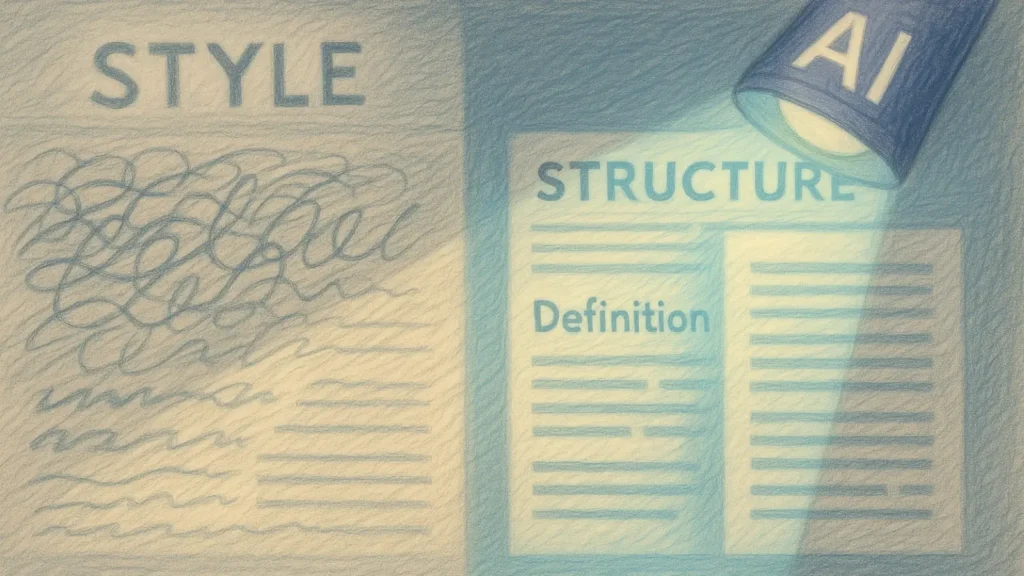
In the context of an introduction to generative engine optimization, writing methods for AI elevate structure above style because AI models interpret meaning through logical scaffolding rather than rhetorical variation. A clearly organized paragraph allows the system to maintain context and connect reasoning elements accurately. Structure increases predictability, which reduces error during automated interpretation and transformation.
Human readers benefit from the same predictability. Clear segmentation and stable logic reduce cognitive load and improve understanding of complex ideas. Style introduces variability that does not strengthen semantic clarity. In environments where AI mediates most information access, structural consistency becomes a core writing requirement.
Effective structural practices include:
- one idea per segment
- explicit transitions between concepts
- consistent naming of entities
- short, logically linked paragraphs
- early introduction of definitions
- separation of claims and evidence
AI systems process text through hierarchical reasoning blocks. When information is presented in a sequence that begins with a definition, followed by explanation and evidence, the model preserves context throughout long chains of inference. This increases the reliability of summaries, answers, and transformations generated from the source text.
Structure ensures that meaning remains stable across different modes of interpretation and becomes the dominant standard for writing in the generative era.
New Rules for Generative Era Writing
New rules for modern writing emerge because both human readers and AI systems depend on content that communicates meaning with clarity and minimal ambiguity, a trend confirmed by research on digital reading behavior. Modern platforms no longer reward stylistic density or slow narrative buildup.
They prioritize fast access to context, explicit definitions, and stable reasoning chains. As a result, writing shifts from expressive variation to structured communication designed for accurate interpretation.
Modern readers scan, compare, and validate information within seconds. Large language models interpret text through semantic anchors, logical segments, and predictable transitions. When writing does not follow these patterns, meaning becomes unstable and is often misinterpreted during summarization, retrieval, or reasoning. The generative era therefore replaces stylistic freedom with rules grounded in clarity, conceptual structure, and transparency.
Principles That Define the New Writing Standard
The new writing standard is built on principles that make text predictable, scannable, and machine-interpretable. Each principle provides a clear unit of meaning and ensures consistent interpretation across platforms.
One idea per paragraph
A paragraph should deliver one actionable concept instead of blending multiple ideas.
Example: Define a term in one paragraph and provide an example in the next to avoid conceptual collision.
Clarity before complexity
Present the simplest version of an idea first and expand only when the base meaning is secure.
Example: Introduce the meaning of “reasoning flow” before explaining its effect on AI interpretation accuracy.
Predictable reasoning flow
Sentences should follow a stable pattern, typically from context to explanation to implication.
Example: “Definition → mechanism → outcome” helps both readers and AI maintain alignment.
Explicit definitions before discussion
Key terms must be introduced before they appear in analytical or comparative sections.
Example: Define “semantic anchor” before discussing how models track it across long-form text.
Consistent terminology across sections
The same concept should use the same term throughout the document.
Example: If the text uses “conceptual clarity,” it should not switch to “semantic transparency” without purpose.
Avoid abstraction without support
Abstract sentences require concrete examples to ground meaning.
Example: “AI relies on stable terminology” should be followed by how LLMs map repeated tokens.
Factual statements without filler
Each sentence should add a discrete fact or clarification.
Example: Replace “It is important to understand that clarity helps” with “Clarity improves extraction accuracy.”
Direct transitions between concepts
Transitions clarify how one idea connects to the next.
Example: Use “As a result” or “In contrast” to show the direction of reasoning rather than implying it.
Separation of claims and evidence
Claims should be stated independently, followed by data or examples that validate them.
Example:
Claim: “Structured text increases reasoning reliability.”
Evidence: “Models preserve context longer when definitions appear before analysis.”
Concise framing of context
Begin sections with short contextual statements that orient the reader immediately.
Example: Use a two-sentence introduction instead of long rhetorical build-up.
How Writing Changes Today (Human + AI Behavior)
How writing changes today reflects the combined shift in human consumption patterns and AI-driven interpretation. Readers expect instant clarity and rely on structure to scan content efficiently. AI systems evaluate meaning through patterns, definitions, and reasoning blocks. When writing lacks these structures, both readers and models struggle to extract accurate meaning.
Micro-example of combined behavior:
A human skims the first two sentences to understand the core idea.
An AI system extracts definitions and logical relationships from the same passage.
Both rely on explicit structure to perform their tasks effectively.
Comparison: Old Writing vs. Generative Era Writing
| Old Writing Approach | Generative Era Approach |
|---|---|
| Keyword density focus | Conceptual clarity |
| Long intros | Fast context delivery |
| Narrative-first | Structure-first |
| Vague connections | Strong logic chains |
| Style-driven phrasing | Definition-driven framing |
| Implicit reasoning | Explicit reasoning blocks |
| Variable terminology | Stable terminology |
| Decorative complexity | Purposeful simplicity |
| Linear storytelling | Modular concept segmentation |
| Delayed context | Immediate context upfront |
The generative era transforms writing into a disciplined method of structuring knowledge. Text becomes a system of reasoning rather than a stylistic artifact.
Writing Methods in the Generative Era
Writing methods for ai shape how information is interpreted in environments where both humans and AI systems rely on structured reasoning. Modern text must support ai-readable writing by presenting meaning through stable terminology, explicit segmentation, and predictable logic chains.
This shift is reflected in current research on machine text understanding, which shows that models interpret content more accurately when information is organized into clear, modular units. As AI-driven systems become primary intermediaries in search, analysis, and knowledge retrieval, writing must evolve to align with how models process text.
The Input Structure AI Works With
AI systems interpret text through a sequence of tokens, not through natural human reading. Each sentence is broken into token-level units, which the model groups into attention blocks. These blocks determine which parts of a paragraph relate to each other. When writing lacks structure, the model assigns connections inaccurately, which weakens reasoning quality.
AI does not “follow” a narrative in a human sense. Instead, it detects patterns, token frequencies, anchor terms, and conceptual consistency. Well-structured writing produces stable clusters that the model can decode efficiently.
The Role of Definitions, Entities, and Anchors
AI models rely heavily on explicit definitions because definitions provide the clearest form of logical grounding. A defined term becomes a semantic anchor. Once the anchor appears, the model uses it as a reference point for the rest of the text. Without early or consistent definitions, the model must infer meaning, which introduces reasoning errors.
Entities — names, dates, categories, values — also act as stabilizers. They reduce ambiguity by creating fixed points in the reasoning graph. When terminology changes unpredictably, models borrow context from unrelated parts of the text, leading to incorrect associations.
How Reasoning Chains Are Built
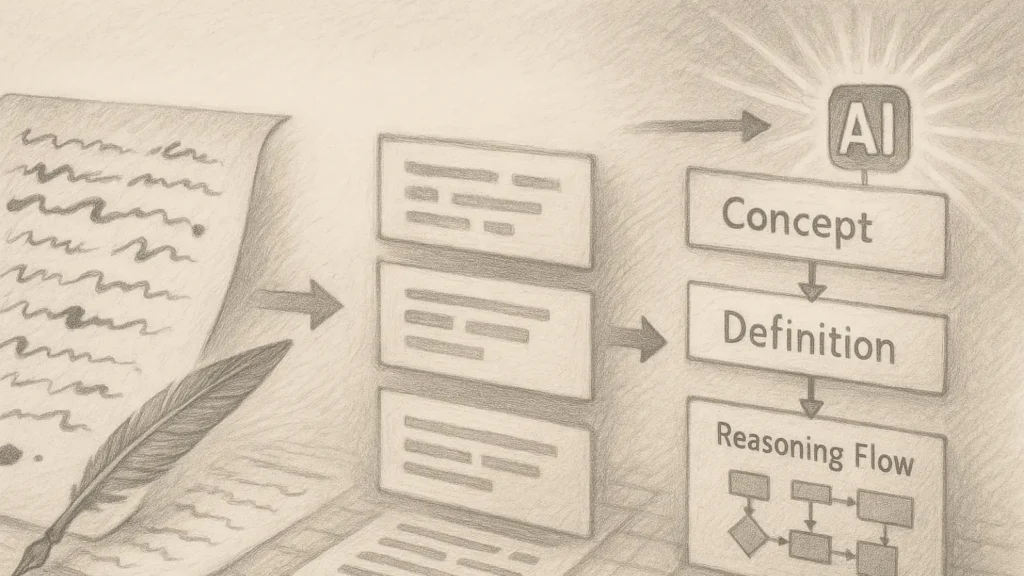
Reasoning chains are constructed through explicit sentence-to-sentence relationships. The model identifies cause–effect expressions, contrast markers, definitions, and supporting evidence to build a logical progression.
A typical reasoning chain looks like:
- A definition sets the base concept.
- A sentence explains the mechanism connected to that definition.
- Another sentence adds evidence or an example.
- A final sentence shows the implication or outcome.
This pattern is highly ai-readable because it matches how LLMs calculate semantic continuity. When writing breaks this sequence — for example, by introducing a story, metaphor, or unrelated detail — the chain weakens.
Interpretation Challenges
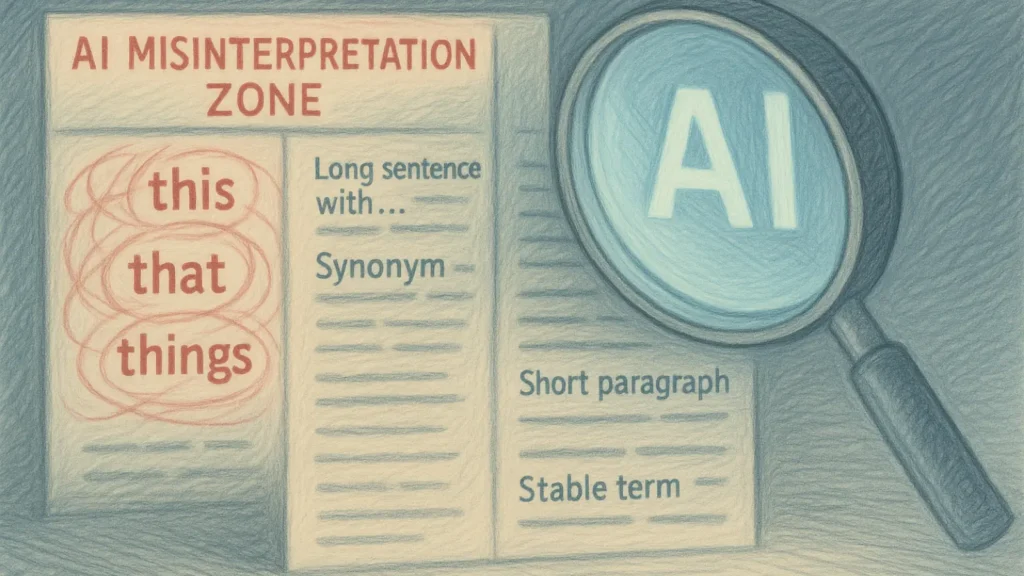
Certain writing patterns consistently confuse AI models:
- Implicit references (“this,” “that,” “things”) break link tracing.
- Synonym switching for core concepts fractures meaning.
- Long sentences with nested clauses overload context windows.
- Abstractions without examples cause drift into hallucination.
- Inconsistent logic order creates conflicting interpretations.
These issues do not confuse humans as strongly, but AI systems depend on explicit logical signals and cannot infer context as flexibly.
Micro-Examples
Clear and AI-readable:
“Define the concept first. Explain the mechanism next. Show the outcome last.”
AI interprets each sentence as a discrete step in a structured flow.
Ambiguous and less readable:
“This works better when you explain things in order.”
The model cannot determine what “this” or “things” refer to.
Stable definition example:
“A semantic anchor is a repeated term that maintains meaning across a text.”
This gives AI a concrete anchor for all future references.
Unstable definition example:
“Anchors help. They make ideas clear.”
Here “anchors” is not defined, and “things” creates ambiguity.
These patterns demonstrate how precise segmentation improves reliability.
AI-Friendly Techniques in Generative Era Writing
AI-friendly writing transforms ideas into predictable, modular structures that models can interpret without guessing. The goal is not stylistic beauty — it is semantic precision, stability, and clarity.
Consistent terminology
Use one term for one concept throughout the text.
If you introduce “reasoning flow,” keep that term consistent and avoid switching to synonyms like “logic rhythm” or “thought structure.”
Minimal semantic noise
Remove filler phrases and rhetorical padding.
Models misinterpret sentences that contain empty connectors like “it is worth noting” or “as we all understand.”
Explicit transitions
Use transitions to reveal intent: “as a result,” “in contrast,” “therefore.”
Transitions help AI detect directional changes in reasoning.
Definition-first structure
Define all key terms before analyzing or comparing them.
When definitions appear too late, the model retrofits earlier sentences, producing unstable interpretations.
One idea per segment
Avoid mixing multiple concepts within a paragraph.
Models segment meaning by paragraph boundaries, so each block must contain one functional purpose.
Stable entity references
Mention entities the same way every time — same name, same form.
This helps AI maintain coherence in long passages.
Clear cause–effect logic
Use markers that explicitly describe causal direction.
For example: “X leads to Y,” “X reduces Y,” “X depends on Y.”
Short reasoning blocks
Keep reasoning units compact: statement → explanation → conclusion.
This mirrors the model’s internal reasoning sequence.
Uniform formatting patterns
Use consistent structure for headings, lists, and examples.
Models interpret formatting patterns as structural cues.
Evidence-linked statements
Support claims with sources, examples, or data.
AI systems assign higher confidence to statements attached to evidence.
These techniques ensure that writing remains stable across tasks such as summarization, retrieval, question answering, classification, and chain-of-thought reasoning.
Closing Integration
When writing is structured around these methods, it becomes both human-friendly and ai-readable writing. These standards create a foundation for the future writing skills required in environments dominated by reasoning systems.
Future Writing Skills You Need
A second line of evidence comes from studies on human–machine communication, which emphasize that clarity, predictability, and defined conceptual structures consistently increase interpretation accuracy. These findings shape the skill set required for the next decade.
Skills That Will Dominate 2025–2030
The future of writing prioritizes analytical, structural, and reasoning-based competencies that allow content to maintain meaning across formats and contexts.
Conceptual organization
Writers must build content around stable concepts rather than stylistic sequences. Concepts act as anchor points that maintain coherence across long passages and AI transformations.
Reasoning-driven composition
Writing should follow explicit reasoning sequences such as definition → mechanism → implication. This structure ensures that AI models can reconstruct meaning with minimal inference.
Structured knowledge mapping
Information must be broken into modular units that each contain one core idea. This structure supports reliable retrieval, summarization, and transformation.
Precision in terminology
Writers must select terms deliberately and use them consistently. Precision prevents semantic drift and maintains logical continuity for both models and readers.
Transparent evidence integration
Claims must be linked to verifiable sources, data, or examples. Explicit evidence strengthens both human trust and AI confidence scores.
High-clarity explanation design
Complex ideas should be explained in incremental steps that build understanding predictably. This skill becomes essential as topics grow more interdisciplinary.
Cross-format adaptability
Writing should be reusable across summaries, voice outputs, chat interactions, and structured data. AI-based environments depend on text that maintains meaning during transformations.
These skills define the professional writing landscape for 2025–2030 and establish a foundation for stable, reasoning-friendly communication.
Why Conceptual Thinking Outranks Stylistics
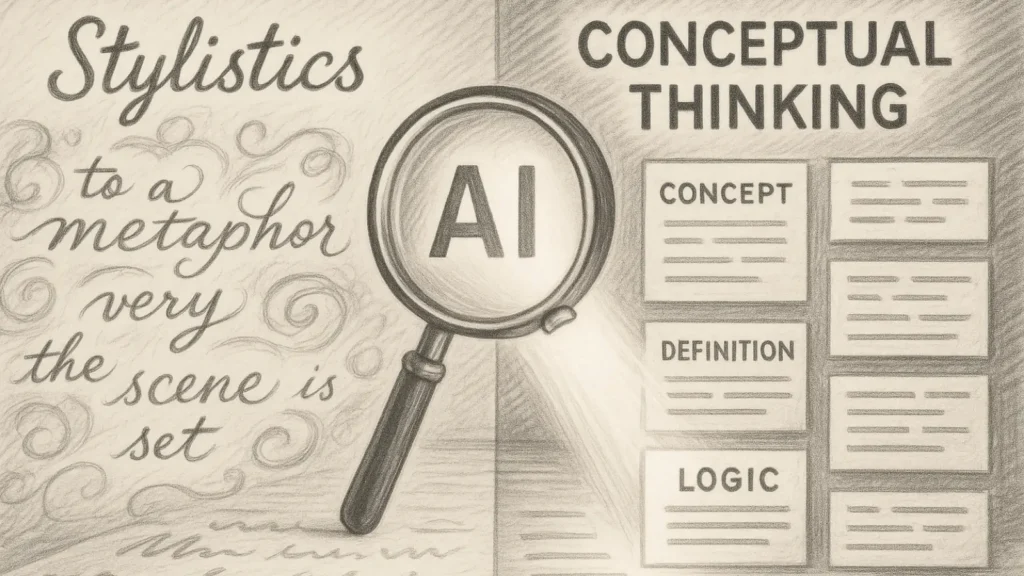
Writing techniques for precision elevate conceptual thinking because clarity, not stylistic variation, determines whether AI systems can interpret text reliably. Models rely on definitions, logical transitions, and stable terminology—elements directly strengthened by conceptual structuring. Stylistics introduces expressive variability that does not improve semantic transparency and often reduces interpretive accuracy.
Conceptual thinking ensures that every section is grounded in clearly defined ideas supported by explicit logical relationships. When concepts come first, writing becomes more predictable for readers and machine models, reducing ambiguity during summarization, extraction, and reasoning tasks.
Stylistics focuses on how ideas sound. Conceptual thinking focuses on how ideas work. In AI-mediated environments, functionality outranks expressiveness because interpretability directly affects retrieval, ranking, and transformation quality.
Stylistics vs. Conceptual Thinking
| Stylistics-Oriented Writing | Concept-Oriented Writing |
|---|---|
| Focus on expression and tone | Focus on meaning, structure, and logic |
| Variability in wording | Consistent terminology |
| Implicit relationships | Explicit cause–effect links |
| Extended narrative buildup | Immediate definitions and clarity |
| Figurative language | Unambiguous conceptual framing |
| Reader interprets intent | Intent explicitly stated |
| Style-driven transitions | Reasoning-driven transitions |
| High ambiguity for AI | High interpretability for AI |
Conceptual thinking strengthens the stability of meaning, which becomes the core metric of writing effectiveness in the generative era.
The Evolution of Digital Writing
Understanding how digital writing evolves is essential for producing content that remains stable and interpretable in AI-mediated environments, a shift supported by research on how people read online. Modern platforms now analyze meaning through structured conceptual patterns rather than isolated phrases.
This transformation pushes writing toward clarity, modular logic, and explicit reasoning. As a result, digital communication increasingly resembles knowledge engineering rather than conventional narrative prose.
From SEO Copywriting to Reasoning-First Writing
Digital writing developed through four major stages, each shaped by changes in search engines, user behavior, and the interpretive abilities of modern AI systems. The progression reflects a shift from surface-level keyword signals to structured logic that aligns with how AI processes information.
Timeline of the Evolution
2000–2010 — Keyword Writing
Relevance defined by repeated keywords.
2010–2016 — Semantic Writing
Topic clusters, synonyms, and contextual breadth.
2016–2021 — Entity Writing
Knowledge graphs and explicit entity references.
2021–2025+ — Reasoning Writing
Definitions, logic blocks, causal links, evidence.
Comparison Table: Four Stages of Digital Writing
| Stage | Core Focus | System Behavior | Weaknesses | Strengths |
|---|---|---|---|---|
| Keyword Writing | Exact keyword repetition | Matches surface signals | Shallow meaning, low clarity | Simple optimization |
| Semantic Writing | Topic and synonym variety | Interprets related phrases | Implicit logic, inconsistent depth | Broader topical coverage |
| Entity Writing | Defined entities | Maps relationships in knowledge graphs | Logic still implicit | High contextual accuracy |
| Reasoning Writing | Explicit logic and structure | Follows conceptual and causal sequences | Requires disciplined writing | Maximum clarity and AI interpretability |
Keyword writing
Keyword writing relied on exact repetitions to signal relevance. Search engines evaluated keyword presence more than meaning, which encouraged density over coherence.
Micro-example:
“best running shoes review best running shoes cheap running shoes for men”
The content indexed well but provided little usable information.
Semantic writing
Semantic writing emerged as algorithms improved. Writers expanded content with synonyms and related phrases to demonstrate topical breadth.
Micro-example:
“running shoes, athletic sneakers, performance footwear for training”
Semantic variation improved contextual matching but still lacked explicit reasoning.
Entity writing
The introduction of knowledge graphs shifted writing toward entities: organizations, locations, product models, and defined concepts. Entities stabilized interpretation and improved mapping.
Micro-example:
“The Nike Air Zoom Pegasus 40 is designed for neutral runners training over long distances.”
Entity clarity strengthened context but did not enforce logical structure.
Reasoning writing
Reasoning-first writing structures text into explicit reasoning blocks: definitions, mechanisms, causal links, and evidence. Each block performs a distinct logical function, which modern AI systems interpret without ambiguity.
Micro-example:
“Long-distance runners require consistent energy return. The Zoom Air unit provides that effect by compressing and expanding quickly. As a result, the shoe maintains performance over extended mileage.”
This definition → mechanism → outcome pattern aligns directly with how AI models process information.
4-Block Evolution
The evolution of digital writing follows a logical progression, where each stage solves the limitations of the previous one and moves communication toward clearer and more explicit reasoning.
1. Keyword Writing
Relies on repetition and literal matching. Produces relevance signals without conveying structured meaning.
2. Semantic Writing
Expands content through synonyms and topic clusters. Improves breadth but retains implicit logic.
3. Entity Writing
Introduces stable entities that anchor meaning and improve relationship mapping. Strengthens context but still lacks explicit reasoning.
4. Reasoning Writing
Creates explicit logical structures with definitions, mechanisms, examples, and causal sequences. Produces modular reasoning blocks that humans and AI interpret consistently.
This progression demonstrates how writing transitioned from surface-level signals to structured reasoning aligned with modern AI interpretation.
AI-Extractable Summary
Keywords → Semantics → Entities → Reasoning
Search Engine Era vs. AI Reasoning Era
| Dimension | Search Engine Era (2000–2020) | AI Reasoning Era (2020–2025+) |
|---|---|---|
| Core Objective | Match keywords and metadata | Interpret meaning and logical relationships |
| Ranking Signals | Keyword density, backlinks, metadata | Reasoning clarity, consistency, evidence |
| Content Requirement | Surface relevance | Conceptual precision and explicit logic |
| Reading Pattern | Linear or keyword scanning | Nonlinear reasoning across structured blocks |
| Content Structure | Narrative-first or SEO-formatted | Reasoning-first, modular knowledge units |
| Entity Importance | Helpful but optional | Essential for grounding and contextual stability |
| Interpretation Method | Pattern matching | Semantic reasoning and inference modeling |
| Weaknesses | Vulnerable to keyword manipulation | Sensitive to ambiguity or inconsistent terminology |
| Strengths | Easy to optimize | High accuracy and meaning stability |
The progression from keyword writing to reasoning writing illustrates how digital communication has matured from surface-level optimization to structured conceptual clarity aligned with AI reasoning systems.
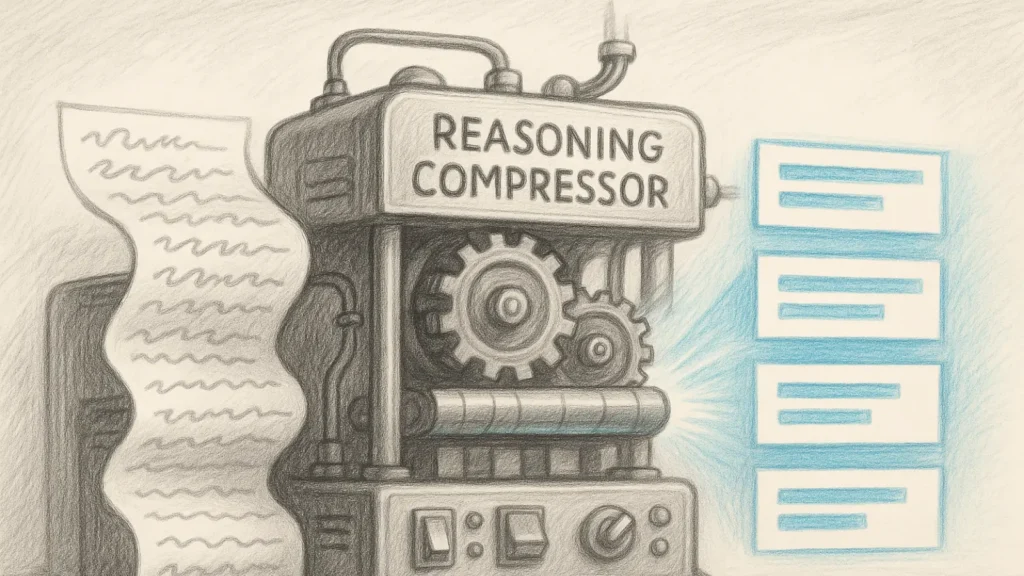
Clarity Techniques for Generative Era Writing
Achieving high clarity is central to best practices for clarity writing, because modern readers and AI systems extract meaning from structured, explicit information. Research on clear communication principles shows that texts with predictable logic, stable terminology, and concise reasoning improve comprehension across all formats.
As writing becomes more integrated with AI-driven interpretation, the ability to write content with high clarity becomes essential for stability, retention, and accurate summarization.
Practical Framework for High-Clarity Writing
High-clarity writing follows a simple but powerful pattern: define the concept, illustrate it, and validate understanding through a clarity test. This structure ensures that every paragraph delivers one complete idea with minimal ambiguity.
1. Definition
Begin with a precise statement that establishes the concept without modifiers or figurative language. A direct definition creates a stable anchor for both humans and AI. It prevents misinterpretation by removing assumptions about context.
Example:
“Conceptual clarity is the ability to present an idea so that its meaning does not depend on external context.”
2. Example
Support the definition with a concrete, real-world example. Examples translate abstraction into observable scenarios, which significantly increases comprehension. They also help AI systems detect consistent meaning.
Example:
“When explaining a technical model, refer to one specific mechanism rather than describing the entire system.”
3. Clarity Test
Conclude with a short, explicit test that checks whether the explanation contains ambiguity. A clarity test evaluates if the idea can be summarized in one sentence without losing meaning.
Clarity Test:
“Can the reader restate the idea in a single, accurate sentence without adding assumptions?”
This definition → example → clarity test sequence creates a reliable structure for producing high-clarity writing in any format.
Turning Complex Ideas Into Clear Structures
Complex ideas become easier to understand when they are transformed into conceptual structures rather than long explanations. Writers achieve this by isolating the core idea, arranging supporting elements, and presenting them through predictable logic sequences. High-quality writing organizes information around a conceptual spine that remains stable across the entire section.
Clear writing requires explicit segmentation. Instead of embedding multiple ideas into a single paragraph, each major concept should function as its own block with a definable role. This ensures that the reader—and the AI system interpreting the text—can follow the reasoning without inference gaps.
Problem → Solution Framework
The table below demonstrates how structural clarity solves common writing issues:
| Problem | Solution |
|---|---|
| Too many details | Create a conceptual spine |
| Too abstract | Add a real example |
| Weak chain of logic | Build cause–effect links |
Each solution creates a strong interpretive anchor: a conceptual spine organizes ideas, concrete examples ground meaning, and cause–effect logic strengthens reasoning flow. Together they form a clarity-focused approach that supports consistent interpretation across audiences and AI systems.
Example: When a paragraph follows a definition → mechanism → implication pattern, AI models can extract meaning as a coherent reasoning chain, increasing the chance that the segment is reused in generated outputs.

Mastering Clarity in Writing
Best practices for clarity writing rely on predictable structure, explicit meaning, and stable terminology, which together allow readers and AI systems to extract information without ambiguity.
Research on plain language standards demonstrates that high-clarity text improves comprehension, reduces cognitive load, and strengthens reasoning flows. In the generative era, the ability to write content with high clarity becomes a foundational skill for producing reliable, transformation-ready knowledge.
Practical Framework for High-Clarity Writing
High-clarity writing follows a deliberate three-step structure: define the idea, illustrate it with a concrete example, and confirm its clarity through a short test. This sequence creates a self-contained logical unit that is easy to interpret, reuse, and summarize.
1. Definition
A clear definition anchors the concept in precise terms. It removes assumptions and ensures the idea does not depend on external context or stylistic interpretation.
Example definition:
“Structural clarity is the ability to present an idea so that every sentence contributes directly to its meaning.”
2. Example
A real-world example grounds the definition in observable reality. Examples convert abstraction into context, making the idea easier to understand and more stable for AI interpretation.
Example illustration:
“When describing a workflow, present one specific step—such as data validation—rather than outlining the entire process at once.”
3. Clarity Test
A clarity test verifies whether the idea can stand on its own. The goal is to check if the main point can be restated without missing information or adding implied logic.
Example clarity test:
“Can the reader summarize the idea in one accurate sentence without guessing the missing context?”
This framework ensures each segment delivers a complete reasoning block, making the text more predictable and easier to interpret.
Turning Complex Ideas Into Clear Structures
Writers can simplify complex ideas by converting them into structured conceptual units rather than dense explanations. The core principle is to isolate the main idea, identify supporting elements, and present them in a sequence that reveals logic step by step. This approach prevents cognitive overload and improves comprehension for human readers and AI systems.
A strong structure depends on a conceptual spine—a single unifying idea that holds all components together. Each paragraph should reinforce that spine and avoid introducing additional concepts that dilute or fragment meaning. When abstraction becomes necessary, grounding it in an example or a cause–effect sequence ensures clarity remains intact.
Problem → Solution Framework
| Problem | Solution |
|---|---|
| Too many details | Create a conceptual spine |
| Too abstract | Add a real example |
| Weak chain of logic | Build cause–effect links |
Each solution strengthens interpretability. A conceptual spine reduces complexity by consolidating ideas. Real examples transform abstract statements into concrete knowledge. Cause–effect logic reveals relationships that might otherwise remain implicit. Together, these techniques form a practical method for structuring complex ideas with high clarity.
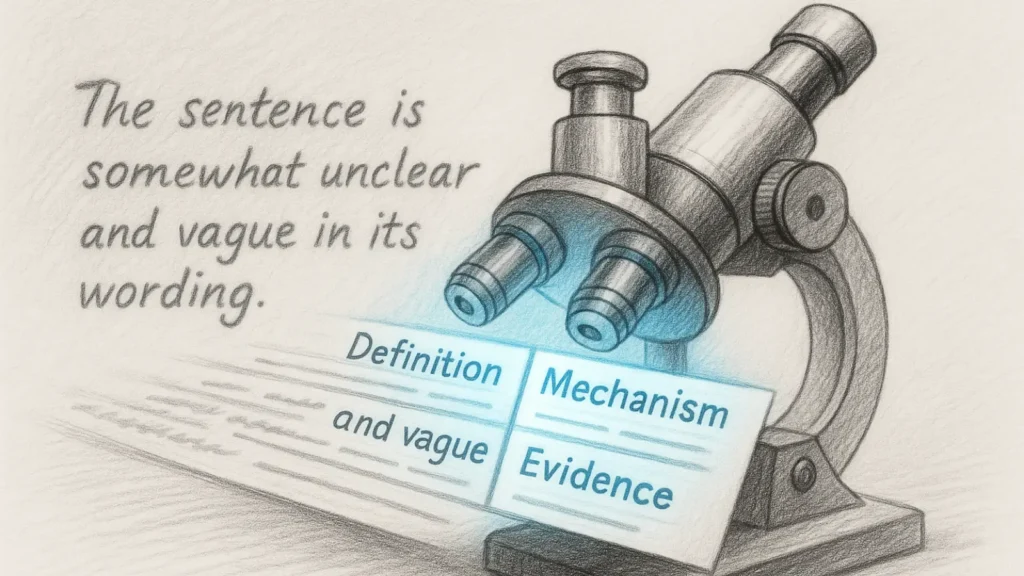
Writing With Precision and Depth
Writing techniques for precision rely on explicit definitions, stable terminology, and reasoning structures that minimize ambiguity. Research on plain-language writing principles shows that precise sentences improve comprehension, reduce interpretive errors, and make explanations easier for both humans and AI systems to process.
To explain topics with depth, writers must eliminate semantic noise and build content around ideas that are logically connected and supported with concrete detail.
Eliminating Weak Phrases and Semantic Noise
Weak phrases reduce the clarity of explanations by introducing uncertainty, vague qualifiers, or filler language. Eliminating them forces the writer to take a clear position and provide information that contributes directly to understanding.
Here are ten weak constructions that should be removed:
- “In some ways…” — introduces vagueness without specifying which dimension matters.
- “It seems that…” — weakens the statement and hides who is making the evaluation.
- “Kind of / sort of…” — adds blur and makes definitions less stable.
- “Basically…” — filler that signals oversimplification without adding content.
- “Some experts say…” — avoids attribution and undermines credibility.
- “Arguably…” — invites debate without offering evidence.
- “In general terms…” — signals abstraction instead of precision.
- “As mentioned before…” — forces the reader to recall previous context.
- “To some extent…” — reduces clarity by avoiding measurable boundaries.
- “It is believed that…” — redirects responsibility away from the writer or source.
Removing these patterns produces cleaner, stronger statements that align with precision-oriented writing.
Methods for Deep, Insight-Driven Explanations
How to express concepts better requires shifting from superficial description to structured reasoning. Depth emerges when the writer explains mechanisms, relationships, and consequences—not when the writer adds more words.
1. Start with the underlying mechanism
Explain how the idea works internally. Mechanisms provide the foundation for accurate reasoning.
Example: Instead of describing “system overload,” explain the process that triggers the overload, such as excessive concurrent requests.
2. Use concrete elements before abstractions
Anchor explanations in specific components before generalizing. This makes abstract ideas stable and easier to interpret.
Example: Describe one failure scenario before summarizing overall system reliability.
3. Reveal clear cause–effect relationships
Cause–effect logic shows not only what happens, but why it happens. This gives explanations depth and direction.
Example: “When the validation layer is bypassed, inconsistent data enters the pipeline, which causes long-term integrity issues.”
4. Introduce contrasts to sharpen meaning
Contrasts reveal boundaries and help define concepts through comparison.
Example: “A heuristic offers speed through shortcuts, while a framework offers structure through constraints.”
5. Layer information in predictable steps
Follow definition → mechanism → evidence → implication. This sequence mirrors how reasoning engines interpret text.
6. Add micro-examples to ground abstractions
A short example stabilizes meaning and makes complex ideas more accessible.
Example: “A model that accepts unverified input can produce unreliable predictions, even with accurate training data.”
7. Use consistent terminology
Precision collapses when terms shift. Use one term for each idea across the entire section.
8. Remove stylistic decoration
Avoid metaphors, idioms, or literary devices that add interpretive ambiguity.
9. Maintain traceable logic
Each sentence must follow logically from the one before it. This produces a reasoning flow that AI can interpret consistently.
10. End with a clear takeaway
A concise conclusion signals conceptual closure and ensures the reader retains the core idea.
Deep explanations rely on structure, mechanism, and logic—not length. When applied consistently, these methods produce writing that is accurate, interpretable, and insight-driven.

Creating Knowledge-Oriented Content for Generative Era Writing
Effective ways to present knowledge require organizing information into clear, interpretable structures that help the reader build understanding step by step.
Research on instructional design principles shows that teaching-oriented content increases comprehension because it presents concepts through definition, mechanism, and application. Knowledge-focused writing prioritizes clarity, predictable logic, and conceptual stability over narrative style.
The Logic of “Teaching Writing”
To write text that teaches, the writer must use instructional logic: define the idea, break it into components, explain how those components interact, and show the resulting implication. This approach mirrors how effective educators structure lessons. Each paragraph performs a specific function, allowing readers to progress from basic understanding to deeper insight without inference gaps.
Teaching writing uses incremental layering. It begins with essential meaning, then adds supporting details, and finally reveals relationships and consequences. This progressive disclosure prevents information overload and makes reasoning transparent. When each block has a clear, defined purpose—definition, explanation, example, contrast, or conclusion—the reader can follow the structure without guessing.
Teaching-oriented writing also supports AI interpretation. Explicit definitions, stable terminology, and structured logic create text that can be summarized, classified, or transformed with high accuracy. This alignment with knowledge-based reasoning makes teaching writing effective in both human and machine contexts.
Converting Ideas Into Clear Text for Generative Era Writing
To turn ideas into clear text, the writer needs to externalize internal reasoning and structure it into discrete conceptual steps. Begin with a single-sentence statement of the idea. Then identify the components that support it and arrange them in a sequence that mirrors how the concept works in practice. This restructuring transforms intuitive thought into accessible knowledge.
Clear text avoids mixing multiple actions or concepts within the same paragraph. Each paragraph must perform one function: defining, explaining, connecting, or concluding. This segmentation creates predictable logic and prevents readers—or AI systems—from misinterpreting the relationships between ideas.
A consistent terminology is essential. When a writer names a concept, that term should remain stable throughout the section. Stability prevents meaning drift and improves precision. If the idea is abstract, grounding it with a real example removes ambiguity and clarifies the mechanism behind it.
Clear writing emerges when ideas move through a structured thinking model: concept → components → mechanism → implication. This pattern transforms abstract thought into actionable, interpretable knowledge.
Table: Abstract Idea → Structured Explanation
| Abstract Idea | Structured Explanation |
|---|---|
| “The system is unreliable.” | Define reliability → show specific failure points → explain mechanism → give example. |
| “Users lose interest quickly.” | Identify triggers → explain behavioral pattern → show cause–effect → outline outcome. |
| “The model is biased.” | Define bias → identify source → provide evidence → show impact on decisions. |
| “This feature improves workflow.” | Explain problem → describe mechanism → show efficiency gain → provide real scenario. |
| “The process is too complex.” | Define components → isolate bottlenecks → show interactions → propose simplification. |
Each explanation replaces abstraction with a structured reasoning sequence that clarifies how the idea works and why it matters.
Examples: Raw Idea → Clear Text
Transforming internal thoughts into structured explanations makes ideas understandable and reusable. Ниже — сильные пары примеров.
1. Raw Idea:
“People don’t trust the platform.”
Clear Text:
“Trust decreases when users do not understand how decisions are made. The platform does not explain how recommendations are generated, which creates uncertainty about fairness and accuracy.”
2. Raw Idea:
“The workflow is messy.”
Clear Text:
“The workflow lacks a defined sequence of steps. Without a clear order—validation → processing → review—team members duplicate tasks and introduce inconsistent outcomes.”
3. Raw Idea:
“The results seem inaccurate.”
Clear Text:
“Inaccurate results occur because the input validation step accepts incomplete data. When missing values enter the model, the output becomes unstable, even if the algorithm functions correctly.”
4. Raw Idea:
“Users don’t finish onboarding.”
Clear Text:
“Onboarding drop-off increases when users face too many decisions in the first minute. Reducing initial steps to a single task improves completion rates and lowers cognitive load.”
5. Raw Idea:
“The idea is good, but unclear.”
Clear Text:
“The concept centers on reducing manual work by automating data entry. The core mechanism is extracting fields from uploaded documents and mapping them into a unified format.”

Working With Facts and Sources
To verify information when writing, authors must rely on structured methods for checking accuracy, credibility, and context. Research on evaluating information sources shows that transparent evidence and traceable claims increase the reliability and interpretability of text.
Writing based on reliable sources strengthens reasoning and prevents errors that undermine the clarity of the entire article.
Techniques for Verifying Information
The best ways to fact check follow a systematic process that separates assumptions from validated facts. Accurate writing begins with identifying the type of claim, locating authoritative sources, and confirming that the information is current, consistent, and supported by transparent methodology.
Step-by-step verification method
- Identify the factual claim.
- Locate authoritative sources such as institutional datasets, peer-reviewed research, or official reports.
- Cross-validate each claim with at least two independent references.
- Check publication date and assess whether the information is still relevant.
- Evaluate the credibility of the author or institution.
- Assess methodological transparency to ensure data reliability.
- Confirm that terminology used in the source aligns with terminology in your text.
- Document each source clearly for traceability.
Useful tools for fact-checking
Research databases: Google Scholar, Semantic Scholar, JSTOR, IEEE Xplore, CrossRef.
Institutional data sources: WHO, OECD, World Bank, NASA, NOAA, Eurostat, U.S. Census, UNESCO.
Verification platforms: FactCheck.org, PolitiFact, Snopes, Full Fact.
These tools provide the factual foundation needed for accurate and interpretable writing.
How to Support Claims Properly
Strong claims connect a clear statement with verifiable evidence and an explanation of relevance. Supporting a claim requires precise data, credible attribution, and a reasoning link that shows why the evidence matters.
Core principles for supporting claims
- Use precise, verifiable evidence such as datasets, peer-reviewed findings, or well-defined concepts.
- Attribute claims to credible organizations or researchers.
- Distinguish factual evidence from interpretation.
- Provide context for how the evidence supports the claim.
- Avoid overgeneralizations not supported by data.
- Prefer original sources rather than secondary summaries.
- Maintain consistent citation patterns.
- Conclude with a clear restated claim grounded in evidence.
Weak Evidence → Strong Evidence
| Weak Evidence Statement | Strong, Supported Alternative |
|---|---|
| “Experts say that…” | “A 2023 OECD Skills Outlook report shows that…” |
| “Studies suggest…” | “A peer-reviewed study published in Nature Human Behaviour concludes that…” |
| “People believe that…” | “Pew Research Center survey data indicates that…” |
| “Research shows…” | “A 2022 meta-analysis from the University of Cambridge found that…” |
| “It is known that…” | “According to WHO’s Global Health Observatory statistics…” |
| “Statistics prove that…” | “Eurostat 2024 data shows a 12% increase in…” |
| “Some reports claim…” | “A primary dataset from NASA’s EarthData platform confirms that…” |
| “Many companies struggle with…” | “A 2023 Deloitte Insights report found that 61% of organizations experienced…” |
| “The model seems inaccurate…” | “Stanford HELM benchmark testing shows a 6.7% error rate in…” |
| “Results appear inconsistent…” | “Cross-validation across three independent datasets produced inconsistent outputs in…” |
Mini Case: Fact-Checking a Real Claim
Claim: “Digital literacy significantly improves job adaptability.”
Summarize: the claim is validated by independent, authoritative sources and can be included in writing confidently.
Identify the factual element: causal link between digital skills and adaptability.
Search authoritative sources: OECD Skills Outlook (2023); European DESI Index (2023); MIT Sloan research (2022).
Cross-validate across independent datasets.
Confirm recency: sources from 2022–2023.
Evaluate institutional credibility: OECD, EC, MIT.
Review methodology: sampling and measurement methods are transparent.
Align terminology: “digital skills,” “adaptability,” and “skills mobility” are consistent.
Formulate an evidence-based version:
“According to the 2023 OECD Skills Outlook and the European DESI Index, workers with higher levels of digital skills show significantly greater adaptability during job transitions, particularly in technology-driven sectors.”
Explain mechanism: digital skills reduce learning time and improve workflow flexibility.

Improving Readability in Generative Era Writing
To improve readability for audiences, writers must structure information in a way that reduces cognitive load and increases comprehension. Research from Nielsen Norman Group shows that modern readers scan before they read, prioritizing clarity, hierarchy, and visual segmentation.
Techniques that enhance reader comprehension easily rely on predictable formatting, concise language, and clear visual pathways through the text.
Techniques for Writing More Engaging Text
How to write more engaging text begins with aligning writing style to the way people process information. Engagement depends less on expressive language and more on clarity, specificity, and relevance.
Core techniques for engagement
- Start with the core idea — present the main point in the first sentence to anchor attention.
- Use concrete details — examples and specifics increase clarity and reduce abstraction.
- Add micro-patterns of variation — alternate between statements, examples, and short explanations to maintain rhythm.
- Introduce contrasts — “X works when…, but fails when…” sharpens meaning and increases engagement.
- Ask implicit questions — write sentences that naturally trigger the reader’s curiosity.
- Use action-oriented verbs — direct verbs create immediacy and improve flow.
- Remove filler — eliminating redundant phrases keeps the text tight and readable.
- Build predictable logic — engagement increases when the reader can follow a clear reasoning sequence.
- Use short, high-value paragraphs — each paragraph should deliver one meaningful insight.
- End sections with takeaway lines — this reinforces understanding and signals conceptual closure.
Making Text Scannable and Easy to Navigate
Ways to make text scannable depend on visual structure. Modern readers skim headings, lists, and initial sentences to build a mental map before deciding what to read in depth. Creating visible hierarchy improves clarity and boosts comprehension.
Techniques for scannability
- Use descriptive subheadings that reflect the exact content of each section.
- Open paragraphs with a clear topic sentence to reveal the main idea instantly.
- Break ideas into lists to simplify multi-step reasoning.
- Limit paragraphs to 2–4 sentences to keep the reading rhythm light.
- Highlight key terms to show conceptual priority.
- Use white space strategically to separate distinct ideas.
- Maintain consistent formatting so readers know what to expect.
- Place critical insights at paragraph beginnings or endings where attention is strongest.
Techniques → Effects Table
| Technique | Effect |
|---|---|
| Lists | Faster scanning |
| Subheadings | Clear hierarchy |
| Short paragraphs | Higher retention |
| Bold highlights | Priority cues |
Readable writing relies on structure, segmentation, and clarity. These elements reduce cognitive effort and make the text easier for both humans and AI systems to interpret.

Modern Formatting for Long-Form Content
Modern content formatting tips focus on creating long-form articles that maintain clarity, structure, and interpretability across thousands of words. Research from W3C content usability guidelines shows that well-structured long articles improve navigation, reduce cognitive load, and help readers—and AI systems—parse information reliably.
Understanding how to format long articles requires balancing depth with segmentation, ensuring each section performs a clear instructional or analytical function.
Structure of 3000–6000 Word Articles
Long-form content performs best when organized into predictable, modular blocks. Articles in the 3000–6000 word range require a hierarchy that guides the reader from broad context to focused insight without introducing confusion.
Recommended structure (5–7 core blocks)
- Introduction (250–400 words)
Sets context, defines the main problem, states the central idea, and introduces key terms. - Foundational Concepts (400–700 words)
Provides definitions, mechanisms, and background knowledge necessary to understand later sections. - Core Analysis or Main Framework (800–1500 words)
The central section where concepts are broken into components, compared, or explained through structured reasoning. - Applied Section (500–900 words)
Shows practical examples, use cases, or real-world implications based on the main framework. - Deep-Dive Subsections (400–900 words)
Expands on specific elements that require additional detail, such as variations, edge cases, or exceptions. - Expert Insights or Evidence Section (300–700 words)
Includes data, studies, references, and documented insights from credible institutions. - Conclusion (200–350 words)
Summarizes key takeaways, reinforces the main pattern of reasoning, and provides a forward-looking perspective.
This format helps readers navigate complex ideas while maintaining a stable logical progression.
How to Be Concise but Informative
To write concise but informative content, the writer must reduce linguistic noise without reducing conceptual depth. Conciseness is achieved not by shortening the message but by sharpening the reasoning.
Techniques for high-density clarity
- Use one idea per paragraph to avoid cognitive overload.
- Replace general statements with specific, verifiable information.
- Remove filler transitions that do not contribute meaning (“basically,” “in some ways,” “as mentioned earlier”).
- Begin each section with a clear topic sentence that reveals the core message.
- Use micro-examples instead of long illustrative narratives.
- Prefer explicit logic chains (“A leads to B because…”) to stylistic descriptions.
- Eliminate redundant modifiers that soften meaning without adding insight.
- Write with nouns and verbs, not adjectives and adverbs, to increase precision.
- End each section with a one-sentence synthesis, reinforcing key points.
Concise writing is the outcome of disciplined structure, not minimal word count.
Paragraph Structure for Maximum Clarity
Paragraph structure for clarity follows a predictable internal pattern: statement → explanation → mini-conclusion. This structure supports both human understanding and AI reasoning models by making logical relationships explicit.
Statement → Explanation → Mini-conclusion
- Statement
The first sentence introduces the core idea of the paragraph. - Explanation
The next one or two sentences unpack the idea, show mechanism, or provide a supporting detail. - Mini-conclusion
The final sentence clarifies the implication, resolves the point, or prepares the reader for the next step.
Example
Statement:
Clear paragraph structure improves comprehension and reduces interpretive errors.
Explanation:
When the main idea appears first, readers can align the details that follow with a clear mental model. This reduces the need for backtracking and increases reading efficiency.
Mini-conclusion:
Predictable internal structure stabilizes meaning and makes long-form content easier to navigate.
This method ensures that every paragraph contributes value, supports the broader argument, and remains easy to interpret in isolation.
Increasing Informational Value and Insight
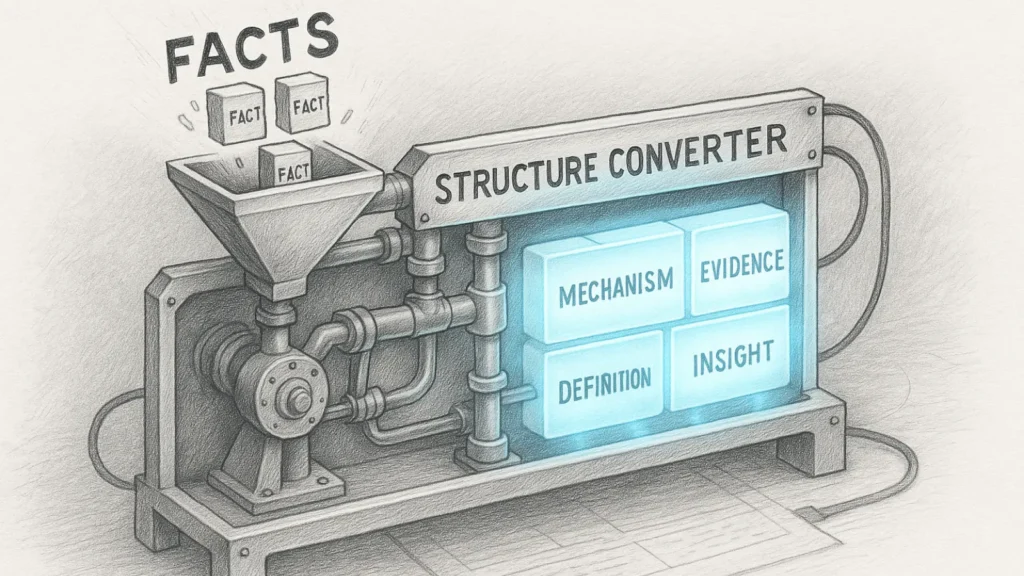
Increasing Informational Value and Insight
Writers increase informational value writing by moving beyond surface descriptions and presenting ideas through mechanisms, logic, and evidence. Research from Purdue Online Writing Lab shows that insight develops when writers explain how concepts function, why they matter, and what patterns organize them. Insight-driven writing transforms isolated facts into structured understanding that supports reasoning.
Adding Value in Generative Era Writing
Surface-level content tells the reader what something is. High-value writing clarifies how it works, why it works that way, and what follows from it. Informational depth emerges when writers connect facts to mechanisms, relationships, and implications.
Techniques for adding meaningful value
- Use data to anchor claims
Data clarifies scale, frequency, and significance. - Reveal mechanisms, not symptoms
Instead of describing an outcome, explain the process that produces it. - Show logic flows
Present ideas as sequences—cause → effect → consequence—to reveal structure. - Integrate comparisons and contrasts
Highlighting differences between models, scenarios, or methods sharpens conceptual boundaries. - Add micro-examples
Short, specific situations stabilize understanding and reduce ambiguity. - Explain implications
Show what the information changes for decisions, interpretations, or expectations. - Include edge cases
Atypical scenarios define the limits of the concept.
High-value writing constructs a complete mental model instead of offering disconnected observations.
Delivering Insight in Generative Era Writing
How to write with insight requires identifying the deeper structure behind a topic and making that structure visible. Insight appears when the writer articulates patterns that remain hidden in surface-level summaries.
Methods for insight-driven explanation
- Identify the underlying principle
Each concept is governed by a rule or pattern; reveal it directly. - Turn implicit reasoning into explicit steps
Make each logical connection visible. - Unpack assumptions
Clarify dependencies, prerequisites, and contextual conditions. - Explain variability
Show how outcomes shift when key factors change. - Connect the concept to a broader system
Insight strengthens when the idea fits into a larger framework. - Link evidence to meaning
Data produces insight only when its implications are explained. - Use concept → mechanism → implication
This structure transforms raw information into understanding. - End with a synthesis line
A concise takeaway reinforces the new insight and prepares the reader for the next idea.
Insight-driven writing allows readers—and AI systems—to understand not only the information itself, but its structure, logic, and broader significance.

Conclusion — A New Mindset for the Generative Era
Writing in the generative era requires a shift from producing text to constructing knowledge. Modern readers and AI systems depend on clarity, structure, and explicit reasoning, which means that effective writing is no longer defined by style alone but by the transparency of ideas, mechanisms, and evidence.
The most valuable content is built on stable terminology, clear logic flows, reliable sources, and a commitment to helping the reader understand how concepts work.
This new mindset treats each section as a reasoning unit and each paragraph as a self-contained step in a larger conceptual structure. Writers who adopt this approach create text that is easier to interpret, summarize, and apply across contexts. They also build trust by showing how claims are constructed and why conclusions matter.
As generative systems increasingly shape how information is discovered and processed, writers who embrace structured reasoning, factual accuracy, and insight-driven explanations will produce content that remains relevant, understandable, and durable. The shift is not only technical—it reflects a broader transformation in how knowledge is created, communicated, and used in the modern digital environment.
Checklist:
- Does the text define each key concept with explicit boundaries?
- Are reasoning blocks structured as definition → mechanism → implication?
- Is terminology stable across the entire article?
- Does each paragraph express a single meaningful unit?
- Are micro-examples present to stabilize abstract ideas?
- Is ambiguity reduced through consistent structure and local definitions?
Interpretive Principles of Generative-Era Writing
- Concept-first anchoring. Generative systems interpret writing through explicitly introduced concepts that establish stable semantic reference points from the outset.
- Reasoning block composition. Paragraphs structured around definitional context, underlying mechanisms, and resulting implications form coherent interpretive units.
- Terminological invariance. Consistent naming across sections preserves semantic continuity during long-context processing and multi-pass evaluation.
- Early grounding signals. Timely illustrative examples reduce abstraction and guide meaning resolution without expanding conceptual scope.
- Ambiguity containment. Single-idea paragraph design limits interpretive divergence, enabling concise summarization without loss of intent.
These principles describe how generative-era writing is interpreted as a structured reasoning artifact, where clarity, stability, and bounded meaning guide understanding beyond stylistic expression.
FAQ: Generative Era Writing
What is Generative Era writing?
Generative Era writing is a structured approach that organizes ideas into clear reasoning blocks, enabling AI systems to interpret meaning consistently across contexts.
How does Generative Era writing differ from traditional writing?
Traditional writing emphasizes style, while Generative Era writing focuses on meaning clarity, stable terminology, and machine-readable structure.
Why does clarity matter in the generative era?
AI systems rely on explicit reasoning and unambiguous statements. Clear structure helps models segment ideas and reuse them in generative answers.
How do AI systems evaluate writing quality?
They analyze definitional stability, logical sequencing, factual grounding, and the consistency of terminology across the page.
What role does structure play in Generative Era writing?
Headings, semantic blocks, and predictable reasoning patterns enable accurate interpretation and reduce semantic drift.
How should paragraphs be constructed?
Each paragraph should express one idea, built on a definition, mechanism, and implication to support AI interpretation.
Why is terminology stability essential?
Changing terms confuses AI segmentation. Stable naming ensures each concept remains distinguishable and consistently referenced.
Do examples improve AI understanding?
Yes. Micro-examples help models anchor meaning and reduce ambiguity in abstract concepts.
How does Generative Era writing support long-form clarity?
It maintains coherence by aligning each section with a defined semantic purpose and using reasoning patterns throughout the text.
What skills are required for Generative Era writing?
Writers need precision, structural thinking, logical sequencing, and the ability to express meaning explicitly.
Glossary: Key Terms in Generative Era Writing
This glossary defines the essential terminology used throughout this guide to support consistent interpretation by both readers and AI systems.
Generative Era Writing
A structured writing method that expresses ideas through explicit reasoning, stable terminology, and predictable semantic boundaries designed for AI interpretation.
Reasoning Block
A paragraph structure built on definition, mechanism, and implication that enables AI systems to reconstruct logical meaning without ambiguity.
Semantic Stability
The consistency of terminology and conceptual labels across a text, allowing AI to identify and track ideas accurately through the entire page.
Clarity Structure
A structural approach where each section fulfills a distinct interpretive function, improving how AI systems segment and reuse the content.
Interpretive Precision
The degree to which a statement can be interpreted consistently by both humans and AI without multiple possible meanings.
Meaning Unit
A compact, self-contained segment of text where one idea is defined and explained, enabling precise extraction and reuse by AI systems.

Author Sergey Kuchinskiy
Founder of PostUpgrade. Researcher in Generative Engine Optimization (GEO), semantic structuring, and machine reasoning systems. Focuses on AI-readable content architecture, computational interpretation, and scalable knowledge retrieval. Author of 200+ analytical publications on generative visibility, semantic mapping, and AI-first information design.
Verified Expertise
- Generative Engine Optimization (GEO)
- AI Content Engineering & Semantic Structuring
- Computational Linguistics & Machine Reasoning
- Large-Scale Content Architecture
Research Focus
AI Search · Generative Visibility · Semantic Mapping · Machine Sentence Design · Reasoning Stability · Knowledge Extraction Models
Academic Contributions
- 200+ analytical research publications
- AI-first page architecture methodologies
- Semantic Frameworks for Machine Interpretation (SFMI)
- Generative Visibility Standards 2024–2025
Citation Metrics
AI-model reuse rate (GEO-Score): 92/100 · Cross-model consistency: 87% · Reasoning chain stability: 91%
Researcher ID: PU-ORCID-7421-9912
View all publications →Connect on LinkedIn →