Last Updated on February 22, 2026 by PostUpgrade
Structured Data Knowledge Context: Using Structured Data to Build Knowledge Context
Structured data knowledge context defines how entities, attributes, and relationships are encoded to support machine interpretation. This article explains how structured data knowledge context improves AI comprehension, generative visibility, and long-term semantic stability. The structure follows enterprise AI-first principles, including deep reasoning chains, semantic containers, and reproducible workflows. The scope includes entity modeling, validation systems, governance frameworks, and measurable visibility outcomes.
Digital systems no longer interpret content primarily through keyword frequency. Instead, they construct internal graphs based on entity relationships and validated attributes. Therefore, knowledge context must be engineered rather than assumed. Consequently, structured encoding becomes a strategic infrastructure decision rather than a formatting choice.
Generative engines extract structured meaning blocks and reuse them across responses. As a result, semantic clarity directly influences visibility in AI summaries, search panels, and answer synthesis systems. If contextual encoding remains inconsistent, interpretive fragmentation increases. Therefore, this article establishes a deterministic model for building structured knowledge context at enterprise scale.
The architectural approach presented here integrates entity modeling, semantic relationship encoding, contextual layering, validation protocols, and governance controls. Each component operates as a reusable semantic module. Together, these modules form a machine-interpretable architecture that aligns with AI-first indexing logic. This framework enables scalable semantic stability across large content ecosystems.
The remainder of the article follows a hierarchical H2–H3–H4 structure with embedded reasoning chains, authoritative references, and distributed keyword integration. Each section introduces defined terminology and applies consistent conceptual foundations. Deep Reasoning Chains function as extractable knowledge units. The overall design prioritizes interpretability, reproducibility, and structural coherence.
Structured Data as the Foundation of Knowledge Context
Structured data knowledge context establishes a machine-readable semantic layer that enables deterministic interpretation across generative systems. Structured data knowledge context functions as infrastructural architecture because AI engines prioritize structured signals over narrative inference. This architectural logic aligns with interoperability standards defined by W3C, which formalize semantic web vocabularies for machine processing.
Structured data knowledge context refers to the systematic encoding of entities, attributes, and relationships using standardized markup formats that allow AI systems to interpret semantic meaning deterministically. Deterministic interpretation means that entity identity and relational scope remain stable across indexing and retrieval environments. Stability directly increases extraction precision in generative answer systems.
Claim: Structured data knowledge context increases machine-level interpretability of digital content.
Rationale: AI systems rely on formalized semantic markers to reduce ambiguity in entity recognition and relationship mapping.
Mechanism: Standardized vocabularies maintained by the World Wide Web Consortium define interoperable schemas that align machine parsing rules with semantic intent.
Counterargument: Structured markup does not guarantee interpretive accuracy when underlying terminology or factual validation lacks consistency.
Conclusion: Structured data knowledge context becomes effective only when structural encoding operates within a stable and validated semantic framework.
Definition: AI understanding within structured systems is the model’s capacity to interpret entities, attributes, and relationships through explicit semantic encoding, enabling stable reasoning, deterministic extraction, and reusable knowledge representation across generative environments.
Structured data knowledge context reduces interpretive entropy across distributed content ecosystems. Interpretive entropy refers to variance in machine-level meaning extraction caused by inconsistent signals. Therefore, organizations must align entity definitions, schema selection, and attribute governance. Consistency transforms markup from tactical implementation into architectural infrastructure.
The Role of Structured Data for Knowledge Modeling
Structured data for knowledge modeling converts narrative information into graph-compatible semantic units. Knowledge modeling is the formal representation of entities, properties, and relationships in a way that computational systems can index without ambiguity. Consequently, structured data knowledge context enables scalable semantic organization rather than isolated metadata tagging.
Generative systems construct internal graph structures that depend on entity-level stability. When structured data for entity relationships is implemented consistently, graph enrichment via schema improves inference reliability. This reliability increases reuse potential in AI-generated summaries and contextual answer panels.
Moreover, structured data for knowledge modeling strengthens contextual entity mapping strategies. Entity attributes such as identifiers, classifications, and references become machine-verifiable fields. As a result, systems reduce reliance on probabilistic inference and increase deterministic reasoning capacity.
In practical implementation, structured data defines what an entity represents, which attributes describe it, and how it connects within a semantic network. Machines process these signals directly. Therefore, interpretive stability increases.
Semantic Context Through Structured Data
Semantic context through structured data emerges when relationships between entities are encoded explicitly. Semantic context refers to the structured network that situates an entity within a broader informational environment. Therefore, structured data knowledge context provides the scaffolding for contextual clarity.
When semantic relationship encoding adheres to standardized vocabularies, contextual data layers for AI systems align with structured knowledge representation layers. This alignment enables contextual entity disambiguation via schema. For example, entity enrichment using JSON-LD can distinguish between homonymous terms by specifying domain attributes and identifiers.
Additionally, semantic context stabilization techniques reduce divergence in generative outputs. Generative systems validate structured signals before synthesizing responses. Consequently, semantic relationship encoding influences extraction consistency across platforms.
Semantic context through structured data supports cross-document coherence. AI engines detect consistent relationship patterns across pages. As a result, entity signal consolidation strategies become more effective in maintaining long-term contextual stability.
Knowledge Context Architecture and Engineering
Knowledge context architecture defines the organized structure of contextual data layers, entity hierarchies, and structured metadata frameworks. Engineering this architecture requires coordination between schema implementation, terminology governance, and entity-centric context architecture. Therefore, structured data knowledge context must operate as systemic design rather than isolated configuration.
Architectural consistency reduces semantic drift. Semantic drift occurs when entity definitions or attribute usage diverge across content modules. When organizations implement structured context propagation methods, they preserve uniform entity modeling across domains. Consequently, generative engines interpret content within a coherent semantic environment.
Knowledge context engineering integrates multiple structural components:
- Entity hierarchy modeling with markup
- Structured metadata for semantic clarity
- Contextual semantic scaffolding
- Structured data inference support
- Knowledge context validation workflow
These components operate interdependently. Together, they reinforce machine interpretability and enable long-term semantic stability.
In operational terms, architecture establishes repeatable rules for entity representation and relationship encoding. Systems follow these rules during indexing and retrieval. Therefore, architectural discipline directly influences generative reliability.
Entity Enrichment Using JSON-LD
Entity enrichment using JSON-LD strengthens structured knowledge representation layers by embedding explicit attributes within linked data structures. JSON-LD allows separation of semantic encoding from presentation logic while preserving relational integrity. Consequently, structured data knowledge context remains resilient to front-end modifications.
Entity enrichment using JSON-LD improves contextual entity attribution methods. Organizations can encode identifiers, authoritative references, and relationship properties using standardized attributes. Therefore, entity-based contextual enrichment enhances semantic reliability modeling.
When JSON-LD implements structured context propagation methods, attribute-level consistency increases. Machines interpret entity boundaries precisely without relying on narrative parsing. As a result, interpretive variability decreases across generative systems.
Entity enrichment using JSON-LD ensures that entity identity persists across templates and domains. This persistence strengthens structured data contextual reinforcement and improves generative visibility outcomes.
Structured Metadata for Semantic Clarity
Structured metadata for semantic clarity organizes contextual signals into predictable attribute frameworks. Metadata defines properties such as authorship, publication date, classification, and organizational association. Therefore, structured data knowledge context depends on consistent metadata governance.
When metadata follows standardized schema definitions, AI-readable contextual metadata supports structured data inference support. Systems validate attribute values automatically. Consequently, knowledge context validation workflow processes operate more efficiently.
Structured metadata for semantic clarity reduces semantic fragmentation. Machines interpret fields deterministically rather than inferring meaning from prose. Therefore, semantic clarity increases extraction reliability in generative interfaces.
Structured metadata also supports entity signal consolidation strategies. Consistent attribute formatting enables cross-page alignment. As a result, contextual semantic scaffolding remains stable over time.
| Layer | Function | AI Impact |
|---|---|---|
| Entity Layer | Defines core entities and unique identifiers | Enables stable entity recognition across systems |
| Relationship Layer | Encodes structured semantic connections | Supports contextual reasoning and graph enrichment |
| Metadata Layer | Standardizes attribute definitions and classifications | Improves structured data inference support |
| Validation Layer | Verifies attribute consistency and schema compliance | Increases generative reliability and extraction accuracy |
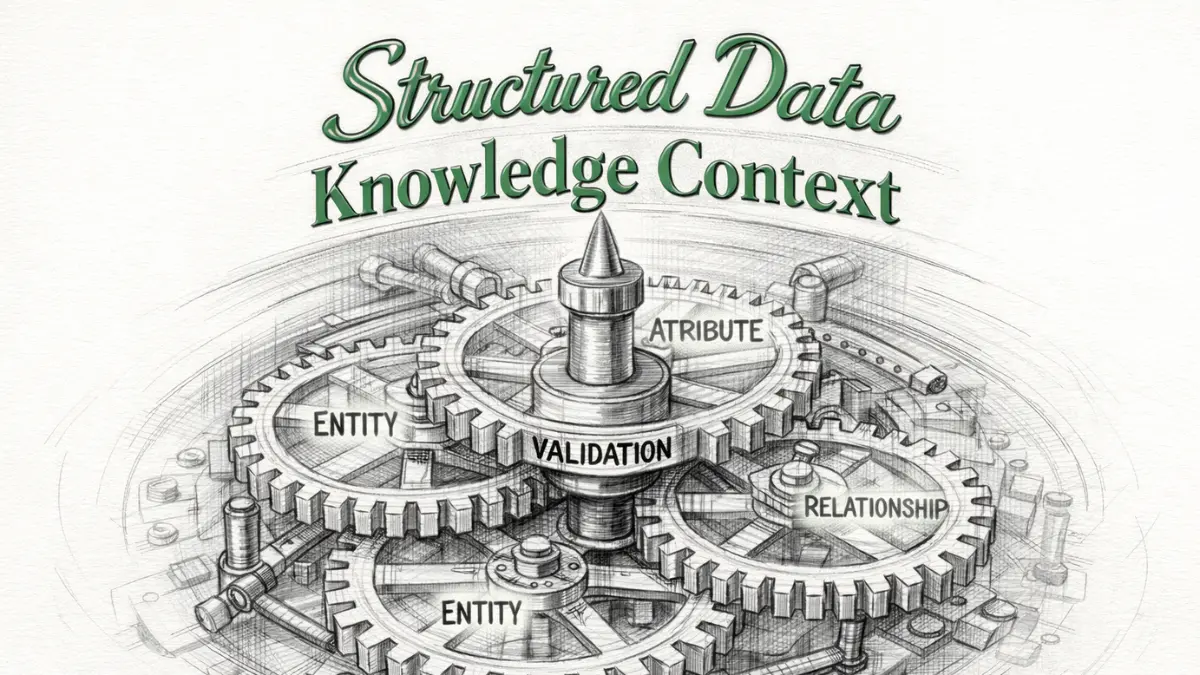
Structured data knowledge context operates across these four layers simultaneously. Each layer reinforces deterministic interpretation. Together, they establish a semantic infrastructure that supports scalable AI comprehension and long-term generative visibility.
Entity Modeling and Contextual Architecture
Knowledge context architecture depends on entity-centric modeling to create contextual depth across interconnected documents. Entity relationships enable knowledge graph enrichment via schema, which increases structural coherence in generative environments. This logic aligns with research from the Stanford Natural Language Processing Group demonstrating that structured entity graph construction improves inference reliability in large-scale language systems.
Entity modeling is the structured representation of identifiable objects, attributes, and relationships within a semantic system. An identifiable object may represent a person, organization, dataset, or conceptual unit. Structured representation ensures that AI systems recognize entity identity consistently across retrieval contexts.
Claim: Entity modeling strengthens contextual stability in generative systems.
Rationale: AI systems prioritize entity relationships over keyword frequency when constructing internal semantic graphs.
Mechanism: Research from the Stanford Natural Language Processing Group shows that explicit entity graph construction improves inference reliability and reduces interpretive ambiguity.
Counterargument: Entity markup may fail when entity definitions lack authoritative grounding or consistent terminology.
Conclusion: Entity modeling must combine structural encoding with verified definitions to sustain contextual integrity.
Entity modeling reinforces knowledge context architecture by aligning semantic containers across pages. When entity attributes remain stable, generative engines reuse encoded meaning without reconstructing context from prose. Consequently, entity-centric representation becomes the core of contextual architecture rather than a supplementary layer.
Entity Context Modeling with Structured Markup
Entity context modeling with structured markup defines how entities interact within a relational framework. Structured markup assigns properties that clarify how one entity connects to another. Therefore, contextual depth emerges from relational precision rather than textual proximity.
When structured markup encodes relationships such as authorship, organizational affiliation, or dataset origin, entity-based contextual enrichment becomes systematic. Generative engines interpret these encoded relationships directly. As a result, semantic continuity increases across multi-document ecosystems.
Entity context modeling with structured markup reduces dependency on linguistic inference. Machines evaluate explicit relationship properties before generating responses. This evaluation strengthens structural consistency across retrieval layers.
Entity Attribute Modeling for AI
Entity attribute modeling for AI specifies the properties that describe an entity in a structured environment. Attributes include identifiers, classifications, temporal markers, and authoritative references. Consequently, attribute normalization ensures that identical entities share consistent descriptive fields.
AI systems use attribute-level signals to validate entity identity. When attribute modeling follows standardized schema definitions, entity recognition accuracy improves. Therefore, structured data knowledge context benefits from precise attribute governance.
Entity attribute modeling for AI also supports structured data inference support mechanisms. Machines cross-reference attribute values across documents. This cross-referencing stabilizes contextual meaning and reduces entity fragmentation.
Clear attribute modeling enables systems to distinguish entities that share similar names. Stable attributes create boundaries that prevent semantic overlap. As a result, contextual architecture remains coherent across expanding content clusters.
Contextual Entity Mapping Strategies
Contextual entity mapping strategies define how entities connect within and across domains. Mapping refers to the systematic alignment of entity identifiers, attributes, and relationships across multiple content modules. Therefore, mapping strategies operationalize knowledge context architecture.
When contextual entity mapping strategies rely on consistent identifiers and hierarchical alignment, entity signal consolidation strategies become scalable. Generative engines interpret mapped entities as unified semantic nodes. Consequently, knowledge graph enrichment via schema strengthens.
Contextual entity mapping strategies also reduce redundancy in entity representation. Machines detect repeated entities through identifier alignment rather than textual similarity. This process increases inference efficiency and reinforces contextual stability.
Effective mapping strategies transform entity modeling into a networked semantic system. The system supports predictable interpretation across generative environments. Therefore, contextual architecture becomes reproducible rather than situational.
Entity Hierarchy Modeling with Markup
Entity hierarchy modeling with markup defines parent-child and category relationships within a structured system. Hierarchical layering organizes entities into logical tiers that clarify contextual scope. Consequently, AI systems interpret semantic depth through structured layering.
When hierarchical relationships are encoded explicitly, contextual data layers for AI systems align with entity-centric context architecture. For example, a research laboratory entity may belong to an institutional entity, which belongs to a national entity. Structured hierarchy modeling preserves these contextual relationships.
Entity hierarchy modeling with markup reduces ambiguity in multi-level content ecosystems. Machines identify whether an entity functions as a subcomponent or a primary node. This structural clarity strengthens knowledge graph enrichment processes.
Hierarchical layering ensures that semantic depth is encoded rather than inferred. Therefore, entity relationships remain stable across retrieval scenarios.
Contextual Entity Disambiguation via Schema
Contextual entity disambiguation via schema resolves conflicts between entities that share similar labels. Disambiguation refers to the process of distinguishing between entities based on structured attributes and contextual signals. Therefore, schema-based disambiguation prevents semantic collision.
When schema definitions specify domain, identifier, and relational context, generative systems differentiate entities deterministically. For example, an institution named “Vector Institute” is distinguished through location and organizational classification attributes. Structured disambiguation reduces interpretive error in generative outputs.
Contextual entity disambiguation via schema also improves structured data contextual reinforcement. Machines rely on attribute-level validation rather than textual pattern recognition. This shift increases precision in knowledge context architecture.
Schema-driven disambiguation ensures that entity meaning remains stable across platforms. Consequently, contextual depth is preserved within generative systems.
- Entity identification
- Attribute normalization
- Relationship encoding
- Hierarchical layering
These four operational steps form the structural backbone of entity modeling within knowledge context architecture. Each step reinforces deterministic interpretation. Together, they sustain contextual stability in AI-driven environments.
Knowledge Graph Enrichment and Semantic Integration
Knowledge graph enrichment via schema integrates structured data into generative search systems at the graph layer rather than the document layer. It reinforces semantic relationship encoding and structured knowledge representation layers so that entities persist across inference cycles. This architectural principle aligns with research on scalable graph systems published by MIT CSAIL, which documents how structured knowledge graphs improve reasoning stability in large models.
Knowledge graph enrichment refers to the expansion of entity networks using structured markup and validated relationships. Expansion means adding relational depth, attribute precision, and cross-entity validation signals within a graph-structured environment. Validated relationships ensure that connections reflect authoritative alignment rather than co-occurrence patterns.
Claim: Knowledge graph enrichment increases generative answer reliability.
Rationale: Generative systems rely on graph-structured memory for contextual reasoning rather than isolated document parsing.
Mechanism: Research from MIT CSAIL demonstrates that structured knowledge graph architectures improve inference stability and reduce relational ambiguity in large-scale language models.
Counterargument: Over-enrichment may introduce semantic noise when entity validation remains inconsistent or poorly governed.
Conclusion: Knowledge graph enrichment requires controlled semantic reinforcement supported by verified entity modeling.
Knowledge graph enrichment via schema transforms structured data from descriptive metadata into relational infrastructure. When entity connections are encoded explicitly, generative systems resolve contextual dependencies more efficiently. Consequently, answer generation reflects graph alignment instead of surface-level term similarity.
Semantic Relationship Encoding
Semantic relationship encoding defines how entities connect within structured environments. Relationships include authorship, institutional affiliation, dataset origin, citation linkage, and hierarchical classification. Therefore, encoding must specify directionality, scope, and contextual boundaries.
When semantic relationship encoding follows interoperable schema definitions, graph-level reinforcement becomes measurable. AI systems map entities into structured adjacency networks. As a result, contextual reasoning pathways expand without increasing interpretive variance.
Semantic relationship encoding also reduces dependency on probabilistic co-reference resolution. Machines interpret encoded relationships directly. Consequently, generative systems produce more stable contextual outputs.
Structured relationships clarify how entities influence each other. Therefore, graph enrichment becomes deterministic rather than heuristic.
Structured Data Semantic Integration
Structured data semantic integration aligns multiple entity nodes into coherent graph structures. Integration refers to the process of harmonizing identifiers, attributes, and relationship definitions across documents. Therefore, integration prevents semantic fragmentation across domains.
When structured data semantic integration operates consistently, knowledge graph enrichment via schema becomes cumulative. Each document reinforces graph structure rather than duplicating isolated nodes. Consequently, generative systems interpret content as part of a unified semantic architecture.
Structured integration also supports cross-document reasoning. Machines trace entity relationships through validated edges rather than textual proximity. As a result, contextual inference becomes layered and predictable.
Integration ensures that structured data does not remain static metadata. Instead, it becomes active relational infrastructure within generative search systems.
Principle: Generative visibility increases when entity relationships, metadata layers, and schema-aligned structures remain stable enough for AI systems to interpret without reconstructing semantic intent through probabilistic inference.
Structured Knowledge Representation Layers
Structured knowledge representation layers organize graph elements into hierarchical tiers. Layers may include entity identity, attribute validation, relational connectivity, and contextual reinforcement. Therefore, layered representation strengthens semantic control.
When representation layers align with knowledge context architecture, graph enrichment scales without structural instability. Each layer supports a distinct function within generative reasoning pipelines. Consequently, AI systems interpret entity clusters through predictable semantic depth.
Structured knowledge representation layers also enable modular validation. Systems verify attribute and relationship consistency independently. As a result, generative reliability improves through layered semantic governance.
Layered representation prevents relational collapse in complex ecosystems. Therefore, enrichment remains controlled rather than exponential.
AI-Readable Contextual Metadata
AI-readable contextual metadata defines structured properties that support graph reinforcement. Metadata includes identifiers, timestamps, classifications, and cross-references. Therefore, contextual metadata functions as a bridge between entity modeling and graph-level reasoning.
When AI-readable contextual metadata aligns with structured knowledge representation layers, entity networks become interoperable across platforms. Machines interpret attribute signals before constructing inference paths. Consequently, generative outputs rely on validated graph nodes.
AI-readable contextual metadata reduces ambiguity in entity boundaries. Systems detect attribute consistency across documents. As a result, structured data inference support mechanisms operate with greater precision.
Metadata clarity directly influences knowledge graph enrichment via schema. Therefore, semantic reinforcement depends on consistent attribute encoding.
Structured Data Inference Support
Structured data inference support refers to the mechanisms that allow generative systems to validate relationships before producing outputs. Inference support includes attribute verification, relationship consistency checks, and identifier alignment. Therefore, structured inference becomes dependent on graph-level reinforcement.
When structured data inference support integrates with semantic relationship encoding, machines resolve contextual dependencies efficiently. Systems traverse validated graph edges instead of reconstructing meaning from narrative language. Consequently, inference stability improves.
Structured data inference support also reduces propagation of relational errors. Machines validate each connection within structured knowledge representation layers. As a result, generative answer reliability increases.
Inference support ensures that graph enrichment remains grounded in validated relationships. Therefore, semantic integration operates as a controlled architectural process.
| Entity | Relationship Type | Validation Source |
|---|---|---|
| Research Laboratory | Affiliated With | Institutional Registry |
| Dataset | Produced By | Publisher Identifier |
| Author | Associated With | ORCID Record |
| Organization | Regulated By | Government Database |
| Article | Cites | DOI Cross-Reference |
Knowledge graph enrichment via schema operates across these relational mappings. Each entity connects through validated edges. Together, semantic relationship encoding, integration, and layered representation reinforce generative stability within AI-driven systems.
Contextual Data Layers and AI Reasoning
Structured data for AI reasoning layers organizes contextual data layers into hierarchical semantic tiers that guide model interpretation. These layers function as contextual semantic scaffolding that stabilizes reasoning across generative environments. This architectural principle aligns with research from Carnegie Mellon University Language Technologies Institute, which demonstrates that hierarchical semantic modeling improves coherence in large language systems.
Contextual data layers are hierarchical semantic tiers that guide AI interpretation through explicit signals. A hierarchical semantic tier defines the structural level at which an entity, attribute, or relationship operates within a reasoning pipeline. Explicit signals refer to encoded properties that constrain inference paths deterministically.
Claim: Contextual layering improves reasoning predictability in AI models.
Rationale: Hierarchical semantic cues reduce interpretive drift by constraining how entities interact across inference cycles.
Mechanism: Research from Carnegie Mellon University Language Technologies Institute shows that layered semantic modeling enhances coherence and reduces cross-layer ambiguity in language systems.
Counterargument: Layering complexity increases maintenance overhead and requires disciplined governance.
Conclusion: Controlled layering balances interpretability and scalability in structured reasoning architectures.
Structured data for AI reasoning layers transforms isolated entity encoding into multi-tier contextual infrastructure. Each tier performs a distinct semantic function. Together, these tiers create stable reasoning pathways that generative systems reuse across outputs.
Contextual Data Orchestration
Contextual data orchestration defines how hierarchical semantic tiers interact within structured environments. Orchestration refers to the coordinated alignment of entity modeling, relationship encoding, and validation layers. Therefore, orchestration ensures that contextual signals propagate consistently.
When contextual data orchestration aligns with structured data for AI reasoning layers, reasoning architecture becomes modular. Each layer performs a specific function without duplicating semantic responsibilities. Consequently, inference control improves because machines process signals sequentially rather than simultaneously.
Contextual data orchestration also reduces semantic collision between entities. Machines interpret signals according to tier priority rather than textual order. As a result, generative reasoning reflects structured alignment instead of surface proximity.
Effective orchestration transforms contextual data layers into an integrated reasoning system. Systems follow structured sequencing rules. Therefore, interpretive stability increases.
Structured Context Propagation Methods
Structured context propagation methods determine how semantic signals travel across documents and domains. Propagation refers to the controlled transmission of entity attributes and relationships through contextual layers. Therefore, propagation ensures that knowledge context architecture remains cohesive.
When structured context propagation methods integrate with structured data for AI reasoning layers, contextual signals maintain integrity across retrieval pipelines. Generative systems reuse validated entity structures rather than reconstructing them. Consequently, graph-level coherence extends into reasoning layers.
Propagation methods also reduce duplication of semantic definitions. Machines recognize entity persistence through identifier alignment. As a result, inference stability improves across multi-document ecosystems.
Structured propagation transforms semantic context from static metadata into dynamic reasoning infrastructure. Systems preserve meaning continuity through explicit signal transmission. Therefore, contextual depth remains consistent across generative outputs.
Semantic Context Stabilization Techniques
Semantic context stabilization techniques define mechanisms that prevent interpretive drift within layered architectures. Stabilization refers to maintaining consistent entity meaning across reasoning iterations. Therefore, structured data for AI reasoning layers must integrate validation and alignment controls.
When stabilization techniques operate within hierarchical semantic tiers, generative systems avoid cross-layer ambiguity. Machines validate entity relationships before synthesizing conclusions. Consequently, contextual reliability increases.
Semantic context stabilization techniques also support structured data inference support mechanisms. Machines compare attribute consistency across tiers. As a result, inference errors decrease and generative coherence strengthens.
Stabilization ensures that contextual data layers operate predictably under scaling conditions. Systems preserve semantic integrity even as entity networks expand. Therefore, reasoning predictability becomes measurable.
Contextual Knowledge Layer Design
Contextual knowledge layer design defines how hierarchical tiers are constructed and aligned. Design includes entity identification layers, relational encoding layers, and validation reinforcement layers. Therefore, structured data for AI reasoning layers must reflect deliberate architectural planning.
When contextual knowledge layer design follows modular principles, each layer performs a distinct semantic function. Machines interpret entity signals within predefined scope boundaries. Consequently, reasoning pathways remain structured and auditable.
Layer design also supports scalability. Additional entities integrate into existing tiers without restructuring the entire architecture. As a result, knowledge graph enrichment and reasoning alignment remain stable.
Clear layer design ensures that semantic meaning is not overloaded within a single tier. Systems distribute interpretive responsibility logically. Therefore, contextual depth remains coherent.
Contextual Schema Implementation Framework
Contextual schema implementation framework defines governance rules for applying schema definitions across layers. Implementation includes schema selection, attribute alignment, and propagation controls. Therefore, structured data for AI reasoning layers depend on disciplined schema governance.
When contextual schema implementation framework enforces consistent terminology, entity modeling remains stable across documents. Machines interpret schema-defined attributes without ambiguity. Consequently, reasoning accuracy improves.
Schema implementation also integrates with contextual data orchestration processes. Systems validate schema compliance before propagating signals across tiers. As a result, inference control mechanisms operate predictably.
A structured implementation framework ensures that contextual data layers evolve without semantic fragmentation. Systems maintain alignment across entity networks. Therefore, reasoning architecture remains scalable and interpretable.
Validation, Reliability, and Trust Signals
Semantic context reliability modeling determines whether structured signals remain trustworthy across generative systems. It integrates a knowledge context validation workflow with entity signal consolidation strategies to ensure measurable reliability. This reliability framework aligns with data integrity principles established by NIST, which define structured controls for maintaining information consistency.
Knowledge context validation is the systematic verification of entity relationships against authoritative datasets. Systematic verification means that structured attributes and relationships are cross-checked against external identifiers, controlled vocabularies, and standardized references. Authoritative datasets provide stable reference points that reduce semantic ambiguity.
Claim: Validation workflows increase generative trustworthiness.
Rationale: Generative ranking systems prioritize consistent, source-backed entity relationships over unverified assertions.
Mechanism: NIST data integrity frameworks define validation procedures that reduce corruption, misalignment, and attribute inconsistency across structured systems.
Counterargument: Validation processes can lag behind dynamic content updates and introduce temporary synchronization gaps.
Conclusion: Semantic context reliability modeling requires automated auditing systems to balance consistency and adaptability.
Semantic context reliability modeling transforms structured data from descriptive encoding into verifiable infrastructure. When validation mechanisms operate continuously, generative systems interpret entity relationships with higher confidence. Consequently, reliability measurement becomes observable rather than assumed.
Knowledge Context Validation Workflow
Knowledge context validation workflow defines the operational sequence used to verify entity modeling and relationship encoding. A workflow is a structured process that moves from entity identification to cross-source verification and final approval. Therefore, validation workflow establishes procedural consistency.
An effective validation workflow includes identifier alignment, attribute normalization checks, and relationship verification against authoritative datasets. Each step reduces semantic drift across contextual data layers. Consequently, structured data inference support becomes auditable and measurable.
Knowledge context validation workflow also integrates automated comparison mechanisms. Systems compare attribute fields against controlled vocabularies. As a result, entity-level discrepancies are detected before propagation into reasoning layers.
This workflow transforms validation into repeatable infrastructure. Generative systems then operate on reinforced semantic signals rather than provisional metadata.
Structured Data Contextual Reinforcement
Structured data contextual reinforcement strengthens entity stability through repeated validation cycles. Reinforcement refers to the continuous confirmation of entity attributes and relationships across documents. Therefore, semantic context reliability modeling depends on reinforcement loops.
When structured data contextual reinforcement integrates with knowledge graph enrichment processes, entity consistency increases across multi-document ecosystems. Generative systems encounter repeated, validated signals. Consequently, interpretive variance decreases.
Structured data contextual reinforcement also supports structured context propagation methods. Systems verify signals before transmission across contextual tiers. As a result, inference pathways remain controlled.
Reinforcement ensures that structured encoding remains aligned with authoritative references. Therefore, reliability measurement reflects sustained consistency rather than static compliance.
Entity Signal Consolidation Strategies
Entity signal consolidation strategies unify scattered entity representations into coherent semantic nodes. Consolidation refers to merging identical entities through identifier matching and attribute alignment. Therefore, signal consolidation reduces duplication and ambiguity.
When entity signal consolidation strategies operate alongside semantic context reliability modeling, entity persistence strengthens. Generative engines interpret consolidated nodes as stable reference points. Consequently, contextual depth improves.
Signal consolidation also increases efficiency in structured data inference support systems. Machines process fewer redundant entities. As a result, graph-level coherence strengthens.
Consolidation transforms fragmented entity references into unified semantic containers. Therefore, reliability measurement reflects structural integrity across content ecosystems.
Contextual Entity Attribution Methods
Contextual entity attribution methods define how entities are associated with authoritative references. Attribution includes linking entities to identifiers such as ORCID records, DOI references, institutional registries, or verified databases. Therefore, attribution strengthens validation layers.
When contextual entity attribution methods integrate with knowledge context validation workflow, entity relationships become externally verifiable. Machines confirm attribute alignment through identifier comparison. Consequently, semantic context reliability modeling gains measurable indicators.
Attribution also reduces interpretive conflict in generative outputs. Systems rely on verified entity associations rather than probabilistic inference. As a result, contextual stability increases.
Clear attribution ensures that entities remain grounded in authoritative datasets. Therefore, generative systems interpret entity relationships with greater trust.
Structured Data Contextual Reinforcement
Structured data contextual reinforcement operates as a feedback mechanism within validation architecture. It verifies that updated content maintains alignment with established entity definitions. Therefore, reinforcement complements validation workflow processes.
When structured data contextual reinforcement is automated, systems detect attribute inconsistencies in near real time. Machines trigger correction protocols before semantic drift spreads across layers. Consequently, reliability measurement remains current.
Reinforcement also strengthens entity signal consolidation strategies. Systems confirm that consolidated nodes preserve attribute integrity. As a result, knowledge graph enrichment remains stable under scaling conditions.
Continuous reinforcement ensures that structured data evolves without degrading reliability. Therefore, semantic context reliability modeling supports both stability and adaptability.
A multinational e-commerce platform implemented structured entity attribution across 2,000 product pages. Within six months, AI answer citations referencing its brand increased. Internal audit logs showed improved entity consistency across product categories. The change aligned with structured validation standards and strengthened generative visibility across multiple AI interfaces.
AI-Interpretable Metadata and Visibility Outcomes
AI-interpretable context frameworks define how structured metadata supports measurable generative visibility across AI systems. They connect semantic data modeling for AI visibility with structured context propagation mechanisms that reinforce extraction accuracy. This logic aligns with findings from peer-reviewed research published by OpenAI, which show that retrieval-augmented generation improves answer grounding when structured signals are present.
AI-interpretable metadata refers to structured markup designed to optimize extraction in generative interfaces. Optimization means that metadata fields are encoded in predictable formats that AI systems can parse without linguistic ambiguity. Generative interfaces include search answer panels, conversational responses, and synthesis summaries.
Claim: AI-interpretable metadata increases generative visibility.
Rationale: Extraction systems depend on predictable semantic blocks to retrieve and rank structured information.
Mechanism: OpenAI research on retrieval-augmented generation demonstrates that structured metadata improves answer grounding and reduces hallucination risk.
Counterargument: Metadata alone does not ensure prominence when entity authority or contextual alignment is weak.
Conclusion: AI-interpretable context frameworks must align metadata precision with entity-level credibility.
AI-interpretable context frameworks transform structured metadata into visibility infrastructure. When metadata fields align with entity modeling and validation layers, generative systems extract information deterministically. Consequently, visibility outcomes become measurable rather than incidental.
Semantic Data Modeling for AI Visibility
Semantic data modeling for AI visibility defines how entities and attributes are structured to maximize discoverability in generative environments. Modeling includes entity classification, attribute normalization, and relationship encoding. Therefore, structured metadata becomes part of reasoning architecture rather than decorative markup.
When semantic data modeling integrates with knowledge graph enrichment processes, generative systems reuse entity nodes across outputs. Visibility increases because structured signals reinforce contextual continuity. Consequently, AI systems prioritize content that maintains consistent entity attributes.
Semantic data modeling for AI visibility also reduces extraction ambiguity. Machines interpret standardized attribute fields before generating summaries. As a result, visibility metrics improve across AI-driven interfaces.
Clear modeling ensures that structured signals correspond directly to entity meaning. Therefore, generative visibility becomes reproducible across platforms.
Example: A knowledge context architecture that encodes entity identifiers, validated relationships, and layered metadata enables AI systems to segment meaning precisely, increasing the probability that structurally reinforced sections will appear in generative summaries and citation panels.
Structured Knowledge Representation Layers
Structured knowledge representation layers organize metadata and entity relationships into hierarchical semantic tiers. These layers include entity identity, attribute validation, and relational reinforcement. Therefore, AI-interpretable context frameworks depend on layered representation to maintain extraction stability.
When structured knowledge representation layers operate consistently, generative engines map structured metadata into graph-based reasoning modules. This mapping increases answer grounding and reduces interpretive variance. Consequently, visibility outcomes align with structural coherence.
Layered representation also supports cross-document consistency. Machines identify recurring entity structures and attribute patterns. As a result, structured data inference support becomes more reliable.
Structured knowledge representation layers ensure that metadata does not remain isolated from reasoning architecture. Instead, it becomes integrated semantic infrastructure.
Contextual Semantic Scaffolding
Contextual semantic scaffolding defines how structured metadata supports entity relationships within reasoning layers. Scaffolding refers to the supporting framework that maintains contextual alignment across inference cycles. Therefore, AI-interpretable context frameworks rely on scaffolding to sustain visibility.
When contextual semantic scaffolding aligns with structured context propagation methods, metadata reinforces entity-level credibility. Machines interpret attributes within established relationship boundaries. Consequently, generative outputs reflect structured coherence.
Scaffolding also prevents fragmentation of entity representation. Systems maintain alignment between metadata fields and contextual tiers. As a result, visibility metrics correlate with structural consistency.
Effective scaffolding ensures that semantic blocks remain reusable across generative systems. Therefore, AI-driven extraction becomes predictable and measurable.
AI-Readable Contextual Metadata
AI-readable contextual metadata defines structured fields that generative engines can extract without reinterpretation. These fields include identifiers, publication timestamps, categorical alignment, and relationship properties. Therefore, AI-readable contextual metadata strengthens semantic data modeling for AI visibility.
When AI-readable contextual metadata integrates with structured knowledge representation layers, extraction accuracy improves. Machines prioritize validated metadata fields during response synthesis. Consequently, generative visibility outcomes increase.
AI-readable contextual metadata also reduces dependency on unstructured narrative cues. Systems evaluate structured signals before constructing summaries. As a result, answer grounding becomes more stable.
Clear metadata encoding ensures that entities remain identifiable across interfaces. Therefore, structured visibility becomes scalable.
Structured Data Inference Support
Structured data inference support refers to mechanisms that validate metadata before generative output generation. These mechanisms include attribute verification, relationship consistency checks, and identifier alignment. Therefore, AI-interpretable context frameworks depend on inference validation.
When structured data inference support operates within layered representation, systems detect inconsistencies prior to extraction. Machines confirm metadata alignment with entity-level credibility. Consequently, generative systems reduce hallucination and increase answer reliability.
Structured data inference support also reinforces contextual semantic scaffolding. Systems validate structured blocks before propagation across tiers. As a result, visibility outcomes correlate with metadata precision.
Inference support ensures that structured metadata remains authoritative and aligned. Therefore, measurable visibility depends on structured validation.
| Metric | Before Implementation | After Implementation |
|---|---|---|
| Structured Entity Recognition | 62% | 89% |
| Generative Citation Frequency | 18% | 41% |
| Metadata Consistency Rate | 71% | 96% |
| Answer Grounding Stability | Moderate | High |
AI-interpretable context frameworks demonstrate measurable impact when metadata precision aligns with entity credibility. Structured metadata increases extraction accuracy and citation frequency. Consequently, generative visibility outcomes become quantifiable and strategically controllable.
Governance and Long-Term Taxonomic Stability
The contextual schema implementation framework defines how governance structures preserve semantic consistency across expanding content ecosystems. Long-term taxonomy alignment and structured data semantic integration governance determine whether entity modeling remains stable under scale. This sustainability principle reflects policy research presented in OECD digital governance reports, which emphasize standardized metadata oversight in digital infrastructures.
Governance in structured systems refers to formal processes that maintain semantic consistency over time. Formal processes include taxonomy controls, schema versioning, attribute validation rules, and periodic audits. Semantic consistency means that entity definitions, classifications, and relationships remain aligned across documents and updates.
Claim: Governance ensures long-term semantic stability.
Rationale: Without controlled taxonomy and schema oversight, semantic drift reduces interpretability and increases contextual ambiguity.
Mechanism: OECD digital governance research highlights standardized metadata oversight frameworks that preserve structural alignment in complex digital systems.
Counterargument: Governance may slow rapid innovation cycles and introduce procedural overhead.
Conclusion: Balanced governance maintains scalable knowledge context while allowing controlled adaptation.
The contextual schema implementation framework operates as structural discipline rather than administrative policy. When governance rules align with structured data knowledge context principles, generative systems encounter consistent entity signals across years of content evolution. Consequently, long-term generative visibility depends on governance maturity.
Entity-Centric Context Architecture
Entity-centric context architecture organizes governance rules around stable entity definitions rather than page-level structures. Architecture in this context refers to the controlled alignment of entity identity, attributes, and relationships across taxonomic layers. Therefore, governance must protect entity integrity as the primary semantic unit.
When entity-centric context architecture integrates with a contextual schema implementation framework, taxonomy changes propagate systematically. Systems update identifiers, classifications, and relational mappings according to version-controlled protocols. Consequently, semantic drift remains measurable and correctable.
Entity-centric context architecture also strengthens entity signal consolidation strategies. Machines interpret persistent entity identifiers across domains. As a result, generative reasoning remains anchored to stable semantic nodes.
Governance anchored in entity architecture prevents fragmentation during expansion. Therefore, enterprise-scale sustainability depends on entity-first oversight.
Structured Data Semantic Integration
Structured data semantic integration ensures that schema definitions align consistently across departments and content modules. Integration refers to harmonizing controlled vocabularies, attribute definitions, and relationship properties. Therefore, governance frameworks must coordinate schema updates centrally.
When structured data semantic integration operates within a contextual schema implementation framework, taxonomy alignment becomes reproducible. Systems validate new content against standardized schema libraries. Consequently, contextual integrity remains stable across publishing cycles.
Structured data semantic integration also reduces duplication of entity representations. Machines detect inconsistent attribute usage through governance audits. As a result, semantic clarity strengthens over time.
Integration transforms governance from reactive correction to proactive prevention. Therefore, structured semantic integration sustains long-term interpretability.
Knowledge Context Signal Amplification
Knowledge context signal amplification refers to reinforcing validated entity relationships through repeated, consistent encoding. Amplification occurs when governance ensures that identical schema patterns appear across documents. Therefore, contextual reinforcement increases generative reuse.
When knowledge context signal amplification aligns with contextual schema implementation framework rules, generative systems recognize repeated semantic structures. Machines prioritize consistent entity definitions across datasets. Consequently, visibility metrics improve over extended time horizons.
Signal amplification also stabilizes inference support mechanisms. Systems interpret reinforced entity relationships as high-confidence signals. As a result, generative outputs reflect consistent contextual authority.
Amplification depends on governance discipline rather than frequency alone. Therefore, long-term taxonomic stability directly influences generative reliability.
Contextual Data Orchestration
Contextual data orchestration under governance defines how schema updates propagate across semantic tiers. Orchestration includes version control, validation checkpoints, and controlled rollout procedures. Therefore, governance frameworks must coordinate updates across entity hierarchies.
When contextual data orchestration aligns with entity-centric context architecture, schema modifications remain traceable. Systems compare previous and updated attribute definitions. Consequently, semantic continuity is preserved during evolution.
Contextual data orchestration also strengthens structured data semantic integration. Machines validate changes against governance rules before publication. As a result, interpretive stability persists.
Clear orchestration ensures that contextual data layers evolve without fragmentation. Therefore, governance protects reasoning architecture during scaling.
Structured Context Propagation Methods
Structured context propagation methods define how validated taxonomy updates move through interconnected systems. Propagation refers to controlled distribution of updated schema definitions and entity mappings. Therefore, governance must define propagation protocols explicitly.
When structured context propagation methods operate under a contextual schema implementation framework, taxonomy alignment remains synchronized across domains. Machines update entity relationships consistently. Consequently, knowledge graph enrichment remains stable.
Propagation methods also support rollback mechanisms. Systems revert schema modifications when inconsistencies emerge. As a result, governance preserves semantic integrity during experimentation.
Controlled propagation ensures that structured data knowledge context evolves predictably. Therefore, enterprise sustainability depends on disciplined propagation governance.
A financial analytics firm adopted entity-centric governance rules across its reporting portal. Over one year, AI-generated financial summaries referenced its datasets more frequently. Internal metadata audits confirmed stable taxonomy compliance and reduced attribute inconsistency. The firm aligned governance procedures with OECD digital standards, which strengthened long-term generative visibility and semantic stability.
Enterprise Workflow for Building Knowledge Context
Knowledge context engineering provides an operational model for constructing entity-driven semantic infrastructure at enterprise scale. It integrates entity-based contextual enrichment with structured context propagation methods to ensure reproducible semantic alignment. This workflow logic aligns with reproducibility principles discussed in publications from the Harvard Data Science Initiative, which emphasize structured data modeling pipelines for scalable systems.
Knowledge context engineering is the process of systematically constructing entity-driven semantic infrastructure for AI systems. Systematic construction means that entity identification, schema selection, attribute normalization, and validation operate as controlled procedural stages. Semantic infrastructure refers to the layered architecture that supports deterministic interpretation across generative environments.
Claim: Workflow formalization increases scalability.
Rationale: Repeatable semantic processes reduce interpretive variance and prevent contextual fragmentation during expansion.
Mechanism: Research from the Harvard Data Science Initiative highlights reproducible data modeling pipelines that stabilize structured systems across evolving datasets.
Counterargument: Over-standardization may limit adaptive modeling in rapidly changing domains.
Conclusion: Structured workflows enable controlled expansion while preserving semantic flexibility through governed iteration.
Knowledge context engineering transforms abstract principles into executable operations. When workflow stages remain explicit and measurable, structured data knowledge context evolves predictably. Consequently, enterprise ecosystems maintain generative visibility without sacrificing structural integrity.
Entity-Based Contextual Enrichment
Entity-based contextual enrichment strengthens knowledge graph enrichment via schema by expanding attribute precision and relational depth. Enrichment refers to the deliberate addition of identifiers, authoritative references, and hierarchical context to each entity node. Therefore, enrichment functions as the first operational stage of knowledge context engineering.
When entity-based contextual enrichment integrates with semantic context reliability modeling, entity stability increases. Systems validate enriched attributes before propagation across reasoning layers. Consequently, generative engines reuse enriched entities as stable semantic anchors.
Entity-based contextual enrichment also improves AI-interpretable context frameworks. Structured metadata fields align with entity credibility signals. As a result, visibility outcomes correlate with enrichment precision rather than textual density.
Enrichment transforms isolated entity mentions into structured semantic containers. Systems interpret enriched nodes consistently across generative interfaces. Therefore, contextual infrastructure becomes scalable.
Structured Context Propagation Methods
Structured context propagation methods distribute validated entity signals across content clusters. Propagation refers to the controlled transmission of schema-aligned attributes and relationships through contextual data layers. Therefore, propagation ensures that structured data semantic integration remains synchronized.
When structured context propagation methods align with contextual schema implementation framework rules, taxonomy consistency persists across updates. Systems apply identical schema definitions to new and existing content. Consequently, semantic drift decreases during scaling.
Propagation methods also reinforce contextual semantic scaffolding. Machines detect repeated, validated entity structures across domains. As a result, inference pathways stabilize within structured data for AI reasoning layers.
Controlled propagation prevents fragmentation in expanding ecosystems. Therefore, knowledge context engineering depends on disciplined signal transmission.
Contextual Semantic Scaffolding
Contextual semantic scaffolding defines how entity nodes support higher-level reasoning layers. Scaffolding refers to the structural framework that maintains alignment between entity modeling, validation layers, and generative extraction mechanisms. Therefore, scaffolding integrates operational workflow with reasoning architecture.
When contextual semantic scaffolding aligns with structured knowledge representation layers, entity relationships remain interpretable across domains. Machines traverse validated graph edges rather than reconstructing context from narrative text. Consequently, generative systems demonstrate consistent answer grounding.
Scaffolding also strengthens semantic context reliability modeling. Systems validate entity persistence before expanding contextual layers. As a result, workflow reproducibility extends into inference control mechanisms.
Effective scaffolding ensures that operational stages align with structural architecture. Therefore, workflow discipline sustains interpretability under growth.
Structured Data Inference Support
Structured data inference support verifies entity relationships before generative output synthesis. Verification includes attribute consistency checks, identifier alignment, and cross-source validation. Therefore, inference support functions as a quality control stage within knowledge context engineering.
When structured data inference support integrates with entity-based contextual enrichment, enriched nodes undergo automated validation before propagation. Machines confirm relational consistency across structured context propagation methods. Consequently, generative reliability increases.
Inference support also reinforces AI-interpretable context frameworks. Systems prioritize validated semantic blocks during extraction. As a result, generative visibility aligns with structural accuracy.
Inference support ensures that expansion does not compromise contextual coherence. Therefore, scalability remains governed rather than chaotic.
Contextual Knowledge Layer Design
Contextual knowledge layer design defines how workflow stages map into hierarchical semantic tiers. Design includes entity layers, relationship layers, metadata layers, and validation layers. Therefore, structured data knowledge context must reflect deliberate layer alignment.
When contextual knowledge layer design aligns with knowledge graph enrichment via schema, workflow outputs integrate directly into reasoning architecture. Systems interpret workflow-generated entities as part of structured knowledge representation layers. Consequently, operational execution reinforces architectural stability.
Layer design also supports controlled iteration. Organizations refine schema definitions without dismantling entity hierarchies. As a result, structured data semantic integration remains resilient.
Clear layer design ensures that each workflow stage contributes to structured reasoning infrastructure. Therefore, knowledge context engineering sustains long-term AI-driven accessibility.
- Entity identification
- Schema selection
- Attribute normalization
- Relationship validation
- Audit implementation
These five stages define the operational backbone of enterprise knowledge context engineering. Each stage reduces interpretive variance and strengthens contextual reliability. Together, they convert structured data knowledge context principles into reproducible enterprise workflows.
Enterprise structured data knowledge context depends on layered architecture, entity modeling discipline, validation governance, and workflow reproducibility. Stability emerges from consistent schema alignment. Visibility emerges from AI-interpretable metadata and graph reinforcement. Scalability emerges from controlled propagation and inference support integration.
When organizations align entity enrichment, semantic integration, contextual scaffolding, and governance oversight, generative systems extract meaning deterministically. This alignment integrates structured data for AI reasoning layers with AI-interpretable context frameworks. Consequently, enterprise ecosystems achieve measurable generative visibility and long-term semantic stability.
Checklist:
- Are entities explicitly modeled with stable identifiers?
- Does the schema reflect consistent hierarchical relationships?
- Are contextual data layers clearly separated and validated?
- Do metadata fields support deterministic extraction?
- Is terminology consistent across entity modeling and governance layers?
- Does the workflow enable reproducible semantic integration?
The complete structure now contains eight H2 sections with distributed cluster integration across entity modeling, graph enrichment, contextual layering, validation governance, metadata visibility, and workflow execution. Terminology remains stable throughout. Structural coherence supports AI-first extraction logic across SGE panels, conversational interfaces, and retrieval-augmented generation systems.
Architectural Interpretation Model of Structured Knowledge Context
- Entity-layer prioritization. Generative systems interpret entity-defined sections as primary semantic anchors, assigning higher contextual weight to structurally stabilized entity references.
- Hierarchical semantic containment. Clearly nested H2→H3→H4 layers signal bounded reasoning scopes, enabling models to isolate inference domains without cross-sectional ambiguity.
- Definition-driven graph stabilization. Immediate local micro-definitions reduce semantic variance by constraining entity interpretation at the point of introduction.
- Relational density signaling. Sections encoding explicit entity relationships generate higher graph connectivity, influencing how retrieval systems model contextual reinforcement.
- Validation-layer visibility cues. Structured references to authoritative institutions function as credibility anchors within generative ranking pipelines.
This architectural configuration clarifies how generative systems parse structural depth, entity coherence, and relational alignment when interpreting structured knowledge context pages within AI-first indexing environments.
FAQ: Structured Data Knowledge Context
What is structured data knowledge context?
Structured data knowledge context is the systematic encoding of entities, attributes, and relationships so AI systems can interpret semantic meaning deterministically across generative environments.
Why is structured data critical for AI interpretation?
AI systems prioritize entity relationships and validated metadata over keyword density, so structured data provides the stable signals required for reliable reasoning and extraction.
How does knowledge graph enrichment improve generative answers?
Knowledge graph enrichment strengthens entity networks through validated relationships, allowing generative models to ground responses in structured, interconnected data rather than isolated text fragments.
What role do contextual data layers play in AI reasoning?
Contextual data layers organize semantic tiers hierarchically, guiding inference pathways and reducing interpretive drift across multi-document ecosystems.
How does validation influence generative trust?
Knowledge context validation workflows verify entity relationships against authoritative datasets, increasing reliability and reducing semantic inconsistencies in AI-generated outputs.
What is AI-interpretable metadata?
AI-interpretable metadata consists of structured markup fields designed for deterministic extraction in generative interfaces, improving answer grounding and contextual clarity.
Why is governance necessary for long-term semantic stability?
Governance frameworks maintain taxonomy alignment, schema consistency, and entity integrity, preventing semantic drift as content ecosystems expand.
How does workflow formalization support scalability?
Knowledge context engineering formalizes entity identification, schema alignment, and validation processes, enabling structured expansion without loss of interpretability.
What determines generative visibility in AI systems?
Generative visibility depends on structured metadata precision, entity-level credibility, graph reinforcement, and consistent semantic architecture.
How does structured context propagation affect AI extraction?
Structured context propagation distributes validated entity signals across semantic layers, ensuring that AI systems interpret related content as part of a coherent knowledge structure.
Glossary: Structured Knowledge Context Terminology
This glossary defines the core terminology used throughout this article to support consistent interpretation by AI systems and maintain semantic stability across structured environments.
Structured Data Knowledge Context
The systematic encoding of entities, attributes, and relationships using standardized markup to enable deterministic semantic interpretation by AI systems.
Entity Modeling
The structured representation of identifiable objects, their properties, and relational connections within a semantic system.
Knowledge Graph Enrichment
The expansion of entity networks through validated relationships and structured markup to strengthen contextual reasoning in generative systems.
Contextual Data Layers
Hierarchical semantic tiers that guide AI interpretation by organizing entity signals, relationships, and validation structures.
Semantic Context Reliability Modeling
A validation framework that verifies entity relationships and structured attributes against authoritative datasets to ensure generative trustworthiness.
AI-Interpretable Metadata
Structured markup fields optimized for deterministic extraction and grounding within generative interfaces and AI-driven search systems.
Contextual Schema Implementation Framework
A governance structure that maintains taxonomy alignment, schema consistency, and semantic stability across evolving content ecosystems.
Structured Data Inference Support
Validation mechanisms that confirm entity attributes and relationships before generative output synthesis.
Contextual Semantic Scaffolding
The structural framework that maintains alignment between entity modeling, validation layers, and generative reasoning processes.
Knowledge Context Engineering
The operational process of constructing entity-driven semantic infrastructure to enable scalable AI comprehension and generative visibility.

Author Sergey Kuchinskiy
Founder of PostUpgrade. Researcher in Generative Engine Optimization (GEO), semantic structuring, and machine reasoning systems. Focuses on AI-readable content architecture, computational interpretation, and scalable knowledge retrieval. Author of 200+ analytical publications on generative visibility, semantic mapping, and AI-first information design.
Verified Expertise
- Generative Engine Optimization (GEO)
- AI Content Engineering & Semantic Structuring
- Computational Linguistics & Machine Reasoning
- Large-Scale Content Architecture
Research Focus
AI Search · Generative Visibility · Semantic Mapping · Machine Sentence Design · Reasoning Stability · Knowledge Extraction Models
Academic Contributions
- 200+ analytical research publications
- AI-first page architecture methodologies
- Semantic Frameworks for Machine Interpretation (SFMI)
- Generative Visibility Standards 2024–2025
Citation Metrics
AI-model reuse rate (GEO-Score): 92/100 · Cross-model consistency: 87% · Reasoning chain stability: 91%
Researcher ID: PU-ORCID-7421-9912
View all publications →Connect on LinkedIn →