Last Updated on January 19, 2026 by PostUpgrade
How to Build AI-Readable Page Architecture
AI page architecture defines how information is organized so machine systems can consistently interpret and reuse meaning. In AI-driven environments, visibility increasingly depends on structural clarity rather than surface signals or presentation choices. Architecture therefore functions as the primary interface between authored knowledge and automated reasoning.
This article explains how to design page structures that support machine comprehension, generative visibility, and long-term reuse across AI systems. The focus remains on semantic boundaries, hierarchy, and interpretability rules instead of writing techniques or optimization tactics.
The objective is to describe a stable architectural model that scales across large content systems and remains reliable as AI retrieval, summarization, and reasoning mechanisms evolve.
AI Page Architecture as a Machine-Interpretable System
AI page architecture defines how information units align into a system that supports machine interpretation rather than visual presentation. This section establishes structural logic as the primary design concern, separating architecture from content writing choices and stylistic layout decisions. The approach treats pages as interpretable systems whose meaning emerges from consistent organization, not from surface formatting, as formalized by document semantics defined by the W3C.
Claim: AI page architecture functions as a system-level interface that enables machines to interpret meaning through structure rather than presentation cues.
Rationale: Machine systems rely on predictable structural signals to identify scope, priority, and relationships between information units.
Mechanism: A page exposes interpretability through stable hierarchy, explicit boundaries, and ordered progression of semantic units that machines can parse deterministically.
Counterargument: Visual layout and stylistic cues can still influence human comprehension and sometimes guide machine heuristics indirectly.
Conclusion: Architecture remains the dominant interpretability layer because it governs how meaning persists across rendering contexts and machine interfaces.
Definition: AI understanding refers to a system’s capacity to interpret structured information by resolving hierarchy, semantic boundaries, and conceptual dependencies into stable internal representations that support reasoning, summarization, and reuse.
Page Architecture vs Page Layout
Page architecture defines the logical arrangement of information units, while layout controls their visual placement. Architecture determines how machines infer relationships between sections, whereas layout influences how humans scan and perceive content. This distinction matters because machine interpretation persists even when visual presentation changes.
An ai interpretable page layout may appear similar across different designs, yet architecture remains constant when headings, boundaries, and semantic order stay intact. Machines extract meaning from structural markers such as hierarchy depth and section sequencing, not from spacing, colors, or typography. Therefore, architectural decisions must precede layout decisions during page design.
In practical terms, layout answers how content looks, while architecture defines how content is understood. When architecture stays consistent, machines maintain stable interpretation even if the page renders differently across devices or interfaces.
Architecture as a Constraint System
Logical page architecture operates as a constraint system that limits how meaning can shift during interpretation. By enforcing hierarchy rules and explicit section boundaries, architecture reduces ambiguity in how machines traverse and connect information. Constraints guide interpretation by preventing uncontrolled semantic overlap between sections.
When designers apply logical page architecture consistently, machines detect reliable patterns across documents and domains. These constraints enable automated systems to predict where definitions appear, how arguments progress, and which sections carry higher semantic weight. As a result, interpretation becomes repeatable rather than probabilistic.
Put simply, architecture sets the rules that meaning must follow. These rules help machines stay aligned with the intended structure, even when content volume grows or contexts change.
Machine Readability and Structural Decodability
Machine readable page structure determines how reliably automated systems decode a page without relying on surface language cues. Machines extract meaning by scanning predictable structural signals such as hierarchy depth, section order, and boundary markers rather than stylistic phrasing. Standards developed by the NIST formalize this approach by treating document structure as a prerequisite for dependable information processing.
Definition: Machine-readable structure refers to predictable segmentation and hierarchy that supports automated parsing.
Claim: Machine readability depends on structural decodability rather than linguistic sophistication.
Rationale: Automated systems cannot infer intent or emphasis unless structure exposes clear and repeatable signals.
Mechanism: Machines decode pages by traversing headings, section boundaries, and ordered units that define scope and priority.
Counterargument: Advanced models can sometimes infer meaning from unstructured text using probabilistic reasoning.
Conclusion: Structural decodability remains essential because it ensures consistent interpretation across models and contexts.
Structural Tokens and Parsing Boundaries
Structural tokens define the points where machines segment content into interpretable units. Headings, ordered sections, and consistent nesting levels act as anchors that guide how information clusters form during parsing. When these tokens remain stable, machine interpretable page design emerges as a predictable pattern rather than an inferred guess.
Parsing boundaries control how far meaning extends within a section before the system resets context. Clear boundaries prevent unrelated concepts from merging during extraction or summarization. As a result, machines preserve topic integrity and reduce cross-section contamination.
At a basic level, structural tokens tell machines where one idea ends and another begins. Without them, systems struggle to maintain clean separation between concepts, even if the language itself appears clear.
Structural Failures in Long-Form Pages
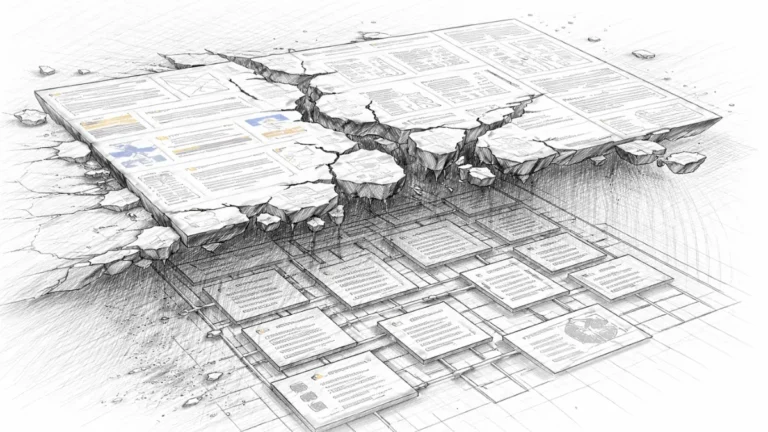
Long-form pages often fail when structure weakens as length increases. Inconsistent heading depth, skipped hierarchy levels, or oversized sections blur boundaries that machines rely on. These failures degrade page structure for computational understanding by forcing systems to infer structure instead of reading it directly.
As pages grow, uncontrolled expansion introduces semantic drift within sections. Machines then misinterpret scope, assign incorrect weights to ideas, or merge distinct arguments into a single cluster. Over time, this reduces reliability across retrieval, summarization, and reasoning tasks.
In simple terms, long pages break when structure stops guiding interpretation. Clear hierarchy and segmentation allow machines to scale understanding as content expands, while weak structure causes meaning to collapse inward.
Hierarchical Depth and Layered Information Models
Hierarchical page architecture manages semantic depth so reasoning systems can interpret information in a controlled sequence rather than as a flat stream. Hierarchy assigns order and relative importance to concepts, which allows machines to traverse meaning without collapsing distinct ideas. Research on hierarchical representation and structured reasoning at MIT CSAIL supports this approach by demonstrating how depth-aware structures stabilize interpretation in complex systems.
Definition: Hierarchical architecture defines ordered semantic depth across content layers.
Claim: Hierarchical page architecture stabilizes machine interpretation by controlling semantic depth.
Rationale: Reasoning systems require ordered layers to determine precedence, dependency, and scope between concepts.
Mechanism: Hierarchy distributes meaning across levels so machines process high-level concepts first and refine understanding through nested sections.
Counterargument: Shallow structures can perform adequately for short or narrowly scoped content.
Conclusion: Hierarchical depth becomes essential as content complexity increases because it prevents interpretive overload.
Layered Page Structure
Layered page structure organizes content into stacked semantic levels that guide how machines descend into detail. Each layer narrows scope while remaining anchored to its parent concept, which preserves contextual continuity. This layered approach enables systems to maintain orientation as they traverse complex documents.
When layered page structure remains consistent, machines detect predictable patterns across pages and domains. These patterns support reuse because models can map new content onto known depth schemas. Consequently, interpretation becomes faster and more accurate as structural familiarity increases.
In practice, layers function like ordered lenses that reveal detail progressively. Machines move from general framing to specific mechanisms without losing alignment with the original intent.
Depth Control and Semantic Saturation
Depth oriented page design limits how much meaning accumulates within a single layer. Without depth control, sections absorb too many concepts and overwhelm parsing mechanisms. Controlled depth ensures that each layer carries a manageable semantic load.
Semantic saturation occurs when a section exceeds its interpretive capacity. Machines then flatten distinctions or misassign importance because boundaries no longer constrain meaning. Depth oriented page design prevents this failure by enforcing strict limits on conceptual density.
Put simply, depth control prevents ideas from crowding each other. By spreading meaning across layers, machines maintain clarity even as content expands.
| Level | Function | Interpretation Role | Failure Risk |
|---|---|---|---|
| H2 | Concept framing | Establishes primary scope | Concept dilution |
| H3 | Mechanism grouping | Refines relationships | Context leakage |
| H4 | Detail isolation | Supports precise parsing | Semantic overload |
| Paragraph | Atomic meaning | Enables extraction | Ambiguity |
This hierarchy distributes meaning in a way that reasoning systems can follow without inference gaps, which preserves interpretability at scale.
Semantic Clarity and Meaning Isolation
Semantic clarity page structure isolates meaning so machine systems can interpret content without cross-contamination between concepts. When sections maintain strict semantic boundaries, models preserve intent during extraction, summarization, and reasoning. Research from the Stanford Natural Language Institute shows that clear segmentation improves model reliability by reducing ambiguity during semantic parsing.
Definition: Semantic clarity is the isolation of concepts into non-overlapping interpretive units.
Claim: Semantic clarity page structure prevents meaning distortion during machine interpretation.
Rationale: Machine systems misinterpret content when concepts overlap across structural boundaries.
Mechanism: Isolated sections, explicit transitions, and controlled scope ensure that each concept maps to a distinct interpretive unit.
Counterargument: Some narrative formats benefit from conceptual blending to support human reading flow.
Conclusion: Meaning isolation remains critical for machine interpretation because it preserves semantic integrity across reuse contexts.
Structured Meaning Architecture
Structured meaning architecture organizes concepts so each unit expresses a single, bounded idea. This structure enables machines to associate statements with precise contexts rather than inferred associations. As a result, models build internal representations that reflect intended relationships instead of accidental proximity.
When structured meaning architecture remains consistent, machines detect patterns that support scalable interpretation. Each section becomes a stable node that models can reference independently. This stability improves extraction accuracy and reduces the risk of unintended semantic linkage.
In essence, structured meaning architecture tells machines exactly where meaning lives. Clear placement allows systems to reuse information without reconstructing context from surrounding text.
Interpretation Boundaries
Interpretation boundaries define where one concept ends and another begins within a page. These boundaries guide how machines reset context during traversal, which prevents semantic carryover across unrelated sections. Interpretability driven page structure relies on these boundaries to maintain clean transitions.
Weak boundaries allow concepts to bleed into each other during processing. Machines then merge signals that were meant to remain separate, which degrades reasoning accuracy. Interpretability driven page structure counters this risk by enforcing strict containment rules.
At a basic level, boundaries act as stop signs for interpretation. They tell machines when to close one meaning before opening the next, which preserves clarity throughout the page.
Principle: Pages remain interpretable in AI-driven environments when their structural hierarchy, terminology usage, and semantic boundaries remain consistent enough to remove the need for probabilistic reconstruction.
Architecture for Language Models and Reasoning Systems
Page architecture for ai models determines how language models consume structure as a signal for probabilistic reasoning rather than simple traversal. Unlike crawlers, language models interpret hierarchy, boundaries, and ordering as inputs that shape inference paths and attention allocation. Research from DeepMind Research demonstrates that structured inputs significantly influence reasoning stability and output consistency in large-scale models.
Definition: Model-oriented architecture aligns structural signals with probabilistic reasoning systems.
Claim: Page architecture for ai models must align with reasoning behavior rather than retrieval behavior.
Rationale: Language models prioritize internal coherence and dependency resolution over linear document traversal.
Mechanism: Architectural signals such as hierarchy depth, scoped sections, and ordered progression guide attention distribution and inference sequencing.
Counterargument: Flat structures can still yield usable outputs for narrow prompts or short contexts.
Conclusion: Model-aligned architecture becomes critical as reasoning depth and context length increase.
LLM-Compatible Structure
LLM-compatible page structure exposes information in a form that supports probabilistic inference rather than deterministic lookup. Language models evaluate structure as a cue for which statements depend on others and which ideas form higher-level abstractions. Clear hierarchy and consistent segmentation allow models to allocate attention without reconstructing implicit relationships.
When llm compatible page structure remains stable, models reduce uncertainty during reasoning. They infer scope directly from structure instead of estimating it from linguistic cues. This alignment improves consistency across summarization, synthesis, and multi-step reasoning tasks.
In simple terms, models think more clearly when structure tells them what matters first and what depends on it. Predictable structure reduces guesswork and keeps reasoning aligned with intent.
Reasoning-Oriented Layout
Page architecture for reasoning systems emphasizes logical progression over navigational convenience. Reasoning-oriented layouts ensure that premises appear before implications and that conclusions emerge from explicitly bounded sections. This ordering supports internal chain construction within the model.
When page architecture for reasoning systems degrades, models infer missing links or reorder ideas incorrectly. Such inference increases variance and weakens reliability across outputs. A reasoning-oriented layout reduces this risk by presenting dependencies in a form that models can follow directly.
At a practical level, reasoning works best when structure mirrors thought order. Clear progression allows models to connect ideas without inventing transitions or assumptions.
Example: When a page maintains fixed section roles and consistent terminology across its hierarchy, AI systems can isolate high-confidence meaning units and reuse them independently in generated responses.
Information Architecture and Interpretation Flow
Structured information architecture governs how meaning progresses through a page in a directional and interpretable sequence. Machines do not read pages as static collections of sections but as ordered flows where earlier units constrain how later units are interpreted. Work from the Allen Institute for Artificial Intelligence demonstrates that controlled information flow improves downstream interpretation by reducing ambiguity during multi-step reasoning.
Definition: Information architecture defines how meaning progresses across sections.
Claim: Structured information architecture determines how machines construct interpretive flow across a page.
Rationale: Automated systems rely on directional progression to maintain context and resolve dependencies between concepts.
Mechanism: Ordered sections, explicit transitions, and constrained scope guide machines through meaning in a predictable sequence.
Counterargument: Short or self-contained pages may not require explicit flow control to remain interpretable.
Conclusion: Interpretation flow becomes essential as pages grow in length and conceptual dependency.
Meaning-Driven Architecture
Meaning driven page architecture organizes sections so each unit advances interpretation rather than repeating or diluting prior content. This approach ensures that meaning accumulates through progression instead of expansion. Machines use this progression to infer which concepts serve as foundations and which act as extensions.
When meaning driven page architecture remains consistent, systems identify interpretive direction without reconstructing intent from language alone. Each section inherits context from its predecessors while contributing a bounded addition to the overall meaning. This design supports reliable summarization and synthesis across different retrieval scenarios.
In practice, meaning-driven architecture prevents circular interpretation. Machines follow a clear path where each step builds on the previous one without collapsing distinctions.
Interpretation-Oriented Design
Page design for information interpretation prioritizes how machines transition between sections rather than how users navigate visually. Interpretation-oriented design uses ordered sequencing and clear section demarcation to control context carryover. These signals tell machines when to extend context and when to reset it.
Without interpretation-oriented design, machines infer flow implicitly, which increases variance across outputs. Sections may appear interchangeable or disconnected, even when the author intended a specific progression. Page design for information interpretation reduces this risk by making flow explicit.
At a basic level, interpretation-oriented design tells machines how to move forward without guessing. Clear progression keeps interpretation aligned with the intended structure and preserves meaning across reuse.
Structural Consistency and Terminology Stability
AI aligned information architecture enables long-term reuse by maintaining consistency across large and evolving content systems. When structure and terminology remain stable, machines can link new content to existing representations without reinterpreting foundational concepts. Research from the Oxford Internet Institute highlights that consistency across information systems directly affects how reliably automated models construct and maintain knowledge graphs.
Definition: Terminology stability ensures consistent node representation in AI knowledge graphs.
Claim: AI aligned information architecture depends on structural consistency and stable terminology.
Rationale: Machine systems degrade interpretive accuracy when identical concepts appear under varying structural or lexical forms.
Mechanism: Consistent hierarchy, repeatable section roles, and controlled vocabulary allow models to map content to persistent internal nodes.
Counterargument: Limited variation in terminology can sometimes restrict expressive flexibility for human authors.
Conclusion: Stability outweighs flexibility in machine-facing systems because it preserves long-term interpretability.
Stable Vocabulary Systems
AI oriented content architecture relies on a controlled vocabulary that maps concepts to fixed structural positions. When authors reuse the same terms within the same architectural roles, machines recognize recurring patterns instead of generating new interpretations. This repetition enables models to consolidate meaning rather than fragment it.
Stable vocabulary systems also reduce the need for probabilistic disambiguation. Machines associate terms with known contexts based on position and hierarchy rather than inferring meaning from surrounding language. As a result, interpretation remains consistent across documents and time.
In effect, stable vocabulary systems teach machines what stays the same. Predictability allows models to focus on new information instead of re-evaluating familiar concepts.
Structural Drift and Degradation
Structural drift occurs when content expands without enforcing architectural rules. Sections begin to absorb multiple roles, hierarchy levels blur, and terminology appears in inconsistent contexts. These changes weaken structured content hierarchy and introduce interpretive noise.
As drift accumulates, machines lose confidence in structural signals. Models then rely more heavily on probabilistic inference, which increases variance and reduces reliability. Structured content hierarchy prevents this degradation by enforcing repeatable patterns even as content scales.
Simply put, drift happens when structure stops acting as a constraint. Enforced hierarchy keeps meaning aligned and prevents gradual erosion of interpretability.
Page Architecture as a Reusable Knowledge Asset
Page architecture for machine understanding functions as a reusable interpretive asset rather than a page-specific tactic. When architecture remains stable, machines can extract, recombine, and apply meaning across interfaces without re-evaluating structure each time. Research from Carnegie Mellon Language Technologies Institute shows that consistent structural representations improve transfer and reuse in language processing systems.
Definition: Reusable architecture enables consistent extraction across contexts and interfaces.
Claim: Page architecture for machine understanding creates reusable knowledge units for automated systems.
Rationale: Machines rely on repeatable structural patterns to recognize, extract, and recombine meaning across tasks.
Mechanism: Stable hierarchy, fixed section roles, and bounded concepts allow systems to treat pages as modular knowledge sources.
Counterargument: Highly contextual or experimental content may resist reuse due to intentional variability.
Conclusion: Reusable architecture maximizes long-term value because it allows meaning to persist beyond individual pages.
Architecture for Automated Interpretation
Page architecture for automated interpretation exposes content in a form that systems can process without human mediation. Automated pipelines depend on consistent signals to identify where definitions appear, how arguments progress, and which sections carry authority. When architecture remains predictable, machines execute interpretation steps deterministically.
As page architecture for automated interpretation matures, systems reduce reliance on probabilistic inference. They map structural positions to known functions and extract information with minimal contextual reconstruction. This efficiency improves accuracy across indexing, summarization, and synthesis workflows.
In practical terms, automated interpretation works best when structure does the explaining. Clear architecture allows systems to act on content directly instead of guessing intent.
Architecture for Semantic Processing
Page structure for semantic processing supports how machines transform extracted information into internal representations. Semantic processing depends on clean inputs where concepts arrive isolated, ordered, and scoped. Architecture provides these conditions by defining how meaning enters the system.
When page structure for semantic processing degrades, machines compensate by merging or flattening representations. This behavior weakens downstream reasoning and reduces reuse potential. Strong architecture preserves semantic fidelity by delivering meaning in controlled units.
At a basic level, semantic processing succeeds when structure protects meaning from distortion. Well-defined architecture ensures that what machines extract remains faithful to the original intent.
Checklist:
- Are core concepts defined before being reused across sections?
- Does the page maintain a stable H2–H4 hierarchy without role overlap?
- Does each paragraph express a single bounded reasoning unit?
- Are examples structurally isolated from conceptual explanations?
- Are semantic transitions explicit enough to prevent meaning bleed?
- Does the architecture expose interpretation order without inference?
Interpretive Signals in Machine-Readable Page Architecture
- Hierarchical signal resolution. Multi-level heading depth provides AI systems with an explicit ordering of semantic priority, allowing context to be resolved without probabilistic reconstruction.
- Semantic unit containment. Clearly bounded sections function as closed interpretive containers, preventing meaning propagation across unrelated structural segments.
- Progressive context accumulation. Sequential section ordering enables generative systems to build interpretation incrementally, preserving dependency relationships between concepts.
- Terminology-to-position alignment. Repeated alignment between terms and their structural positions stabilizes internal representation nodes during model interpretation.
- Architecture-driven inference control. Stable structural patterns reduce the need for implicit inference by exposing intent through layout logic rather than language cues.
This structural layer clarifies how generative systems interpret page architecture as an ordered signal framework, independent of content volume or presentation context.
FAQ: Generative Engine Optimization (GEO)
What is Generative Engine Optimization?
Generative Engine Optimization describes how content is structured so AI systems can interpret, reference, and reuse meaning across generative interfaces.
How does GEO differ from traditional SEO?
Traditional SEO focuses on ranking signals, while GEO focuses on structural interpretability, semantic boundaries, and machine-readable architecture.
Why is GEO important in modern AI search?
Modern AI systems generate answers by interpreting structured meaning, making architectural clarity more relevant than positional ranking.
How do generative engines select content?
Generative engines prioritize content blocks with clear hierarchy, stable terminology, and explicit semantic scope.
What role does structure play in GEO?
Structure defines how machines isolate concepts, resolve dependencies, and maintain interpretation flow across long-form pages.
Why are citations more important than backlinks?
Citations indicate interpretive trust within generated answers, whereas backlinks primarily signal navigational relevance.
How do structured pages improve AI understanding?
Structured pages reduce ambiguity by exposing hierarchy, boundaries, and progression directly to machine reasoning systems.
What defines high-quality GEO content?
High-quality GEO content maintains stable architecture, precise definitions, and consistent semantic roles across sections.
How does GEO influence long-term visibility?
Long-term visibility depends on whether AI systems can reliably reuse content as structured knowledge rather than isolated text.
What skills are essential for GEO-focused content?
Effective GEO content requires architectural thinking, semantic discipline, and clarity in structural reasoning.
Glossary: Key Terms in AI-Readable Page Architecture
This glossary defines core architectural and semantic terms used throughout the article to support consistent interpretation by AI and generative systems.
AI Page Architecture
The structural organization of information units that enables machine systems to interpret, extract, and reuse meaning consistently across contexts.
Machine Readability
The degree to which a page exposes predictable structural signals that allow automated systems to decode hierarchy, scope, and relationships.
Hierarchical Depth
An ordered layering of semantic levels that controls how meaning is distributed and interpreted by reasoning systems.
Semantic Boundary
A structural limit that isolates concepts into non-overlapping units, preventing unintended meaning transfer during machine interpretation.
Terminology Stability
The consistent use of identical terms within fixed architectural roles to preserve stable concept representation in AI systems.
Interpretation Flow
The directional progression of meaning across sections that guides how machines accumulate and resolve context.
Structural Consistency
The maintenance of repeatable hierarchy patterns and section roles across a page or content system.
Reusable Architecture
A structural model that allows extracted meaning to be applied across multiple AI interfaces without reinterpretation.
Automated Interpretation
The process by which machine systems derive meaning directly from structural signals without human mediation.
Structural Predictability
The reliability of a page’s architecture in exposing consistent segmentation and hierarchy to AI systems.

Author Sergey Kuchinskiy
Founder of PostUpgrade. Researcher in Generative Engine Optimization (GEO), semantic structuring, and machine reasoning systems. Focuses on AI-readable content architecture, computational interpretation, and scalable knowledge retrieval. Author of 200+ analytical publications on generative visibility, semantic mapping, and AI-first information design.
Verified Expertise
- Generative Engine Optimization (GEO)
- AI Content Engineering & Semantic Structuring
- Computational Linguistics & Machine Reasoning
- Large-Scale Content Architecture
Research Focus
AI Search · Generative Visibility · Semantic Mapping · Machine Sentence Design · Reasoning Stability · Knowledge Extraction Models
Academic Contributions
- 200+ analytical research publications
- AI-first page architecture methodologies
- Semantic Frameworks for Machine Interpretation (SFMI)
- Generative Visibility Standards 2024–2025
Citation Metrics
AI-model reuse rate (GEO-Score): 92/100 · Cross-model consistency: 87% · Reasoning chain stability: 91%
Researcher ID: PU-ORCID-7421-9912
View all publications →Connect on LinkedIn →