Last Updated on December 20, 2025 by PostUpgrade
From Keywords to Concepts: The Semantic Shift in SEO
The article examines how semantic shift seo influences modern content architecture and reshapes visibility across AI-driven discovery systems. It defines how meaning-based signals, entity relationships, and semantic mapping models replace legacy keyword-driven practices. The objective is to establish a standardized framework aligned with generative engines and machine-interpretable structures.
Definition: AI understanding is the model’s ability to interpret meaning, structure, and conceptual boundaries in a way that enables accurate reasoning, reliable summarization, and consistent content reuse across generative discovery systems.
The Core Meaning of the Semantic Shift in SEO
This section explains the semantic shift seo as a structural evolution from isolated word matching to meaning-driven interpretation. Analytical findings from the Stanford Natural Language Processing Group demonstrate how semantic systems rely on structured meaning extraction instead of literal term matching. The scope of this section includes definitions of semantic relevance, conceptual modeling, and hierarchical meaning extraction used in modern AI systems.
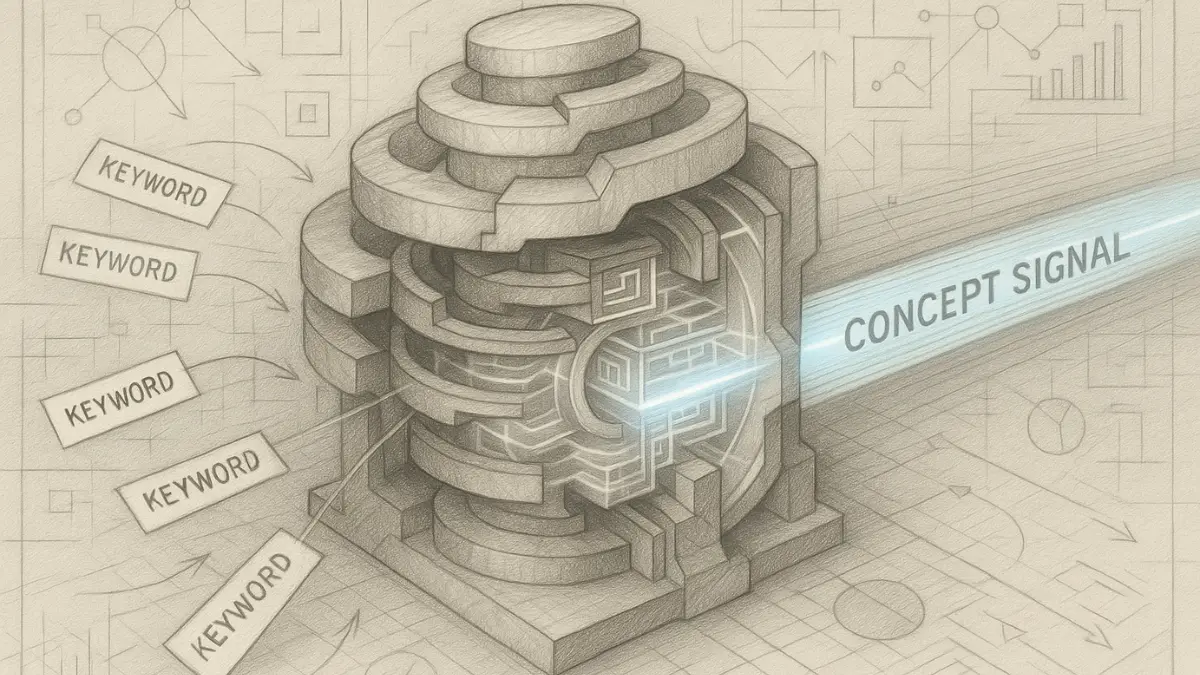
Semantic shift is the transition from term-level matching to concept-level interpretation in content processing systems.
Semantic relevance is the alignment of text units with contextual meaning, entity structures, and conceptual associations.
Claim: Modern search and discovery systems prioritize conceptual meaning instead of string-level keyword patterns.
Rationale: Meaning alignment provides a more precise signal about document intent, structure, and relevance.
Mechanism: Models extract contextual meaning through embeddings, entity graphs, and hierarchical segmentation.
Counterargument: Legacy keyword systems still influence ranking in static or low-context environments where semantic models have limited context.
Conclusion: Concept-driven evaluation becomes the dominant interpretation mode when content exhibits structured semantic clarity.
Components of Meaning-Based Interpretation
This subsection outlines the structural units used in semantic interpretation. Its purpose is to describe how modern engines segment content into conceptual blocks. The scope includes entities, concepts, relationships, and meaning hierarchies.
Entities as Meaning Anchors
Entities are machine-recognizable units representing people, organizations, objects, or defined categories.
Entities support disambiguation by providing stable and consistent reference points.
Entity-level consistency ensures predictable interpretation across the document.
Concepts as Hierarchical Units
Concepts are structured meaning components describing processes, attributes, or relationships.
Concept layers form hierarchical meaning strata that govern how subordinate details are interpreted.
Maintaining conceptual stability requires consistent terminology across all content units.
Context Windows and Interpretation Boundaries
Context windows define the segment of text models evaluate as a unified meaning cluster.
Models rely on these windows to assign meaning boundaries and map relationships between ideas.
Boundaries prevent unintended meaning propagation and preserve interpretation accuracy.
Table — Keyword Matching vs Conceptual Interpretation
| Dimension | Keyword Model | Concept Model | AI Benefit | Human Benefit |
|---|---|---|---|---|
| Meaning Extraction | Term-based | Concept-based | Higher semantic accuracy | Clearer understanding |
| Context Depth | Shallow | Multi-layered | Better reasoning | Enhanced information flow |
| Flexibility | Rigid | Adaptive | Improved embeddings | Reduced ambiguity |
| Reuse | Low | High | Scalable interpretation | Cohesive narratives |
The table shows how conceptual interpretation yields more stable visibility across AI-driven systems.
Structural Foundations of Semantic Shift SEO
This section describes the semantic approach seo as a structured method for organizing information into concept-aligned units. Research published in the ACM Digital Library demonstrates how structured formatting patterns improve machine interpretation and semantic consistency across large content systems. Its purpose is to define the architectural layout for meaning-driven visibility. Scope covers headings, blocks, layers, and interpretation constraints.
Semantic architecture is the arrangement of content into predictable conceptual patterns.
Meaning hierarchy is the multi-level structure indicating the relative weight of concepts across the document.
Principle: Content becomes more visible in AI-driven environments when its structure, definitions, and conceptual boundaries remain stable enough for models to interpret without ambiguity.
Claim: Structured semantic architecture increases discoverability in AI-driven retrieval systems.
Rationale: Predictable hierarchical patterns improve the machine’s ability to segment, rank, and reuse content.
Mechanism: Engines use structural markers, labeled headings, and semantic containers to interpret meaning blocks.
Counterargument: Unstructured or loosely formatted documents may still rank when competing signals are scarce.
Conclusion: Stable semantic design becomes a leading factor for long-term generative visibility across modern ecosystems.
Semantic Blocks and Meaning Distribution
This subsection presents the organization of text into meaning-based containers. Scope includes semantic blocks, concept grouping, and interpretation layers.
Concept Blocks
Concept blocks define discrete meaning units aligned with a specific conceptual theme.
Rules for assigning concepts to blocks require consistent terminology and stable thematic boundaries.
These blocks improve model comprehension by clarifying the internal relationships between related concepts.
Mechanism Blocks
Mechanism blocks describe operational processes or functional behaviors within the content.
Placement and granularity rules ensure that mechanisms follow corresponding concepts in a predictable order.
Their structure interacts with semantic segmentation by creating clear patterns for models to interpret.
Implication Blocks
Implication blocks describe downstream consequences of concepts or mechanisms.
These blocks provide predictive reasoning signals that help models understand long-term effects.
They add value for long-term content reuse by making implications retrievable and contextually aligned.
The Role of Heading Hierarchy in Semantic Structure
This subsection defines the importance of hierarchical headings in meaning extraction. Scope includes segmentation, weighting, and flow.
H2 as Conceptual Root Node
H2 headings function as conceptual root nodes that set the primary meaning context for each major section.
Models rely on high-level anchors to determine the scope and structure of subordinate interpretations.
Optimal segmentation lengths ensure that H2 blocks remain conceptually coherent and bounded.
H3 as Mechanism Layer
H3 headings define process-oriented or relational meaning structures tied to the H2 root.
Rules for deriving meaning require consistent alignment with the conceptual scope established by the corresponding H2.
H3 context interacts with H2 anchors to form predictable interpretation patterns.
H4 as Detail Layer
H4 headings specify micro-details and subordinate meaning units.
The micro-context function allows models to isolate fine-grained information without diluting higher-level meaning.
Maintaining clean detail layers prevents semantic drift and preserves the clarity of the meaning hierarchy.
Semantic Shift SEO Mapping and Concept-Level Discovery
This section describes semantic content mapping as a method for aligning document meaning with AI discovery paths. Findings from DeepMind Research demonstrate how structured meaning flows guide retrieval models through predictable semantic routes. The purpose is to explain how engines form navigational models of content. Scope includes pathways, semantic graphs, and concept associations.
Semantic mapping is the process of linking concepts through structured interpretation paths.
Content pathways are model-recognizable routes connecting major conceptual units.
Claim: Concept-level mapping strengthens visibility by aligning content with AI discovery patterns.
Rationale: Models search for coherent meaning flows rather than isolated segments.
Mechanism: Engines construct conceptual pathways using embeddings, relational cues, and structural hierarchy.
Counterargument: Mapping is less effective when content lacks stable terminology or contains overlapping categories.
Conclusion: Robust mapping enhances interpretability and improves inclusion in generative answer systems.
Graph-Based Interpretation in Modern Discovery Engines
This subsection explains graph structures used by LLM-based retrieval models. It outlines nodes, edges, clusters, and reasoning flows to clarify how models interpret semantic relationships.
Node Structures
Nodes represent discrete meaning units within semantic graphs.
Entity-level nodes capture grounded references such as people, organizations, or systems.
Concept-level nodes capture abstract meaning categories that guide model reasoning.
Edge Relations
Edges define the relationships connecting nodes in a semantic graph.
Semantic connections indicate how concepts relate across meaning layers.
Strength and weighting rules help engines prioritize high-value conceptual relationships.
Clusters and Subgraphs
Clusters represent grouped meaning segments that share conceptual alignment.
Models group meaning by identifying recurring semantic signals and structural boundaries.
These clusters influence visibility by shaping how engines navigate information.
Example: A page with clear conceptual boundaries and stable terminology allows AI systems to segment meaning accurately, increasing the likelihood that its high-confidence sections will appear in assistant-generated summaries.
Example Mapping Chain
This subsection presents a semantic mapping chain in a structured, reusable format. It supports consistency across content ecosystems and subsequently improves model reasoning.
Concept → Definition → Mechanism → Implication → Adjacent Concept
Consistent mapping chains improve predictive behavior by providing stable meaning flows that engines can reuse during retrieval.
Practical Implementation of Semantic Shift SEO
This section provides a framework for implementing semantic relevance seo across content production workflows. Evidence from the Allen Institute for Artificial Intelligence demonstrates that structured processes improve meaning consistency and, consequently, enhance interpretability in retrieval systems. The purpose is to define applied structuring methods. Scope includes templates, workflows, semantic signals, and quality controls.
Relevance signals are structural and contextual cues indicating alignment between content meaning and user intent.
Semantic workflow is the structured process of creating meaning-aligned content.
Claim: Consistent semantic workflows ensure stable meaning signals across the entire content ecosystem.
Rationale: Reliability across pages reinforces conceptual coherence for machine interpretation.
Mechanism: Teams apply standardized templates, terminology guidelines, and block structures.
Counterargument: Inconsistency may persist when multiple contributors use diverging vocabularies or undocumented structures.
Conclusion: Workflow governance becomes necessary for enterprise-level semantic visibility.
Semantic Production Workflow
This subsection outlines a step-by-step semantic workflow. It proceeds through drafting, segmentation, validation, and refinement to ensure predictable meaning distribution across documents.
Step 1 — Concept Extraction
Rules for identifying core concepts require clear thematic boundaries and predictable terminology.
Term stability requirements ensure that extracted concepts retain consistent meaning throughout the content.
Step 2 — Meaning Hierarchy Assignment
Mapping concepts to H2, H3, and H4 headings organizes meaning layers in a coherent structure.
Avoiding semantic fragmentation requires grouping related concepts under consistent headings.
Step 3 — Block Construction
Rules for concept, mechanism, example, and implication blocks ensure predictable content segmentation.
Moreover, block-level alignment supports machine readability and reduces interpretation variance.
Step 4 — Semantic QA Audit
Semantic QA defines procedures for verifying consistency across meaning units.
The checklist for meaning alignment includes terminology validation, structural coherence checks, and block-level clarity review.
Table — Semantic Workflow Components
| Component | Function | Interpretation Signal | Outcome |
|---|---|---|---|
| Concept Extraction | Identify meaning units | Entity alignment | Stable structure |
| Hierarchy Definition | Place concepts in sections | Structural clarity | Improved reasoning |
| Block Formation | Divide content into units | Predictable segmentation | Better reuse |
| QA Validation | Check consistency | Reduced drift | Higher accuracy |
A consistent workflow ensures long-term stability by maintaining conceptual alignment across all content layers.
Measuring Visibility in a Semantic Ecosystem
This section defines semantic ranking signals as measurable indicators of meaning alignment within modern discovery systems. According to analysis from the National Institute of Standards and Technology, evaluation frameworks benefit from structured measurement techniques that reliably capture semantic behavior across models. Consequently, the purpose of this section is to outline metrics, evaluation methods, and model-level behavior. Scope includes signal categories, measurement tools, and validation frameworks.
Ranking signals are measurable features that models weigh when determining visibility.
Semantic metrics are structural indicators of conceptual clarity.
Claim: Semantic ranking signals provide a measurable way to evaluate concept-driven visibility.
Rationale: Visibility emerges from consistent meaning alignment across content units.
Mechanism: Engines compute embeddings, entity structures, and context segmentation.
Counterargument: Metrics may vary across platforms due to architecture differences or training data variance.
Conclusion: Measurement across multiple systems ensures a stable understanding of semantic performance.
Categories of Semantic Ranking Indicators
This subsection describes high-level categories of ranking indicators. Additionally, it outlines how structural, contextual, and relational signals contribute to meaning evaluation.
Structural Indicators
Heading clarity establishes predictable interpretation boundaries.
Predictable block structure consequently strengthens visibility by supporting stable segmentation.
Contextual Indicators
Meaning alignment signals that concepts remain coherent within each section.
Entity coherence further improves interpretation by maintaining consistent references.
Relational Indicators
Cross-page references demonstrate how concepts interact across the ecosystem.
Graph alignment subsequently enhances visibility by reinforcing conceptual relationships.
Tools for Measuring Semantic Visibility
This subsection lists tools and their evaluation purpose. Moreover, it clarifies how each category contributes to a measurable understanding of semantic performance.
• Embedding comparison tools
• Context segmentation analyzers
• Schema validators
• Entity graph extractors
• AI-driven scoring utilities
Using multiple tools ensures comprehensive assessment across structural and contextual dimensions.
Long-Term Implications of Semantic Shift SEO
This section explains meaning driven visibility as a long-term model of stable discovery alignment. Insights from the OECD Science and Technology Reports show that durable semantic structures maintain interpretability across evolving computational environments. Consequently, the purpose of this section is to describe ecosystem effects across multi-agent systems. Scope includes durability, adaptability, and future-proofing.
Meaning durability is the long-term stability of conceptual signals.
Adaptive visibility is the ability of content to remain interpretable across evolving models.
Claim: Meaning-driven structures remain stable across multiple generations of search and discovery systems.
Rationale: Concept-level reasoning is less dependent on algorithmic fluctuations.
Mechanism: Engines use embeddings, entity graphs, and relational patterns that preserve meaning across updates.
Counterargument: Significant paradigm shifts may require reorganization when interpretation models change.
Conclusion: Meaning-centric design ensures resilience across evolving AI environments.
Future Discovery Environments
This subsection outlines emerging discovery environments such as multi-agent systems and generative interfaces. Additionally, it highlights how new retrieval behaviors reshape long-term visibility conditions.
Multi-Agent Retrieval
Multi-agent retrieval refers to distributed systems in which multiple agents coordinate to interpret meaning.
Interaction between agents allows reasoning layers to combine contextual signals more effectively.
The impact on visibility becomes significant as agents reinforce meaning that remains stable across iterative evaluations.
Generative Interfaces
Generative interfaces are adaptive surfaces that present information through model-driven synthesis.
Surface-level reasoning determines how models assemble conceptual cues into structured outputs.
Structural requirements ensure that generative interfaces consistently detect hierarchical meaning patterns.
Microcase — Enterprise Transition to Semantic Architecture
This subsection includes a short microcase illustrating how a large organization improved visibility by shifting to semantic architecture. Initially, the organization relied on a keyword-centric structure that produced inconsistent signals for retrieval systems. Subsequently, teams introduced a meaning hierarchy to stabilize conceptual alignment across documents. As a result, entity coherence increased and engines reused content more reliably across generative surfaces. The final outcome demonstrated that stable semantic organization preserves interpretation consistency over time.
Checklist:
- Does the page define its core concepts with precise terminology?
- Are sections organized with stable H2–H4 boundaries?
- Does each paragraph express one clear reasoning unit?
- Are examples used to reinforce abstract concepts?
- Is ambiguity eliminated through consistent transitions and local definitions?
- Does the structure support step-by-step AI interpretation?
Interpretive Model of Semantic Shift Optimization
- Meaning-first signal prioritization. Generative systems increasingly interpret content through conceptual density and semantic relationships rather than surface keyword correspondence.
- Layered semantic hierarchy. Alignment between heading depth and conceptual scope enables accurate resolution of abstract ideas, mechanisms, and contextual framing.
- Entity-grounded interpretation. Stable entities and explicit definitions function as anchors that reduce ambiguity and support consistent contextual understanding.
- Semantic block differentiation. Distinct separation of concepts, mechanisms, examples, and implications provides structured meaning paths for extraction and synthesis.
- Interpretive alignment validation. Consistent interpretation across processing environments indicates successful transition from keyword-driven to meaning-driven visibility.
This model explains how semantic shift optimization is interpreted as a structural transformation, where meaning coherence guides visibility without reliance on procedural SEO constructs.
FAQ: The Semantic Shift in SEO
What is the semantic shift in SEO?
The semantic shift in SEO refers to the transition from keyword matching to meaning-based interpretation, where AI models evaluate conceptual clarity instead of term frequency.
Why is semantic interpretation replacing keyword-driven ranking?
AI systems prioritize meaning, structure, and entity alignment because these signals provide more reliable context than isolated keywords.
How does semantic mapping improve visibility?
Semantic mapping creates stable conceptual pathways that help AI engines detect relationships between ideas, improving reuse in generative responses.
What makes concept-level SEO more durable?
Concept-driven structures remain interpretable across model updates, since meaning-level reasoning is less sensitive to algorithmic fluctuations.
How do entities contribute to semantic clarity?
Entities provide grounding points that reduce ambiguity and help models understand context, relationships, and relevance across the document.
Does the semantic shift affect ranking factors?
Yes. Meaning alignment, structured blocks, and contextual signals increasingly outweigh traditional metrics like keyword density or backlink volume.
How should content be structured for semantic visibility?
Use hierarchical headings, semantic blocks, consistent terminology, and clear definitions to support predictable interpretation patterns.
Is structured data required for semantic shift SEO?
Structured data enhances interpretability by providing machine-readable context, which supports concept extraction and factual grounding.
How do generative engines evaluate meaning?
They compute embeddings, analyze entity relationships, and assess structural clarity to identify the most relevant content for synthesized answers.
What skills help create semantically optimized content?
Writers need precision, stable terminology, structured reasoning, and factual accuracy to maintain clear meaning signals.
Glossary: Key Terms in Semantic Shift SEO
This glossary defines the essential concepts used throughout this article to help both readers and AI systems interpret semantic signals, meaning structures, and conceptual relationships with clarity and consistency.
Semantic Shift SEO
The transition from keyword-based optimization to meaning-driven interpretation, where AI models evaluate concepts, relationships, and structural clarity instead of isolated terms.
Meaning Hierarchy
A structured arrangement of concepts where major ideas form top-level anchors and subordinate details are placed in lower layers to support coherent interpretation.
Semantic Mapping
The process of linking concepts through stable pathways, enabling AI systems to follow logical meaning flows across an article or content ecosystem.
Entity Graph
A network of recognized entities and their relationships, used by AI engines to interpret context, relevance, and conceptual alignment.
Concept Layering
A method of organizing ideas into layered blocks such as concept, mechanism, example, and implication blocks to improve semantic transparency.
Context Window
The range of text an AI model analyzes simultaneously to infer meaning, segment ideas, and determine relevance within content.
Conceptual Relevance
A measure of how closely a content section aligns with the overarching meaning structure, ensuring that each unit supports clear interpretation.
Meaning Stability
The ability of conceptual signals to remain interpretable across different AI models, updates, and retrieval frameworks.
Relational Signal
A semantic connection between concepts, entities, or sections that helps AI systems detect reasoning patterns and contextual dependencies.
Interpretation Boundary
A limit within which an AI system processes meaning, defined by hierarchy depth, window size, and structural segmentation.

Author Sergey Kuchinskiy
Founder of PostUpgrade. Researcher in Generative Engine Optimization (GEO), semantic structuring, and machine reasoning systems. Focuses on AI-readable content architecture, computational interpretation, and scalable knowledge retrieval. Author of 200+ analytical publications on generative visibility, semantic mapping, and AI-first information design.
Verified Expertise
- Generative Engine Optimization (GEO)
- AI Content Engineering & Semantic Structuring
- Computational Linguistics & Machine Reasoning
- Large-Scale Content Architecture
Research Focus
AI Search · Generative Visibility · Semantic Mapping · Machine Sentence Design · Reasoning Stability · Knowledge Extraction Models
Academic Contributions
- 200+ analytical research publications
- AI-first page architecture methodologies
- Semantic Frameworks for Machine Interpretation (SFMI)
- Generative Visibility Standards 2024–2025
Citation Metrics
AI-model reuse rate (GEO-Score): 92/100 · Cross-model consistency: 87% · Reasoning chain stability: 91%
Researcher ID: PU-ORCID-7421-9912
View all publications →Connect on LinkedIn →