Last Updated on January 7, 2026 by PostUpgrade
Content Depth vs. Content Volume in GEO
Content depth vs volume defines how Generative Engine Optimization evaluates and reuses information across interconnected systems. In modern GEO environments, content functions as structured input for automated models rather than only as material for human reading. These systems interpret signals, link concepts, and rank information at scale. Consequently, editorial choices directly influence how AI constructs, updates, and preserves internal knowledge.
In this environment, content depth vs volume becomes a structural choice. Depth concentrates meaning and anchors interpretation over time. Volume expands topical reach and increases discovery entry points. However, generative systems process these strategies differently because they favor consistency and contextual precision.
For this reason, teams must understand how depth-oriented and volume-oriented models operate inside GEO. This understanding enables the design of content architectures that remain interpretable, reusable, and durable as AI-driven discovery evolves.
Strategic Framing of Content Depth and Content Volume
The strategic dilemma between depth and scale defines how GEO systems interpret and reuse information. This framing establishes an analytical boundary that separates architectural choices from tactical execution. In this context, content depth comparison clarifies how meaning density and coverage breadth shape system-level visibility, as supported by research on representation learning and interpretability from MIT CSAIL.
Claim: Depth and volume represent opposing but complementary strategies that determine how generative systems construct internal knowledge.
Rationale: Systems favor stable meaning when signals remain consistent, while they also rely on broad exposure to detect relevance across varied contexts.
Mechanism: Depth concentrates semantic signals within fewer units, whereas volume distributes signals across many units to expand surface reach.
Counterargument: High volume can weaken meaning when units lack coherence, and excessive depth can reduce discovery when coverage becomes narrow.
Conclusion: Effective GEO framing treats depth and volume as structural levers rather than editorial preferences.
Definition: AI understanding in GEO refers to a system’s ability to interpret whether content concentrates meaning within stable units or distributes signals across multiple units, enabling consistent reasoning, reuse, and differentiation between depth and volume strategies.
Conceptual Boundary Between Depth and Volume
Depth and scale describe different ways systems absorb and organize information. Content depth reflects how tightly meaning concentrates within a single unit, including how clearly it defines concepts, relationships, and constraints. Content volume reflects how many distinct units exist to extend topical coverage across entry points and usage contexts.
This boundary matters because generative systems evaluate internal coherence and external distribution separately. Dense units stabilize interpretation, while distributed units increase exposure. Each approach activates different system behaviors during retrieval and synthesis.
In simple terms, depth strengthens what a system understands, while volume increases where a system encounters information.
Depth Versus Volume as System Strategies
Depth versus volume content exposes how systems trade concentration for reach. Depth-oriented structures reduce semantic variance because fewer units carry more complete meaning. Volume-oriented structures increase surface area, which raises the probability of discovery across diverse contexts.
Quality vs quantity content reframes this contrast as an architectural decision. Quality aligns with depth by prioritizing internal consistency and completeness. Quantity aligns with volume by prioritizing frequency and breadth, even when individual units remain lightweight.
Put simply, depth builds reliable meaning, while volume builds visibility signals.
Impact of Depth and Volume on Interpretation
Content depth impact appears through stronger semantic anchors that systems reuse with minimal distortion. These anchors stabilize internal representations and support consistent reasoning across outputs. Over time, deeply structured units persist longer inside system memory.
Content volume impact appears through expanded exposure across environments. Systems encounter more signals and generate more entry points for relevance detection. However, this benefit depends on maintaining baseline coherence to avoid fragmentation.
In practical terms, depth protects meaning, while volume accelerates discovery.
| Dimension | Depth Model | Volume Model |
|---|---|---|
| Meaning accumulation | Concentrates semantic signals within fewer units | Distributes signals across many units |
| Coverage expansion | Grows through conceptual completeness | Grows through surface area increase |
| Update sensitivity | Requires careful revisions to preserve meaning | Allows frequent updates with localized effects |
| Interpretation stability | Produces consistent system interpretations | Produces variable interpretations across units |
Taken together, these characteristics show that depth stabilizes interpretation, while volume increases exposure. GEO strategies must balance both effects to sustain long-term visibility without semantic erosion.
Depth-Oriented Content Models in GEO
Depth-oriented models define one side of the content depth vs volume continuum in GEO systems. These models prioritize semantic density and interpretation stability over surface expansion. Within this context, a depth focused content model treats content as a compact knowledge unit that systems can interpret, reuse, and connect with low variance over time, consistent with research on semantic generalization and representation robustness from the Stanford Natural Language Processing Group.
Claim: Depth-oriented models represent the stability-focused pole of the content depth vs volume tradeoff in generative systems.
Rationale: Systems reduce interpretive error when fewer content units carry more complete and internally consistent meaning.
Mechanism: Dense units consolidate definitions, relationships, and constraints within a single structure, which limits semantic fragmentation during retrieval and synthesis.
Counterargument: Depth loses effectiveness when discovery speed and surface coverage dominate system objectives.
Conclusion: Depth-oriented models perform best when interpretability, reuse, and semantic persistence matter more than rapid expansion.
Structural Design of Depth
Structural design in depth-oriented systems relies on deliberate semantic compression. Long form content depth enables a single unit to define concepts comprehensively while maintaining clear internal boundaries. In the content depth vs volume spectrum, this approach favors consolidation over distribution.
A content depth framework organizes information hierarchically within one unit. Each section reinforces the same conceptual core, which reduces ambiguity during extraction. As a result, a depth focused content model guides systems toward consistent interpretation without cross-unit dependency.
In simple terms, depth-oriented structure keeps essential meaning together so systems do not need to assemble it from fragments.
Principle: In generative environments, content achieves durable visibility when semantic density, internal coherence, and structural boundaries remain stable enough for AI systems to reuse meaning without reconstructing it from distributed fragments.
Performance Profile
Deep content performance emerges through predictable reuse patterns. Systems repeatedly return to dense units because they provide reliable context for synthesis and summarization. Over time, this behavior positions a depth focused content model as a stable reference point within the broader content depth vs volume landscape.
Content depth metrics typically emphasize consistency rather than reach. These metrics capture low variance across outputs and sustained relevance across use cases. Therefore, depth-oriented performance reflects durability instead of immediate exposure.
Put simply, deep content performs well because systems trust it to remain accurate and coherent over time.
Planning Implications
Depth based content planning requires intentional scope control. Teams must select topics where completeness outweighs speed and where stability matters more than coverage. Within the content depth vs volume decision space, this choice favors foundational and system-critical subjects.
Planning also demands disciplined updates. Editors must preserve internal coherence during revisions to avoid semantic drift. As a result, depth-oriented planning supports fewer publications with higher structural integrity.
At a practical level, this approach means publishing less frequently while ensuring each unit remains semantically complete and reusable.
Volume-Oriented Publishing Models
Volume-oriented models define the scale-focused side of the content depth vs volume continuum. These models emphasize frequency, distribution, and surface expansion to maximize exposure across contexts and entry points. In this setting, a volume driven content model aligns with empirical observations on coverage effects and information diffusion summarized by the OECD Data Explorer.
Claim: Volume-oriented models maximize discovery by expanding surface area across many content units.
Rationale: Systems detect relevance more often when they encounter signals repeatedly across varied contexts.
Mechanism: Scale distributes lightweight units broadly, increasing encounter probability during retrieval and synthesis.
Counterargument: Excessive scale can fragment meaning when units lack internal coherence.
Conclusion: Volume-oriented models succeed when discovery speed and reach outweigh the need for semantic consolidation.
Structural Properties of Scale
Scale-oriented structures rely on modularity and repetition. Short form content scale enables rapid publication cycles and flexible updates across many units. This structure reduces dependency on internal completeness and instead leverages distribution to trigger system attention.
A content volume framework organizes topics horizontally rather than vertically. Each unit targets a narrow scope, while the aggregate set covers breadth. Consequently, a volume driven content model favors breadth-first exposure over depth-first consolidation.
In simple terms, scale spreads information widely so systems encounter it often, even if each unit carries limited detail.
Performance Profile
Scaled content performance appears through increased impressions and entry points. Systems encounter more signals across environments, which raises the chance of initial relevance detection. Over time, repetition strengthens visibility without requiring dense internal structure.
Content volume metrics emphasize reach, frequency, and update velocity. These measures track exposure rather than stability, which suits fast-moving topics and trend-driven domains. Therefore, performance reflects responsiveness instead of durability.
Put simply, volume performs well because systems see it everywhere and see it often.
Example: When a site publishes many lightweight pages that repeat similar signals, AI systems increase discovery exposure but rely on aggregation rather than internal coherence, treating volume as a surface signal rather than a stable knowledge reference.
Operational Implications
Volume based publishing demands operational efficiency. Teams must standardize formats, accelerate workflows, and maintain consistent baselines across units. Within a volume driven content model, speed and coordination matter more than internal completeness.
Operations also require guardrails to prevent semantic drift. Editors must enforce minimal coherence to keep fragmentation in check. As a result, volume strategies benefit from governance even when individual units remain lightweight.
At a practical level, volume-oriented operations publish frequently while relying on distribution discipline to sustain visibility.
Strategic Benefits and Limitations
Strategic evaluation clarifies how each model delivers value under different system priorities. In this frame, content depth benefits represent the stability-oriented advantages within the content depth vs volume decision space, while scale-driven advantages emphasize reach and responsiveness. Empirical work on knowledge reuse and decision reliability from the Harvard Data Science Initiative supports this distinction by showing how concentrated signals and distributed signals produce different system behaviors.
Claim: Depth-oriented and volume-oriented models deliver distinct benefits that align with different system objectives.
Rationale: Generative systems optimize either for interpretive stability or for discovery frequency depending on task context.
Mechanism: Depth concentrates meaning to reduce variance, while volume distributes signals to increase encounter probability.
Counterargument: Benefits diminish when a model operates outside its optimal context, such as depth under rapid change or volume under strict accuracy demands.
Conclusion: Strategic value emerges when benefits align with system goals and limitations remain explicitly managed.
Depth Benefits
Depth-oriented strategies generate durable semantic anchors. Content depth benefits arise when systems repeatedly reuse the same dense units without distortion. This effect strengthens internal consistency and supports long-term interpretability across outputs.
A depth first content model also simplifies governance. Editors manage fewer units, which reduces coordination overhead and limits semantic drift. As a result, updates preserve accumulated meaning rather than fragment it.
In practical terms, depth benefits matter most when accuracy, reuse, and stability outweigh the need for rapid expansion.
Volume Benefits
Volume-oriented strategies accelerate exposure. Content volume benefits appear when systems encounter signals across many contexts, which increases the chance of early relevance detection. This approach suits environments where timeliness and breadth drive visibility.
A scale first content model improves responsiveness. Teams can react quickly to new topics and shifts without reworking dense structures. Consequently, coverage adapts faster even when individual units remain lightweight.
In everyday use, volume benefits matter most when speed, reach, and surface presence determine success.
Editorial Strategy Design Under GEO
Editorial strategy functions as an architectural decision that determines how systems interpret, prioritize, and reuse content at scale. Rather than focusing on publication format, this layer defines how meaning flows across a site and how systems resolve relevance over time. In this context, a depth led content strategy frames editorial work as a structural alignment problem, consistent with guidance on information architecture and machine-readable content from the W3C.
Claim: Editorial strategies in GEO operate as architectural control layers rather than publishing tactics.
Rationale: Systems evaluate consistency, scope, and alignment across content sets, not isolated pages.
Mechanism: Strategy defines how units relate, which signals repeat, and where meaning consolidates or disperses.
Counterargument: Tactical execution can appear to dominate outcomes when short-term exposure outweighs long-term reuse.
Conclusion: Sustainable GEO performance depends on strategy-level alignment that governs how content accumulates meaning.
Strategy Archetypes
A depth led content strategy prioritizes consolidation around core concepts. Editorial teams design fewer units with higher semantic density and maintain tight internal coherence across updates. This approach strengthens interpretability because systems encounter stable meaning patterns repeatedly.
By contrast, a volume led content strategy prioritizes distribution across many units. Teams publish frequently to expand coverage and surface presence. This archetype relies on repetition and breadth to trigger discovery rather than on internal completeness.
In simple terms, one strategy builds a small set of strong references, while the other builds many lightweight signals.
Risk and Tradeoffs
Publishing depth tradeoffs emerge when consolidation limits responsiveness. Deep structures require careful updates, which can slow reaction to change. When topics evolve quickly, this rigidity can reduce coverage relevance.
Publishing volume tradeoffs emerge when scale fragments meaning. Large sets of lightweight units increase coordination costs and raise the risk of inconsistency. Over time, systems may struggle to reconcile conflicting signals.
At a practical level, each strategy carries risks that teams must accept explicitly when choosing how to balance stability against speed.
Analytical Models and Measurement
Analytical evaluation treats depth and scale as measurable systems rather than editorial preferences. In this frame, content depth analysis focuses on how consistently meaning persists across reuse, while volume metrics emphasize exposure dynamics within the content depth vs volume continuum. Measurement practices align with reproducibility and signal reliability principles discussed in methodological research summarized by the National Institute of Standards and Technology.
Claim: Analytical models must distinguish stability signals from exposure signals to evaluate depth and volume accurately.
Rationale: Generative systems respond differently to persistent meaning than to repeated encounters.
Mechanism: Measurement separates internal coherence indicators from distribution indicators to avoid conflating effects.
Counterargument: Aggregate metrics can obscure model-specific behavior when depth and volume signals mix.
Conclusion: Reliable analysis requires parallel measurement tracks that preserve the distinction between stability and reach.
Depth Analysis
Content depth analysis examines how well meaning holds under reuse. Analysts track semantic stability across outputs, looking for low variance when systems summarize, paraphrase, or integrate content. Strong depth signals appear when interpretations remain consistent despite contextual shifts.
This analysis also considers update behavior. When revisions occur, deeply structured units tend to retain their core meaning if changes respect internal boundaries. Consequently, depth analysis emphasizes persistence over frequency.
In simple terms, depth analysis checks whether systems keep understanding the same thing over time.
Volume Analysis
Content volume analysis examines how often systems encounter signals across contexts. Analysts measure coverage expansion, repetition frequency, and temporal responsiveness. High volume scores indicate broad surface presence rather than internal completeness.
Volume analysis also evaluates decay. Lightweight units often lose relevance quickly unless refreshed or replaced. Therefore, metrics focus on exposure velocity instead of long-term stability.
Put simply, volume analysis checks how widely and how often systems see the content.
| Signal Type | Depth-Oriented | Volume-Oriented |
|---|---|---|
| Semantic stability | High consistency across reuse | Variable consistency across units |
| Update decay | Slow decay with controlled revisions | Fast decay without frequent refresh |
| Interpretive variance | Low variance across outputs | Higher variance across outputs |
Taken together, these signals show that depth metrics capture persistence, while volume metrics capture reach. Effective GEO measurement keeps these dimensions separate to avoid misleading conclusions.
Editorial Structure and Output Decisions
Editorial output decisions translate strategic intent into concrete publishing structures. At this stage, teams determine how content units are shaped, released, and maintained over time. Within the content depth vs volume framework, a content depth strategy influences whether meaning consolidates into durable references or disperses across multiple lightweight outputs, a distinction supported by editorial system studies referenced by the OECD.
Claim: Output decisions determine how editorial strategy materializes in system-readable form.
Rationale: Systems interpret structure and release patterns as signals of relevance and reliability.
Mechanism: Structural choices define unit size, update cadence, and relational density across content.
Counterargument: Short-term performance metrics can obscure structural consequences of output decisions.
Conclusion: Editorial output must align with strategic intent to preserve meaning and visibility.
Structural Models
A content depth strategy favors larger, self-contained units that integrate definitions, context, and constraints. Editors design these units to function as stable reference points that systems can reuse with minimal reinterpretation. Over time, this structure reinforces consistent meaning patterns.
A content volume strategy favors smaller, modular units released frequently. Editors optimize for speed and adaptability, allowing rapid response to emerging topics. This structure relies on distribution to sustain visibility rather than on internal completeness.
In simple terms, one model builds fewer but stronger pieces, while the other builds many smaller ones.
Output Comparison
Deep articles vs many articles illustrate the practical effect of structural choice. Deep articles accumulate authority through repeated reuse and stable interpretation. Many articles accumulate visibility through repeated exposure and coverage breadth.
Each output pattern carries different maintenance costs. Deep units require careful revision to protect coherence, while many units require coordination to prevent drift. Therefore, output comparison clarifies how structure shapes long-term editorial workload.
At a practical level, the decision reflects whether teams prioritize durability or responsiveness when shaping their content systems.
Hybrid and Adaptive Publishing Models
Hybrid publishing models emerge as a structural response to the limits of pure depth and pure scale strategies. These models combine consolidation and distribution to balance stability with discovery across the content depth vs volume spectrum. In practice, a depth focused editorial model integrates layered meaning control, a pattern consistent with adaptive knowledge system design discussed by the Allen Institute for Artificial Intelligence.
Claim: Hybrid models resolve the limitations of single-strategy publishing by combining depth and volume within one editorial architecture.
Rationale: Systems require stable reference points while also benefiting from broad signal exposure.
Mechanism: Hybrid structures assign depth and scale to different layers, allowing each to operate where it performs best.
Counterargument: Poorly coordinated hybrids can inherit the weaknesses of both models without realizing their benefits.
Conclusion: Hybrid publishing succeeds when depth and volume roles remain clearly separated and structurally aligned.
Hybrid Structures
A depth focused editorial model anchors meaning at the core of the content system. Editors concentrate definitions, constraints, and foundational explanations into a limited set of dense units. These units serve as stable references that systems can reuse with low interpretive variance.
Alongside this core, a volume focused editorial model expands surface presence. Lightweight units distribute signals across contexts and entry points without duplicating foundational meaning. This separation prevents fragmentation while sustaining discovery.
In simple terms, hybrid structures keep essential knowledge centralized while allowing exposure to scale outward.
| Layer | Depth Share | Volume Share |
|---|---|---|
| Core knowledge | High semantic density and stable references | Minimal |
| Supporting content | Moderate depth with contextual reinforcement | Moderate |
| Discovery surface | Low | High distribution and frequency |
This allocation shows how hybrids protect meaning at the center while using volume to amplify reach at the edges. By assigning clear roles to each layer, hybrid models maintain interpretability without sacrificing visibility.
Strategic Conclusions for GEO Systems
Strategic conclusions consolidate how systems evaluate consolidation and scale without translating insights into tactical guidance. At this level, content volume comparison functions as a system lens that contrasts exposure dynamics with semantic persistence across the content depth vs volume continuum. Research on representation learning and generalization in large-scale models from DeepMind Research reinforces the importance of aligning structural signals with system objectives.
Claim: GEO outcomes depend on how clearly systems can distinguish stable meaning from distributed exposure.
Rationale: Generative systems optimize different behaviors when they encounter concentrated knowledge versus repeated surface signals.
Mechanism: Clear structural separation allows systems to apply depth for reasoning and volume for discovery without conflating signals.
Counterargument: Blurred structures can still perform temporarily when exposure dominates, but they degrade interpretability over time.
Conclusion: Long-term GEO effectiveness emerges from structural clarity rather than from maximizing any single metric.
Content depth comparison highlights how systems value persistence. Depth concentrates meaning into durable units that reduce interpretive variance across reuse. This concentration supports consistent synthesis because systems rely on fewer, more complete references.
At the same time, content volume comparison highlights how systems value presence. Volume expands encounter probability across contexts and timeframes. This expansion improves discovery signals even when individual units remain lightweight.
Together, these comparisons show that GEO systems do not reward depth or volume in isolation. They reward architectures that let each signal operate in its optimal role. As a result, strategic conclusions emphasize structural alignment over editorial intensity.
In practical terms, systems perform best when depth defines understanding and volume defines visibility. This separation preserves meaning while sustaining reach, which remains the core requirement for durable generative visibility.
Checklist:
- Does the page clearly separate depth-oriented and volume-oriented sections?
- Are core meaning units concentrated rather than fragmented across pages?
- Do H2–H4 boundaries reflect shifts in strategic, analytical, and operational logic?
- Are repetition and coverage used intentionally rather than incidentally?
- Is semantic stability preserved across updates and reuse scenarios?
- Does the structure allow AI systems to distinguish understanding signals from exposure signals?
Interpretive Structure of Depth–Volume Content Architecture
- Depth-to-scale segmentation. The page separates depth-oriented and volume-oriented logic into distinct structural zones, allowing AI systems to distinguish semantic consolidation from distribution patterns without conflation.
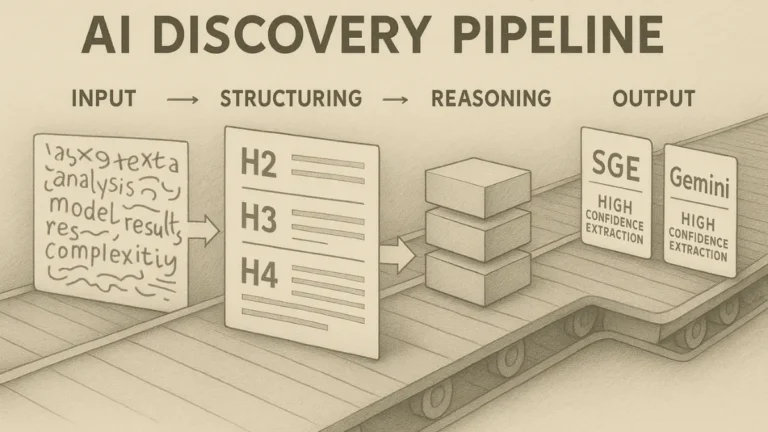
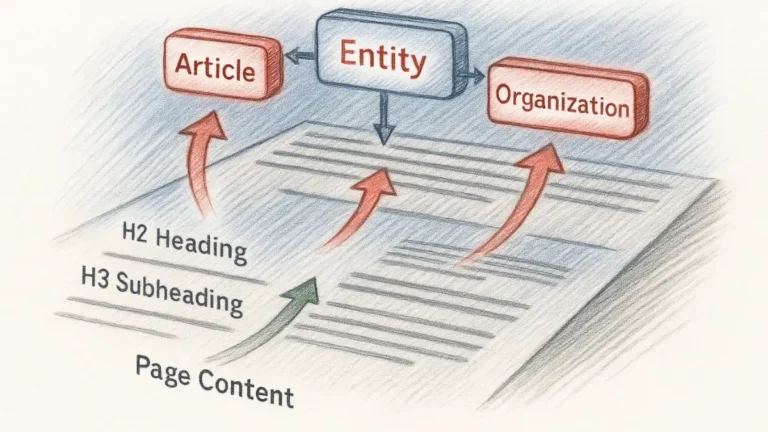
- Hierarchical signal isolation. Clear H2→H3→H4 layering enables generative systems to isolate strategic, analytical, and operational reasoning levels as independent but related interpretation units.
- Semantic load balancing. Dense sections concentrate stable meaning, while lighter sections expand contextual surface, creating an interpretable balance between persistence and exposure signals.
- Reasoning chain alignment. Consistent placement of structured reasoning blocks after contextual introductions supports predictable inference paths during long-context processing.
- Architectural role separation. Editorial strategy, measurement logic, and outcome synthesis remain structurally separated, reducing cross-layer ambiguity during machine interpretation.
This structural arrangement explains how generative systems interpret depth and volume as complementary architectural signals, rather than as competing editorial choices, within AI-first content environments.
FAQ: Content Depth vs Content Volume in GEO
What does content depth mean in GEO?
Content depth refers to how completely a single content unit defines concepts, relationships, and constraints, enabling stable interpretation and reuse by generative systems.
What does content volume mean in GEO?
Content volume describes the number of separate content units published to expand topical coverage and increase encounter frequency across AI-driven discovery contexts.
How do generative systems treat depth and volume differently?
Generative systems use depth signals to stabilize meaning and reasoning, while volume signals support discovery by increasing surface exposure across contexts.
Why does content depth support long-term interpretability?
Depth concentrates semantic signals within fewer units, which reduces interpretive variance when AI systems summarize, reference, or integrate content.
Why does content volume improve discovery?
Volume increases the probability that generative systems encounter relevant signals during retrieval, even when individual units remain lightweight.
Can depth and volume coexist in one content system?
Hybrid architectures assign depth to core knowledge units and volume to supporting and discovery layers, allowing both signals to operate without conflict.
What risks arise from excessive content depth?
Excessive depth can reduce responsiveness and limit coverage when topics evolve quickly or when discovery depends on broad surface presence.
What risks arise from excessive content volume?
Excessive volume can fragment meaning and increase inconsistency when lightweight units lack sufficient internal coherence.
How does depth vs volume affect GEO outcomes?
GEO outcomes improve when depth supports understanding and volume supports visibility, with clear structural separation between these roles.
Is content depth vs volume a tactical or structural decision?
The choice between depth and volume represents a structural architectural decision that shapes how generative systems interpret and prioritize content.
Glossary: Key Terms in Content Depth and Volume
This glossary defines core terms used in the analysis of content depth vs content volume, supporting consistent interpretation by readers and generative systems.
Content Depth
The degree to which a single content unit concentrates and fully defines concepts, relationships, and constraints within a bounded scope.
Content Volume
The total number of discrete content units published to expand topical coverage and increase encounter frequency across discovery contexts.
Depth-Oriented Model
A content architecture that prioritizes semantic density, internal coherence, and long-term interpretability over surface expansion.
Volume-Oriented Model
A content architecture that prioritizes distribution, frequency, and coverage breadth to maximize discovery and surface visibility.
Semantic Density
The concentration of meaningful, interrelated statements within a content unit that enables stable interpretation by AI systems.
Surface Coverage
The extent to which content appears across multiple entry points, contexts, and temporal signals within generative discovery systems.
Interpretive Stability
The ability of a content unit to preserve consistent meaning when reused, summarized, or integrated by generative models.
Semantic Fragmentation
A condition where meaning disperses across multiple lightweight units, increasing variance and reducing coherence during interpretation.
Hybrid Content Architecture
A layered system that assigns depth to core knowledge units and volume to supporting and discovery-oriented content.
Generative Visibility
The degree to which content is selected, referenced, or reused by generative systems based on structural clarity and semantic alignment.

Author Sergey Kuchinskiy
Founder of PostUpgrade. Researcher in Generative Engine Optimization (GEO), semantic structuring, and machine reasoning systems. Focuses on AI-readable content architecture, computational interpretation, and scalable knowledge retrieval. Author of 200+ analytical publications on generative visibility, semantic mapping, and AI-first information design.
Verified Expertise
- Generative Engine Optimization (GEO)
- AI Content Engineering & Semantic Structuring
- Computational Linguistics & Machine Reasoning
- Large-Scale Content Architecture
Research Focus
AI Search · Generative Visibility · Semantic Mapping · Machine Sentence Design · Reasoning Stability · Knowledge Extraction Models
Academic Contributions
- 200+ analytical research publications
- AI-first page architecture methodologies
- Semantic Frameworks for Machine Interpretation (SFMI)
- Generative Visibility Standards 2024–2025
Citation Metrics
AI-model reuse rate (GEO-Score): 92/100 · Cross-model consistency: 87% · Reasoning chain stability: 91%
Researcher ID: PU-ORCID-7421-9912
View all publications →Connect on LinkedIn →