Last Updated on February 27, 2026 by PostUpgrade
Best Page Structure for AI Search Optimization
Best Page Structure for AI Search Optimization
AI page structure optimization has become the foundation of visibility in modern search.
Today’s AI engines no longer rely on keyword density or backlinks — they analyze how information is structured, how ideas connect, and how meaning unfolds.
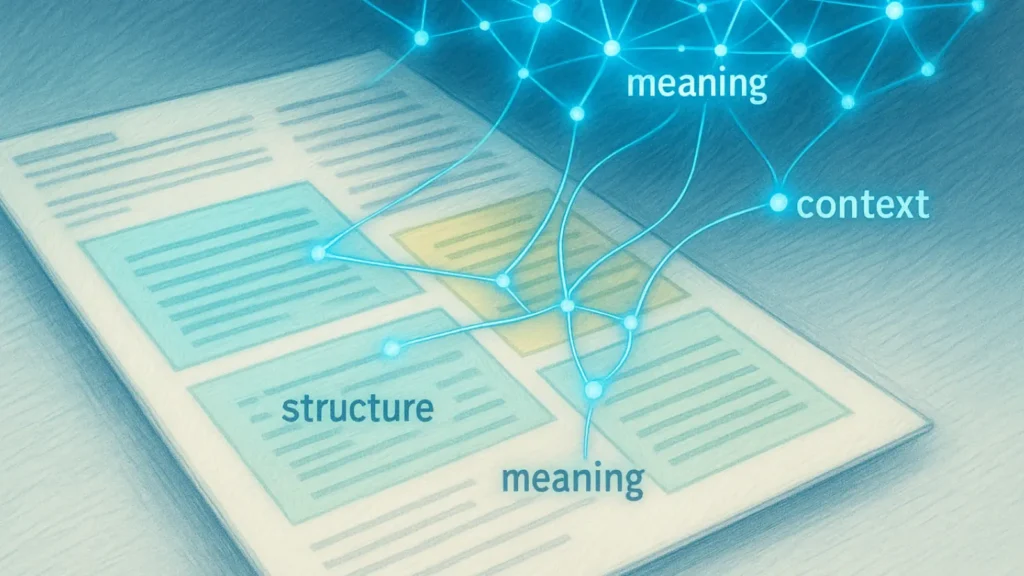
Structure defines comprehension not visually but semantically, turning your page architecture into the logic that artificial intelligence understands.
Definition: AI page structure optimization refers to the process of organizing headings, meanings, and factual segments into machine-readable units that large language models can interpret, classify, and reuse with high accuracy.
How AI Models Interpret Page Architecture
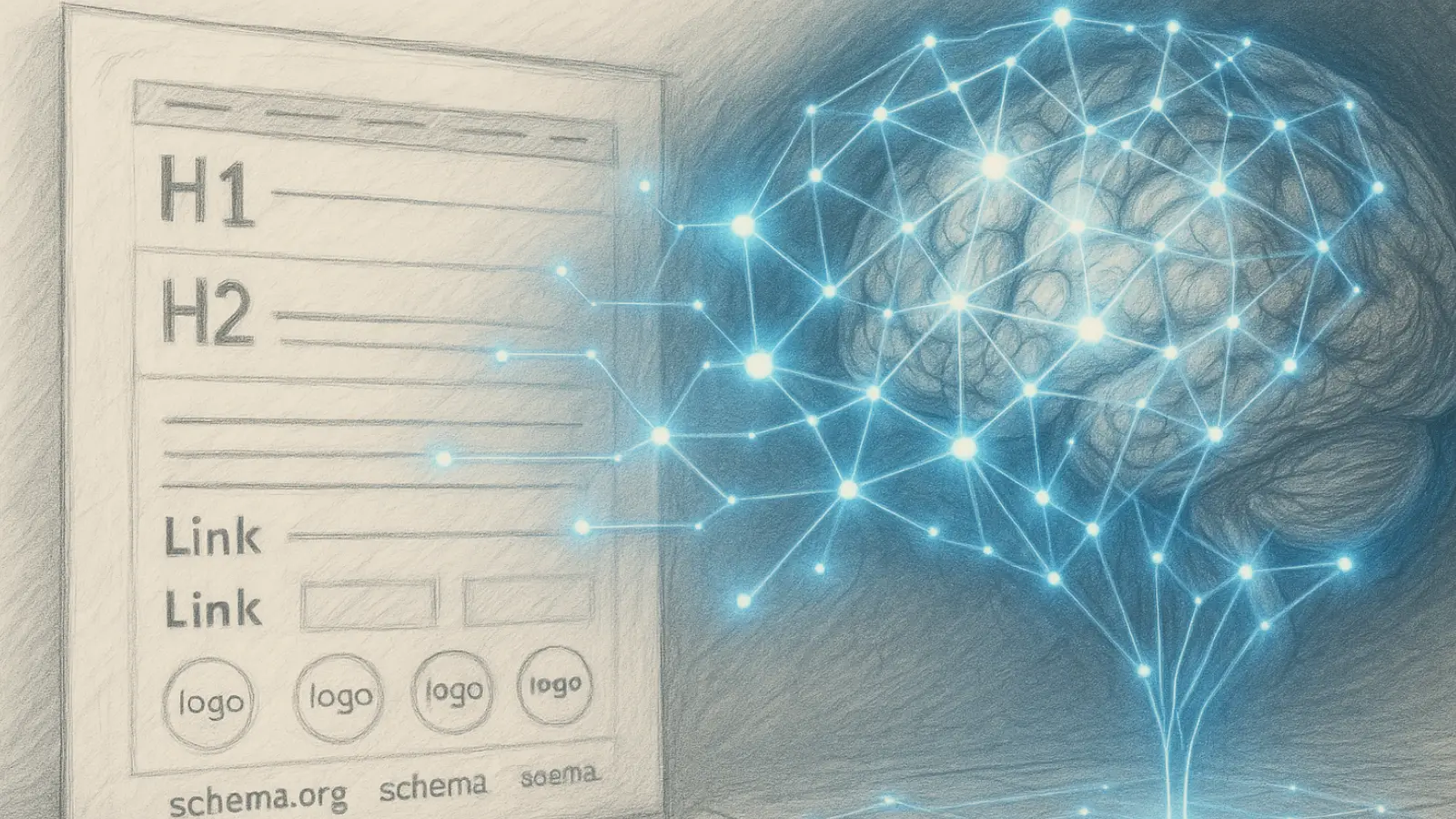
AI systems such as Google SGE and Perplexity AI convert every page into a network of entities and contextual relationships. Instead of scanning for words, they detect the flow of meaning between headings, paragraphs, and factual statements.
When the content hierarchy is consistent, models can determine where one concept ends and another begins — improving summary accuracy and factual retention.
According to MIT CSAIL research, large language models rely on structural cues to extract and prioritize meaning, proving that text organization directly affects machine understanding.
From Visual Layout to Logical Sequence
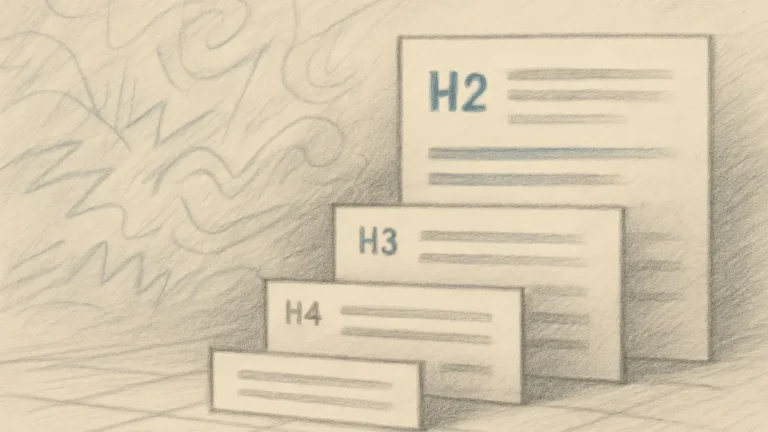
Artificial intelligence rewards logical order over visual design. A well-defined structure — H1 for the theme, H2 for the argument, H3 for the evidence — helps models reconstruct reasoning chains with minimal ambiguity.
When structure collapses, AI loses context and generates incomplete or inaccurate responses.
Clear hierarchy functions as a scaffold for cognition, allowing generative engines to rebuild meaning step by step rather than guessing through keywords.
Human Clarity Mirrors Machine Clarity
An AI-friendly structure benefits human readers just as much. Concise headings, short paragraphs, and factual progression enhance scanning and retention.
User experience studies show that structured content increases comprehension and trust by nearly 50%.
When humans and machines follow the same logical architecture, both readability and visibility improve in parallel.
Transitional Insight
In essence, structure translates ideas into a form that AI can reason about.
It enables algorithms and readers alike to identify logic, expertise, and intent.
The next section explores core principles of AI-optimized page layout — how to build structure that both people and machines instantly understand.
Core Principles of AI Page Structure Optimization
Micro-introduction
Effective page architecture determines how both humans and AI engines interpret information. Generative systems prioritize semantic order, factual coherence, and readability.
As explained by Stanford HAI research, language models process content hierarchically — identifying topics, relations, and intent through layout cues.
In this context, generative engine optimization meaning refers to structuring information so that models can interpret concepts through stable hierarchy, clear boundaries, and consistent terminology.
The following principles outline how to design a page format for generative engine optimization that speaks the language of AI.
Principle: AI systems interpret structure as logic. When headings follow a consistent hierarchy and each block expresses a single idea, generative engines extract meaning with greater precision and produce more reliable summaries.
1. Semantic Clarity Over Keyword Density
A modern AI-focused on-page structure values clarity more than repetition. Each section should convey a single, distinct idea supported by verifiable facts.
Instead of optimizing for density, writers should emphasize semantic precision — ensuring that related terms appear naturally within context.
For example, replacing “AI SEO” repeated ten times with one well-defined block explaining its role in visibility helps models recognize meaning instead of noise.
Meaningful clustering of concepts provides stronger machine signals than mechanical keyword stuffing.
2. Logical Visual Hierarchy
AI-driven website layout strategy begins with heading order. Proper hierarchy (H1 → H2 → H3 → H4) teaches models how ideas connect and depend on one another.
Headings should define purpose, not style — avoiding design tricks that break semantic flow, such as random bolding or visual dividers without structural value.
For instance, when subtopics like “Schema,” “Links,” and “Readability” consistently appear under relevant H2 blocks, the page forms a traceable cognitive path for both AI and readers.
Logical heading progression builds the interpretive framework that makes content machine-readable and human-friendly.
3. Modular Composition
Generative optimization favors modular design — distinct sections functioning as standalone meaning units. Each module should answer a specific question or expand one argument.
This method mirrors how large language models learn: by processing short, well-bounded samples of text. Structuring paragraphs as “one idea = one block” improves retrieval and summarization accuracy.
Lists, tables, and concise subsections also enhance how AI systems extract structured insights.
Modular composition transforms static text into reusable data blocks, allowing AI to interpret, cite, and recombine information accurately.
Transitional Insight
Together, these principles form the foundation of AI-driven content architecture — a framework where clarity, logic, and modularity replace outdated SEO mechanics.
In the next section, we’ll explore how structured data and schema markup extend this logic, giving AI engines explicit cues for meaning and hierarchy.

How to Use Headings for AI Page Structure Optimization
Micro-introduction
AI search engines interpret page structure as a logical roadmap. Headings no longer exist for decoration — they function as markers that define meaning and hierarchy.
According to Britannica’s explanation of information architecture, systematic hierarchy improves comprehension because it reflects the way humans and algorithms categorize knowledge.
In the context of AI optimization, headings signal the intent, order, and relevance of each section.
Role of H1–H3 in AI Understanding
Large language models (LLMs) read headings as semantic coordinates. Each level defines the relationship between concepts, allowing the model to reconstruct meaning through structure rather than style.
H1 introduces the overall topic — for instance, Best Page Structure for AI Search Optimization.
H2 expands on the main idea, like The Core Principles of AI-Optimized Page Layout.
H3 narrows it to a specific aspect, such as Modular Composition or Logical Hierarchy.
When used consistently, this structure forms a tree of meaning where each branch reinforces the context of the previous one. AI engines use that map to generate accurate summaries, highlight sections, and assign factual confidence to text.
A clean H1–H3 hierarchy converts linear text into a structured dataset interpretable by both readers and AI systems.
Example: A page that uses H1 for the main concept, H2 for core principles, and H3 for supporting logic allows AI to map meaning as a tree of relationships. When this structure is stable, models can extract sections such as “Semantic Clarity” or “Modular Composition” as high-confidence units for generated answers.
Writing Subheadings That Signal Intent
Subheadings act as semantic beacons. Each one should tell AI what question the following text answers — who, what, why, or how.
Good H2/H3 examples include:
- “How to Organize Headings for AI Engines”
- “Best Practices for Content Hierarchy in Generative Search”
- “How Subheadings Improve Semantic Clarity”
These titles are factual, concise, and actionable — they describe the content’s function, not its form. Avoid generic phrases like “More Info” or “Additional Thoughts,” which offer no context.
Embedding intent phrases such as ai content hierarchy best practices inside subheadings helps search models classify text purpose more accurately, improving its discoverability in generative environments.
Intent-driven subheadings guide AI toward the meaning of your text, turning structure into an explicit framework for interpretation.
Transitional Insight
Headings form the logic spine of every AI-readable page.
They guide understanding, enable semantic classification, and improve retrieval precision.
Structured Data for AI Page Structure Optimization
Micro-introduction
For AI search, structure alone is not enough — meaning must be machine-verifiable. This is where the semantic layer comes in.
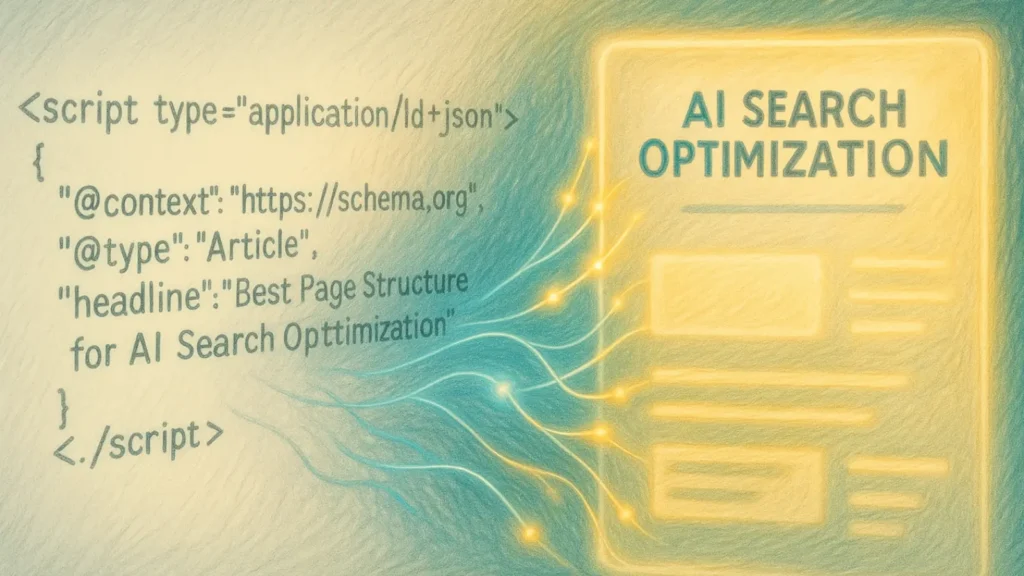
Structured data translates human-written content into metadata that AI systems can interpret with precision. According to Schema.org, schema markup defines entities, context, and relationships between them, enabling engines to identify what a page truly represents.
How AI Uses Schema.org, JSON-LD, and Microdata
AI-based crawlers analyze schema markup to classify a page’s purpose, author, and factual claims.
Elements such as Article, FAQ, HowTo, WebPage, and Organization act as structured “labels” that guide AI in contextual reasoning.
When properly embedded, JSON-LD scripts help language models distinguish between opinion, data, and definition — turning plain HTML into structured knowledge.
For instance, if an FAQPage schema lists questions and answers, AI systems can extract them directly for featured snippets or conversational summaries.
In contrast, pages without markup appear as unstructured text, offering limited interpretability.
How Schema Teaches AI to Understand Entities
Each schema type connects information to recognized entities — people, organizations, products, or abstract concepts.
This entity mapping helps AI infer relationships: who created the content, what it refers to, and how it connects to verified knowledge sources.
In effect, schema acts like a “dictionary” of your page, teaching generative engines to assign meaning correctly.
Below is a concise example of a valid Article JSON-LD snippet for AI search optimization:
<script type="application/ld+json">
{
  "@context": "https://schema.org",
  "@type": "Article",
  "headline": "Best Page Structure for AI Search Optimization",
  "author": {
    "@type": "Person",
    "name": "PostUpgrade Editorial"
  },
  "publisher": {
    "@type": "Organization",
    "name": "PostUpgrade",
    "logo": {
      "@type": "ImageObject",
      "url": "https://postupgrade.com/logo.png"
    }
  },
  "mainEntityOfPage": {
    "@type": "WebPage",
    "@id": "https://postupgrade.com/best-page-structure-ai-search"
  },
  "datePublished": "2025-11-09",
  "description": "Learn how structured data improves AI search visibility through schema markup and JSON-LD integration."
}
</script>
This structure helps AI associate the article with its source, context, and factual metadata.
Recommended Schema Types for GEO
The following schema types are most effective for Generative Engine Optimization (GEO):
| Type | Purpose | Impact on AI Visibility |
|---|---|---|
| Article | Defines the main topic and author | Helps AI connect content to expertise |
| FAQPage | Lists questions and concise answers | Enables direct inclusion in generative summaries |
| BreadcrumbList | Describes site navigation hierarchy | Improves contextual understanding of page location |
| Organization | Provides brand and publisher data | Builds trust and factual identity for AI |
| WebPage | Defines page-level metadata | Enhances contextual linking between sections |
These schema types ensure that AI can read a website’s structure, authority, and topical depth without ambiguity.
Transitional Insight
Structured data bridges human communication and machine interpretation.
By adding schema markup, you give AI engines the semantic map they need to understand intent and trust your content.
Next, we’ll explore how contextual linking and internal hierarchy extend that map, connecting every page into a coherent knowledge network.
Internal Linking in AI Page Structure Optimization
Micro-introduction
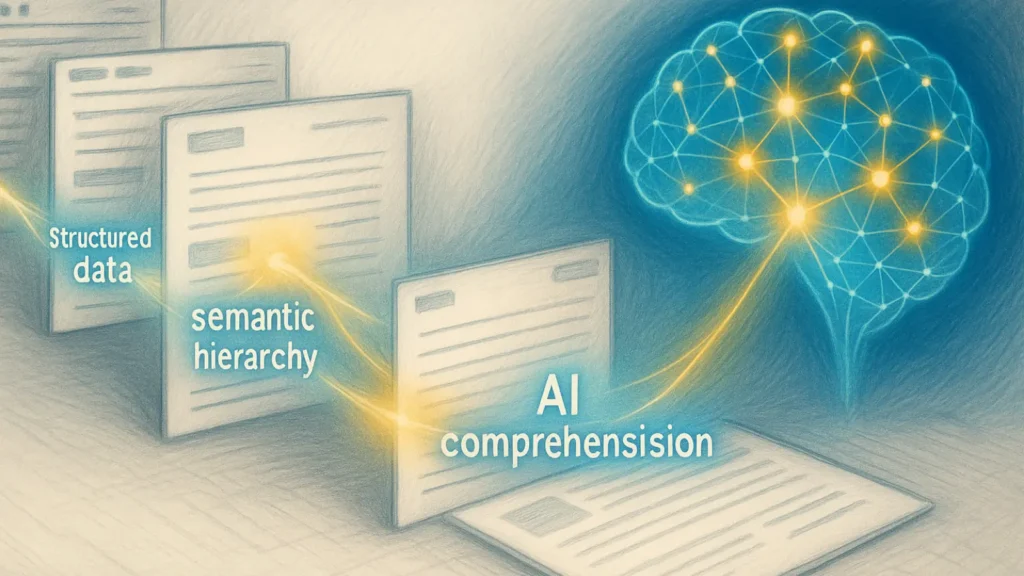
Internal linking has evolved far beyond traditional SEO tactics. In the era of generative engines, links act as context carriers — signals that help AI interpret how ideas, entities, and topics relate across a website.
According to OECD Data’s framework on knowledge networks, systems understand information more accurately when connections reflect conceptual relationships rather than arbitrary navigation paths.
In this sense, linking is not about traffic — it’s about meaning.
Why Internal Links Are Context Bridges, Not Tricks
Internal links guide AI comprehension by defining semantic continuity. When an article links to another with a descriptive anchor, it tells the model: this concept extends or supports the previous one.
Unlike keyword stuffing, which flattens meaning, contextual linking builds a conceptual web — allowing large language models to trace logic through related nodes.
For example, linking “structured data” to a dedicated schema guide strengthens the relationship between structure and visibility in AI reasoning.
Internal links act as semantic bridges that give AI engines a framework for contextual reasoning.
How AI Interprets Anchor Meaning
AI does not treat anchor text as a navigation element but as a linguistic cue. It analyzes the anchor phrase, surrounding sentences, and target page metadata to infer the relationship’s purpose.
A well-chosen anchor like “AI content organization methods” signals thematic relevance, while vague links such as “click here” or “read more” contribute no semantic value.
Embedding descriptive, fact-based anchors helps models associate meaning between pages, reinforcing topical authority.
Every anchor transmits a micro-signal of intent. When consistently factual, those signals form a pattern that AI recognizes as structured knowledge.
Building Semantic Chains Across Pages
A semantic chain connects related pieces of content in a logical sequence — from general concepts to specific explanations.
Instead of treating each page as isolated, you create a progression:
- Topic overview → Implementation guide → Case study → Metrics summary
This continuity allows AI to interpret your website as a coherent knowledge system rather than a set of disconnected posts.
The stronger the thematic consistency between linked pages, the more confidently AI can reuse your content in generated responses.
Semantic chains create a learning path for AI, guiding it through related topics as if reading a structured textbook.
From Hierarchy to Semantic Network
Traditional hierarchy arranges content vertically — categories, subcategories, posts.
However, generative optimization requires a semantic network, where each node (page) connects horizontally by topic relevance and factual depth.
This model — known as a geo-friendly content structure guide — allows AI engines to navigate meaning instead of menus.
It shifts website architecture from a static tree to a living network of knowledge, improving visibility and interpretability across all connected pages.
Turning hierarchy into a semantic network transforms your site into a context map — the very structure generative engines use to understand and trust your content.
Transitional Insight
Internal linking is no longer an afterthought; it’s a language of relationships.
By connecting topics semantically, you teach AI how your knowledge flows and where authority resides.
In the next section, we’ll explore readability and factual architecture — how clarity and verified data strengthen both human trust and machine confidence.

Readability and Factual Architecture
Micro-introduction
In the AI-driven web, readability is not just a user experience metric — it’s a trust signal.
Large language models evaluate how text conveys meaning, evidence, and structure. According to Nielsen Norman Group, readable and fact-based layouts increase comprehension and credibility for both humans and algorithms.
A page optimized for readability allows AI to extract, summarize, and reuse your content with higher confidence.
Why Factual Transparency Builds AI Trust
AI models assess factual clarity through data consistency and explicit verification.
Pages that clearly attribute claims, define entities, and maintain a logical flow rank higher in generative visibility.
When facts are presented transparently — with sources, examples, or numerical context — large language models can validate them against their own knowledge base.
This verification loop improves trust and citation probability in generative results.
Transparent, data-supported writing helps AI distinguish verified knowledge from speculation, strengthening your authority in machine reasoning.
Formatting for AI-Readable Pages
AI readability optimization follows the same cognitive principles that guide human readers.
Structured formatting enhances machine parsing and improves the user experience simultaneously.
Use the following layout techniques to increase comprehension:
- Short paragraphs: Limit to 3–4 sentences per block.
- Bullet lists: Highlight key steps, facts, or takeaways.
- Tables: Use for comparisons, definitions, and metrics.
- Infographics: Visualize relationships or data trends for semantic clarity.
- Consistent typography: Maintain uniform heading styles (H1–H3) to reinforce hierarchy.
Each of these formatting cues acts as a visual and semantic anchor, enabling AI to map content relationships more efficiently.
Key takeaway: Readability and structure are inseparable — clear formatting trains both people and AI to understand your content faster.
E-E-A-T for AI — Expertise, Experience, Authoritativeness, and Trust
The E-E-A-T framework, adapted for AI optimization, represents the foundation of factual architecture.
- Expertise: Demonstrate domain knowledge with precise terminology and credible examples.
- Experience: Include practical insights, case studies, or step-by-step explanations.
- Authoritativeness: Reference recognized institutions, datasets, or scientific publications.
- Trust: Maintain factual accuracy and consistent tone across all pages.
AI models interpret E-E-A-T signals by analyzing entity mentions, citation patterns, and consistency of voice.
The stronger these attributes, the more confidently a model will reference or quote your material in generated summaries.
E-E-A-T for AI transforms human credibility factors into machine-readable trust signals, amplifying visibility in generative engines.
Transitional Insight
Readability converts complexity into clarity; factual structure converts trust into visibility.
Together, they define how AI perceives authority and reliability.
In the next section, we’ll apply these principles to a concrete AI-ready page layout example, showing how structure, hierarchy, and schema combine into a single, machine-interpretable format.
AI Page Structure Optimization Example and Layout Guide
Micro-introduction
An AI-ready page follows logical, semantic, and factual order. Each section communicates intent and connects to the broader meaning of the site.
According to Google Developers’ Search documentation, clear structural markup allows AI crawlers and users to navigate content seamlessly, extracting data in context rather than in fragments.
Below is a practical layout that illustrates how to design a page architecture optimized for generative visibility.
Step-by-Step Structure Example
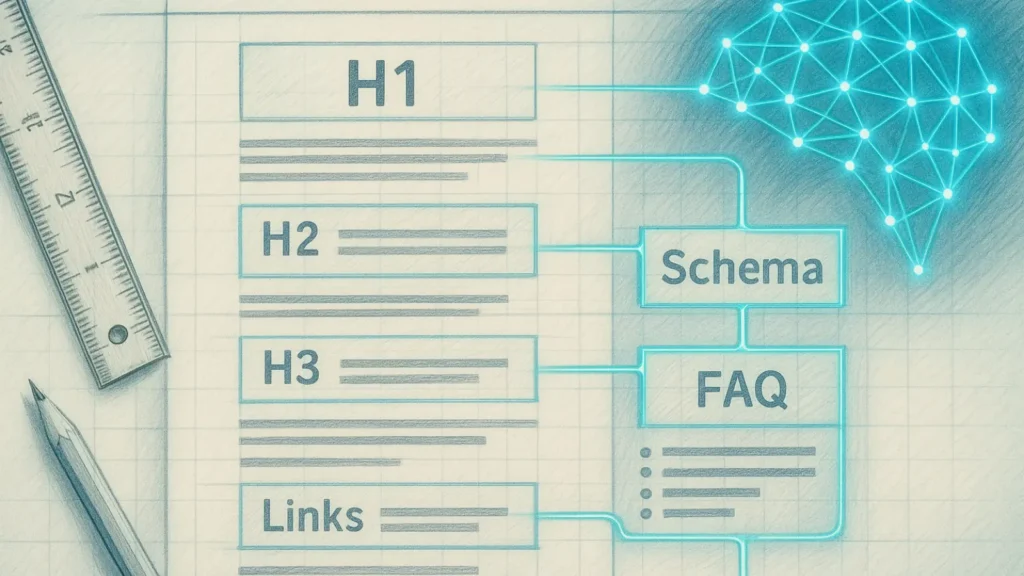
An AI-optimized article balances clarity with hierarchy. The layout can be expressed as pseudocode or a semantic map:
<H1> Main Topic: Best Page Structure for AI Search Optimization </H1>
  <Intro> Concise, factual overview establishing context and purpose. </Intro>

  <H2> Subtopic 1: Core Principles </H2>
    <H3> Insight </H3>
      <p> Explain one idea with supporting data or example. </p>

  <H2> Semantic Layer </H2>
    <p> Add JSON-LD schema markup for visibility. </p>
    <FAQ schema> Common questions and short, factual answers. </FAQ>

  <H2> Related Topics </H2>
    <Links> Internal anchors to complementary articles. </Links>
This hierarchy ensures that each section has a defined role: topic declaration, elaboration, verification, and contextual linkage.
The balance of structural tags (H1–H3), factual intro, and schema components turns the document into machine-interpretable data.
Every heading and schema element acts as a signpost — guiding both humans and AI to interpret meaning consistently.
Visual Representation — Block Diagram
The same logic can be expressed visually as a hierarchical flow:
┌──────────────────────────────────────────────┐
│ H1: Main Topic                              │
│  └─ Intro: Factual context                  │
│     ├─ H2: Subtopic 1                       │
│     │   └─ H3: Insight / Example            │
│     ├─ H2: Semantic Layer                   │
│     │   ├─ JSON-LD Schema                   │
│     │   └─ FAQ Section                      │
│     └─ H2: Related Topics                   │
│         └─ Internal Links / References      │
└──────────────────────────────────────────────┘
This block-scheme visualizes how ideas, entities, and relations cascade from top to bottom.
AI systems read this flow as a knowledge hierarchy — the foundation of interpretability and factual trust.
Applying the Layout to Real Content
When applied to blog posts or landing pages, this model improves both crawlability and comprehension.
Generative search engines reuse the structured hierarchy to build featured summaries or AI-answer citations.
Integrating elements like FAQ schema, internal links, and semantic subheadings ensures every paragraph has informational value.
Treat your page layout as data architecture — a system of meaning built for both human reading and AI reasoning.
Transitional Insight
An AI-ready layout transforms ordinary writing into structured knowledge.
It gives generative systems the scaffolding they need to understand, verify, and reuse your insights.
In the next section, we’ll consolidate these elements into a GEO checklist and toolkit — practical steps to test, refine, and validate your optimization strategy.
Tools and GEO Checklist

Micro-introduction
Generative optimization requires both strategic thinking and technical validation.
Using the right tools helps ensure that every element of your page — structure, schema, readability, and factual layout — meets AI-search standards.
As highlighted by Search Engine Journal, consistent auditing with specialized tools turns on-page SEO into a measurable, data-driven process.
Essential Tools for Generative Optimization
The following tools support structured data validation, readability scoring, and AI-aligned content assessment:
- Schema.org Validator — checks if your JSON-LD and microdata follow the official schema syntax and hierarchy.
- Google Structured Data Testing Tool — verifies how search engines interpret your structured markup and detects missing entities.
- AI Readability Analyzers — evaluate text for clarity, sentence length, and entity consistency to ensure LLM-friendly phrasing.
- Yoast or RankMath Schema Integration — automatically adds schema blocks for Article, FAQ, and BreadcrumbList types in WordPress.
- GPT-powered GEO Audits — use large language models to simulate how AI engines interpret your structure, readability, and internal links.
Each of these tools performs a complementary role, transforming subjective optimization into quantifiable improvement.
Combining human oversight with automated GEO auditing ensures both interpretability and factual precision.
Quick GEO Page Review Checklist
A brief checklist for evaluating whether a page is ready for generative search:
- ✅ Check Headings (H1–H3): Confirm clear hierarchy and consistent semantic order.
- ✅ Validate Schema: Ensure all markup types (Article, FAQPage, Organization) are correctly structured.
- ✅ Verify Facts and Internal Links: Check that data points are accurate and that anchor links connect logically related content.
- ✅ Assess Readability: Maintain short paragraphs, active voice, and clear transitions.
- ✅ Review E-E-A-T Indicators: Confirm visible author identity, references, and domain authority.
This workflow allows you to identify weak points before publishing, ensuring every post aligns with generative visibility standards.
A disciplined audit routine helps maintain quality and consistency across all AI-optimized pages.
Transitional Insight
With the right tools and review steps, GEO optimization becomes a replicable process — measurable, transparent, and aligned with how AI interprets meaning.
In the final section, we’ll summarize the core insights and future direction of AI search writing — the convergence of human clarity and machine reasoning.
Checklist:
- Does each H2/H3 introduce a distinct meaning block?
- Are paragraphs written as atomic units with one idea per block?
- Is the heading hierarchy consistent across the page (H1→H2→H3)?
- Are transitions placed to signal reasoning flow for AI systems?
- Does the structure reinforce factual clarity and semantic boundaries?
- Is internal linking used to connect related meaning blocks across the site?

Beyond Structure — Thinking Like AI
Micro-introduction
Generative search has reshaped what it means to “optimize.” Structure is no longer a design layer — it’s the foundation of meaning.
When content follows a logical hierarchy and factual rhythm, AI systems can interpret, classify, and reuse it with confidence.
The future of visibility belongs to creators who build for cognition, not cosmetics.
From Order to Understanding
An organized page is not just tidy — it’s interpretable.
AI models process structure as context: every heading defines a boundary, every link conveys purpose, every fact builds trust.
Pages that apply a coherent architecture become readable not only to people but also to large language models that power modern search engines.
In this sense, structure equals understanding — it is how meaning becomes machine-accessible.
Designing for Machine Logic
To succeed in generative environments, creators must think the way AI does: hierarchically, semantically, and contextually.
Instead of designing for visual aesthetics alone, focus on how information flows — from headline to entity, from paragraph to schema.
This mindset bridges creativity with precision, ensuring that your expertise is understood, not just displayed.
The Human-AI Partnership in SEO
The true evolution of on-page SEO lies in collaboration between authors and algorithms.
Writers provide expertise; AI interprets and amplifies it.
By adopting AI-ready logic, you future-proof your content — transforming static pages into living frameworks of understanding.
Closing Insight
Think like AI. Build logically, not visually.
Structure is meaning, and meaning is visibility.
Those who design for comprehension will lead the next era of search — where clarity, not clutter, defines success.
Interpretive Structure of AI-Readable Page Architecture
- Meaning block isolation. Pages are interpreted through discrete semantic containers that encapsulate distinct concepts and prevent contextual overlap.
- Hierarchical boundary definition. Predictable depth relationships between structural layers signal scope, priority, and conceptual nesting to generative systems.
- Auxiliary semantic reinforcement. Structured data functions as a supporting layer that clarifies context and relationships without superseding on-page meaning.
- Factual consistency signaling. Stable definitions, terminology, and reasoning chains indicate interpretive reliability during extraction and synthesis.
- Semantic network formation. Internal connections between meaning blocks are interpreted as navigable conceptual pathways rather than rank-distribution mechanisms.
- Model-agnostic structural clarity. Architectures that remain interpretable across different parsing and evaluation environments demonstrate durable AI readability.
This structure explains how AI systems interpret page architecture as a coherent semantic framework, where clarity, hierarchy, and contextual linkage guide understanding independently of procedural optimization.
FAQ: Page Structure for AI Search Optimization
What is AI search optimization for page structure?
AI search optimization focuses on structuring content so that generative engines can interpret, segment, and reuse meaning blocks with high accuracy.
How does AI-focused structure differ from traditional SEO formatting?
Traditional SEO optimizes for ranking signals, while AI-focused structure optimizes for interpretability by reinforcing stable meaning boundaries and explicit logic chains.
Why does structure matter for AI search?
Generative engines rely on headings, semantic blocks, and logical segmentation to interpret context and extract content for AI-driven answers.
How do generative engines interpret page structure?
They decode headings, meaning containers, definitions, reasoning flows, and factual anchors to reconstruct the logic of the page.
Which elements help AI understand content boundaries?
Consistent H2/H3/H4 hierarchy, stable terminology, micro-intros, and clean semantic segmentation improve interpretability.
How does structure improve generative visibility?
Clear structure reduces ambiguity, allowing AI models to reuse blocks in answers, summaries, and reasoning chains with higher confidence.
How should internal linking work in an AI-first structure?
Internal links should map meaning containers across articles to form a machine-navigable semantic network.
What are the best practices for structuring content for AI?
Use atomic paragraphs, reasoning steps, glossary terms, hierarchical headings, and verifiable sources to support machine interpretation.
How does factual clarity influence AI interpretation?
AI models prioritize stable definitions, consistent terminology, and sourced statements when evaluating structural and contextual relevance.
What skills are essential for AI-optimized page structure?
Writers need structural precision, logical clarity, explicit reasoning, and a strong command of AI-first formatting methods.
How do LLMs detect hierarchy boundaries?
LLMs detect boundaries through heading patterns, transition cues, stable terminology, and the consistency of semantic containers.
What signals help AI identify primary vs. secondary content?
AI distinguishes content levels using heading depth, paragraph length, rhetorical intent, surrounding entities, and schema metadata when available.
How does JSON-LD enhance AI interpretation of page structure?
JSON-LD provides explicit metadata about page purpose, entities, authorship, and relationships, enabling AI engines to classify and reuse content with higher confidence.
Glossary: Key Terms in AI-Optimized Page Structure
This glossary defines essential structural concepts used throughout this guide to support consistent interpretation by both readers and AI systems.
Meaning Block
A stable unit of content representing a single concept, enabling AI systems to segment and reuse information with minimal ambiguity.
Hierarchical Structure
A formatting model using clear H2 → H3 → H4 transitions to define logical boundaries that AI engines use to interpret page organization.
Atomic Paragraph
A short, self-contained paragraph expressing one idea, designed to support machine-readable segmentation and reduce contextual ambiguity.
Structural Container
A defined section of the page — such as an H2 block — that groups related ideas and helps AI models navigate content boundaries.
Semantic Boundary
A transition between concepts that signals to AI systems where one idea ends and another begins, improving clarity in generative analysis.
AI-First Formatting
A content design approach that prioritizes machine interpretation — using explicit logic, structural consistency, and stable terminology.

Author Sergey Kuchinskiy
Founder of PostUpgrade. Researcher in Generative Engine Optimization (GEO), semantic structuring, and machine reasoning systems. Focuses on AI-readable content architecture, computational interpretation, and scalable knowledge retrieval. Author of 200+ analytical publications on generative visibility, semantic mapping, and AI-first information design.
Verified Expertise
- Generative Engine Optimization (GEO)
- AI Content Engineering & Semantic Structuring
- Computational Linguistics & Machine Reasoning
- Large-Scale Content Architecture
Research Focus
AI Search · Generative Visibility · Semantic Mapping · Machine Sentence Design · Reasoning Stability · Knowledge Extraction Models
Academic Contributions
- 200+ analytical research publications
- AI-first page architecture methodologies
- Semantic Frameworks for Machine Interpretation (SFMI)
- Generative Visibility Standards 2024–2025
Citation Metrics
AI-model reuse rate (GEO-Score): 92/100 · Cross-model consistency: 87% · Reasoning chain stability: 91%
Researcher ID: PU-ORCID-7421-9912
View all publications →Connect on LinkedIn →