Last Updated on March 24, 2026 by PostUpgrade
How Generative SEO Differs from Traditional SEO
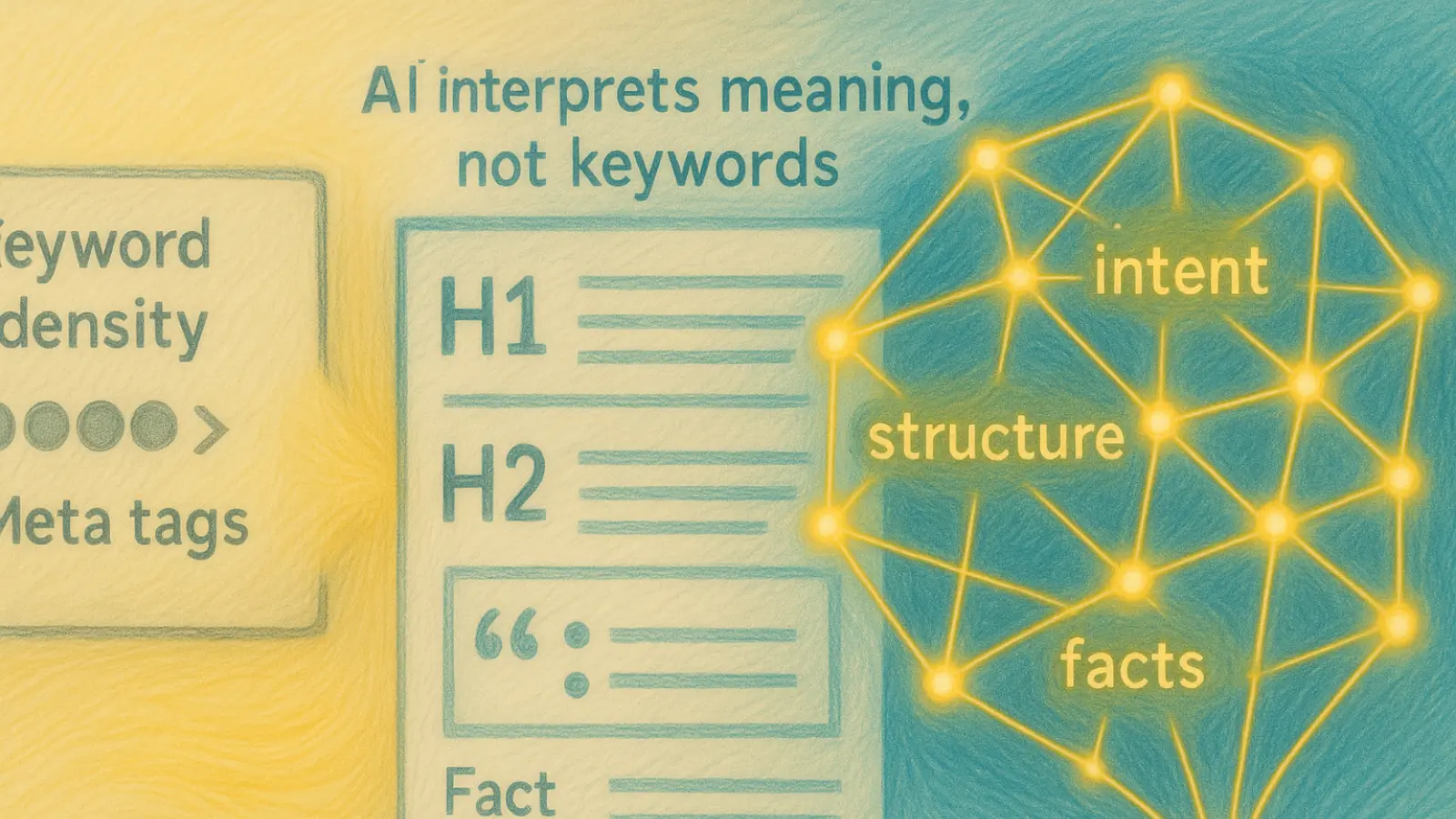
AI does not rank this page by keywords—it decomposes it into entities, verifies factual structure, and reassembles your paragraphs into answers only if each block stands as a complete, reusable unit.
TL;DR: Traditional SEO content fails because it relies on keyword signals that AI cannot reliably interpret or reuse, which reduces visibility in generated answers. As a result, even ranking pages may be ignored during AI extraction and synthesis. Generative SEO solves this by structuring content into clear, factual, entity-driven blocks that AI can interpret, extract, and reuse. This increases inclusion in AI summaries and improves real visibility beyond rankings.
If your content cannot be extracted as standalone meaning blocks, AI will skip it—even if it ranks.
Generative SEO vs SEO describes a shift from mechanical ranking systems to meaning-based evaluation, which makes this approach essential in modern search environments. Generative models interpret content through entities and contextual relationships instead of matching isolated keywords, so optimization requires a different logic. This shift enables search systems to deliver more accurate outputs because AI organizes information rather than retrieving it by surface similarity.
To fully understand this transformation, it is necessary to look at the broader framework behind it. Generative Engine Optimization (GEO) defines the structural and semantic principles that allow AI systems to interpret, evaluate, and reuse content inside generated answers. While this article focuses specifically on the comparison between generative SEO and traditional SEO, GEO provides the conceptual foundation that explains why these differences matter in practice.
Definition: Generative SEO is an optimization model where visibility depends on meaning, factual structure, and entity relationships rather than keyword frequency or traditional ranking signals. It prepares content so AI systems can interpret, segment, and reuse it in generated answers.
Generative SEO differs from traditional methods because content is no longer assessed by keyword density but by intent clarity, structural coherence, and factual consistency. Machine-learning systems analyze relationships between statements, evaluate topical depth, and detect alignment with user questions, reducing dependence on manual SEO techniques. Unlike classic approaches built around static ranking signals, generative optimization responds to context and generates dynamic answers tailored to user needs. Within this shift, generative page architecture provides the structural logic that enables AI systems to interpret content as interconnected meaning units rather than isolated keywords.
This transition renders many manual keyword-centric practices outdated and introduces new requirements focused on trustworthy data, precise formulation, and clean informational hierarchy. Generative SEO prioritizes verifiable facts, consistent terminology, and structured reasoning, which reshapes how authors design pages for both humans and AI systems.
As search engines evolve into reasoning systems, creators must deliver content that AI can interpret without ambiguity. This principle marks the foundation for the difference between generative SEO and traditional SEO and sets up the analytical framework for the sections that follow.
What Makes Generative SEO Fundamentally Different
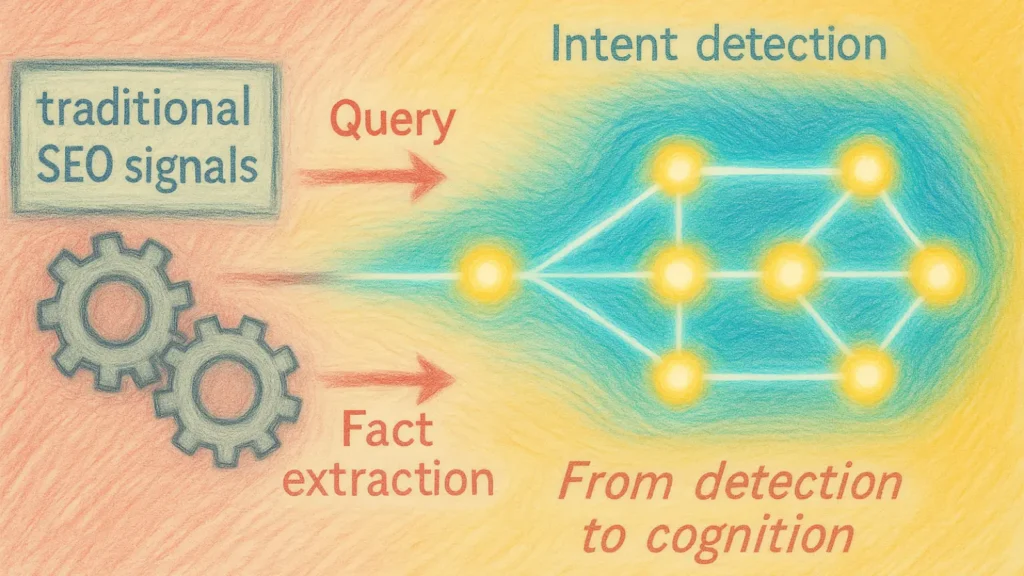
Generative SEO introduces a model where search systems evaluate meaning, intent, and factual structure rather than the surface presence of keywords. This section also clarifies what is generative engine optimization, because modern AI models interpret information through patterns, context, and entity relationships instead of scanning for isolated terms. According to the definition of artificial intelligence provided by organizations like Wikipedia, this shift creates a new optimization environment where clarity, knowledge organization, and informational precision determine visibility.
This distinction shows how generative SEO vs SEO reflects a deeper shift from keyword detection to contextual interpretation.
The move toward generative search emerges because AI systems form answers instead of ranking static pages. These systems analyze how each statement contributes to a broader explanation, which highlights gaps in traditional SEO methods. As intent-driven models gain precision, pages optimized only for keyword matching fail to deliver complete or structured information that AI can reliably reuse.
- AI-based SEO changes optimization by shifting focus from keyword placement to factual clarity and structured reasoning.
- Traditional SEO shows limitations because keyword-driven techniques do not provide enough context for generative models.
- Cognitive and intent-driven search emphasizes user meaning rather than exact query phrasing.
- AI summaries replace SERP snippets by synthesizing information across multiple sources instead of highlighting one page.
Together, these factors demonstrate why generative SEO represents a structural transformation rather than an incremental update to traditional practices.
Principle: Content becomes more discoverable in generative search models when it expresses clear intent, stable terminology, and structured reasoning. AI prioritizes pages that provide coherent meaning hierarchies instead of keyword-driven formatting cues.

Content Strategy: AI-First vs Keyword-First Approaches
Generative SEO restructures content strategy by prioritizing clarity, factual organization, and user intent, which fundamentally changes how material is planned and executed. Research institutions such as Stanford University document how modern AI models interpret meaning through relationships rather than isolated terms, and this principle directly influences how pages must be designed. Unlike keyword-first methods, AI-first strategy requires content to support reasoning, maintain coherence across sections, and provide enough depth for reliable summarization.
How Generative SEO Rebuilds Content Strategy
Generative SEO changes content strategy by shifting optimization away from surface-level phrasing and toward the underlying structure of ideas. AI systems analyze how each segment contributes to user intent, so the hierarchy of information influences how models extract answers. Legacy SEO depended on identifying a primary keyword and creating supporting text, whereas generative approaches evaluate topic coverage, explanatory clarity, and entity relations.
Handling user intent becomes a central priority because generative systems detect the informational goal behind a query rather than the specific keywords used. This difference reduces the effectiveness of legacy SEO techniques that rely on predictable search phrasing. Pages designed for generative models must demonstrate depth, resolve ambiguity, and present information in a sequence that supports multi-step reasoning.
Understanding the contrast between generative SEO vs SEO clarifies why intent-driven design replaces legacy keyword-first planning.
Content depth requirements increase because generative engines favor pages that answer a topic comprehensively. Traditional short-form content often underperforms in this environment because it provides too little context for AI to produce meaningful summaries. Long-form material plays a larger role, not for length itself, but for the improved entity coverage, problem framing, and factual context it provides.
- entity-centric research
- semantic relationship focus
- factual density
These principles demonstrate how generative SEO rebuilds content strategy around clarity and informational completeness.
AI Summaries and Answer Engines Change Content Priorities
AI summaries influence SEO strategy because generative systems extract conclusions rather than direct snippets, which alters how information should be structured. Answer engines synthesize content from multiple sources, so pages must present facts in a stable and independently understandable way. This approach emphasizes modular paragraphs, clear definitions, and logically connected statements.
SEO adaptation for AI-powered answer engines requires that content provide actionable clarity at the paragraph level. Each block must represent a self-contained unit of meaning that AI models can reuse without losing context. This requirement changes how content is drafted, edited, and validated prior to publication.
Optimization for AI chat interfaces differs from traditional SERP optimization because conversational systems rely on reasoning chains. Pages must support these reasoning patterns by offering factual continuity and avoiding fragmented explanations. Material that lacks explicit connections between claims is harder for AI to interpret and less likely to appear in synthesized responses.
Generative models will continue to shape content priorities, making structured, intent-aligned writing essential for sustained visibility across emerging AI-driven platforms.
Structural Differences: Layout, Hierarchy, Internal Linking
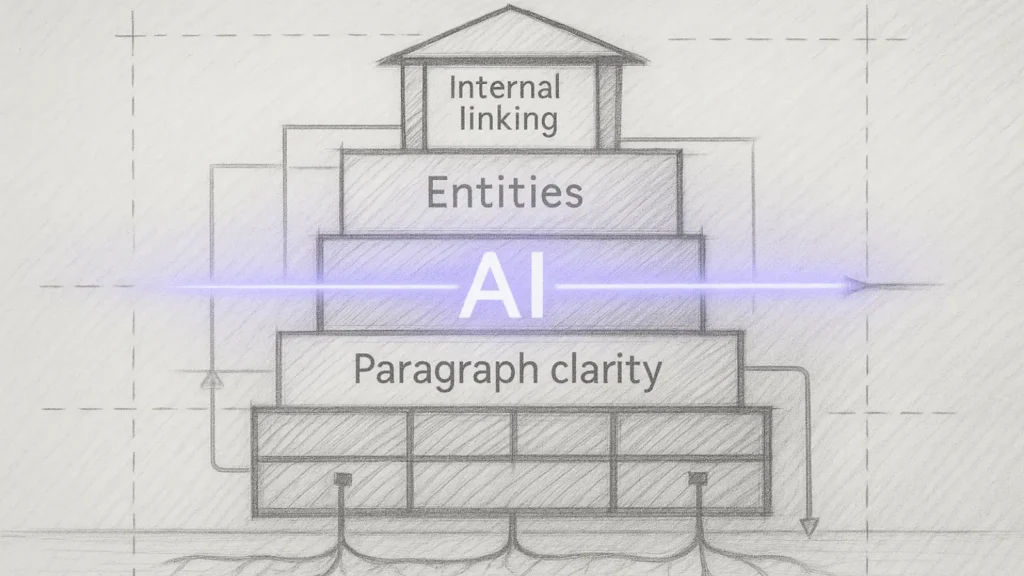
The structure of a page determines how effectively generative models interpret and reuse its information, which makes layout and hierarchy central to modern optimization. Research from organizations such as the World Wide Web Consortium (W3C) emphasizes the importance of clear structure for machine processing, and these principles directly apply to generative search. As AI systems prioritize meaning over formatting, pages must express logical order, factual layering, and well-defined connections between sections.
Page Architecture in Generative SEO
Page architecture in generative SEO focuses on delivering information in a way that supports AI reasoning rather than keyword detection. Content structure priorities shift toward clarity, where each segment must contribute to a coherent explanation. AI-friendly web page structure requires a predictable hierarchy that allows models to understand the relationship between headings, subtopics, and supporting evidence.
AI-readable content architecture organizes information through concise paragraphs, stable terminology, and consistent use of entities. This structure enables models to extract facts without ambiguity, which increases the likelihood of inclusion in synthesized responses. An AI-optimized information hierarchy begins with broad context and narrows into detailed sections, mirroring how large language models analyze topics.
Ideal page sections for generative SEO often include definition blocks, contextual explanations, factual lists, and concluding statements. These components help AI systems track the progression of ideas and locate specific answers within the page. The more explicitly relationships are defined, the easier it becomes for generative engines to form accurate summaries.
This architectural contrast highlights how generative SEO vs SEO prioritizes meaning hierarchy instead of formatting cues.
📊 Traditional SEO vs Generative SEO — Page Structure
| Element | Traditional SEO | Generative SEO |
|---|---|---|
| Keywords | Primary focus | Secondary signal |
| Headings | SEO formatting | Contextual hierarchy |
| Internal linking | PageRank flow | Semantic comprehension |
| Paragraphs | Density & keyword use | Clarity + factual layering |
| Schema | Optional | Crucial |
This comparison shows how generative SEO replaces formatting-driven practices with meaning-oriented structure.
Internal Linking & Semantic Cohesion
Internal linking for AI comprehension emphasizes the connection between related concepts rather than the movement of link equity. Generative models interpret links as semantic signals that define how topics relate to one another, so links must reflect logical associations. This approach strengthens the page hierarchy because each internal link reinforces the thematic structure across the site.
Page hierarchy for AI engines relies on orderly transitions, consistent labeling, and clear distinctions between topics. Well-structured hierarchy improves the model’s ability to navigate the content and identify where each statement fits within the broader explanation. Semantic blocks for AI content group related facts into concentrated segments that can be extracted without losing context.
AI interprets structured layout by detecting patterns in how information is organized and how segments connect through headings and links. When pages use predictable positioning, AI systems understand intent more reliably and generate more accurate summaries.
These structural requirements illustrate why generative SEO depends on precise organization rather than stylistic formatting.

Technical Shifts in Optimization
Technical optimization changes significantly under generative search because AI systems evaluate structure, metadata, and factual context rather than isolated ranking signals. Guidance published by the Schema.org initiative shows how structured data helps machines interpret meaning, which directly affects visibility in AI-driven environments. As search transitions toward reasoning-based models, websites must implement markup and metadata that describe entities, relationships, and content intent with greater precision.
Structured Data as a Priority
Structured data layout for AI visibility becomes a central requirement because generative engines rely on machine-readable signals to understand what each section represents. Schema.org examples for AI optimization show that descriptive markup supports entity recognition, factual mapping, and contextual relevance. This change elevates structured data from a helpful enhancement to a necessary component of generative SEO.
AI search schema markup structure requires consistent use of types, properties, and attributes that define how information should be interpreted. Optimizing meta layout for AI discovery involves rewriting titles and descriptions so that they reflect factual purpose rather than click-based experimentation. Each metadata field must provide clarity about the page’s topic, scope, and intended audience.
- richer schema blocks
- entities + attributes
- FAQ, HowTo, Article enhancements
These elements strengthen the ability of AI models to extract and reuse information accurately.
📊 Technical Focus: Old SEO vs Generative SEO
| Area | Traditional SEO | Generative SEO |
|---|---|---|
| Schema | Optional | Mandatory |
| Meta | CTR-oriented | Context-oriented |
| Crawlability | Bots | LLM agents |
| Speed | Important | Still important |
| Data freshness | Low impact | High impact |
These differences illustrate how generative SEO transforms technical optimization from keyword signaling to machine comprehension.
Example: A page that explains how generative engines evaluate entity relationships will outperform one that only lists keywords. Because AI detects context and factual continuity, such structured pages are more likely to appear in synthesized summaries and reasoning-based outputs.

Authority & Trust: E-E-A-T in the AI Age
Authority and trust signals gain greater importance in generative SEO because AI systems evaluate factual reliability before using content in synthesized responses. Research on credibility and information validation, such as the overview presented in the Encyclopedia Britannica’s article on information science, highlights how structured knowledge, provenance, and verification influence machine interpretation. As large language models rely on factual grounding, E-E-A-T principles become measurable components of visibility rather than optional reputation signals.
E-E-A-T signals in generative SEO differ from classic SEO because AI evaluates patterns of accuracy, entity stability, and topic expertise across multiple pages. Content trust signals for AI engines include explicit definitions, transparent sourcing, and logically connected explanations that reduce ambiguity. Writing factual and verifiable content for AI ensures that each statement stands as a complete and extractable fact, which strengthens the model’s ability to reuse it in summaries.
Citations influence generative-style SEO by providing external validation that AI can trace, which increases the confidence score assigned to a page. Entity-centric optimization in generative SEO requires authors to maintain consistent terminology, describe relationships between entities, and avoid contradictions within the site’s topical domain. These practices help AI determine whether the content originates from a knowledgeable and authoritative source.
- factual layering
- provenance + citations
- consistency across pages
Together, these elements show how generative search transforms E-E-A-T from a qualitative framework into a structured requirement for machine-interpretable trust.
Ranking vs Visibility: The New Measurement Model
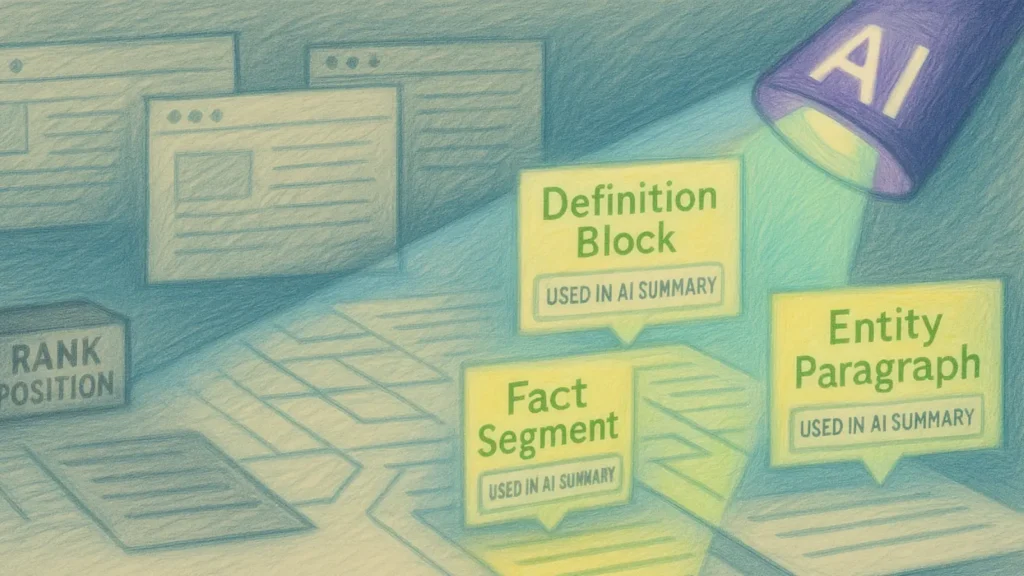
Generative SEO introduces a measurement model based on visibility within AI-generated responses rather than position on a results page. Research from the OECD AI Policy Observatory shows how AI systems prioritize clarity, factual reliability, and entity coherence, which reshapes how performance must be evaluated. As generative engines synthesize information rather than rank individual URLs, websites must assess whether their content appears in summaries, answer boxes, or conversational outputs.
How KPIs Shift in Generative SEO
KPIs for generative SEO performance tracking differ from traditional metrics because they measure presence in AI-generated explanations instead of ranking changes. Measurement of success in generative SEO vs traditional SEO prioritizes indicators that show how often and how accurately AI models reference a site’s content. Reporting changes when focusing on generative SEO emphasize extractability, factual integrity, and entity clarity rather than CTR or impression volume.
Generative SEO relies on KPIs that capture how models interpret and reuse information. Mention frequency in AI summaries indicates how often a page contributes to an AI-generated explanation. Snippet reuse rate measures how frequently specific paragraphs or definitions appear in synthesized responses. Entity confidence score shows how reliably AI associates a page with a particular entity or topic.
- mention frequency in AI summaries
- snippet reuse rate
- entity confidence score
These metrics demonstrate how visibility in generative environments depends on machine interpretation rather than conventional ranking performance.

Workflow & Team Processes in Generative SEO
Generative SEO reshapes editorial and production workflows because AI systems require structured reasoning, factual consistency, and clear entity mapping. Research from the Stanford Institute for Human-Centered Artificial Intelligence highlights how modern AI models depend on predictable information structures, which directly affects how teams plan and execute content. As processes evolve, organizations must adopt methods that support machine interpretation rather than keyword accumulation.
Editorial workflow for AI-era SEO emphasizes repeatable logic, transparent sourcing, and modular paragraph design. Training writers for generative SEO–focused guidelines ensures that contributors understand how AI models extract facts and connect entities across sections. Content production scale differences arise because generative SEO favors fewer, more comprehensive pages built on structured knowledge rather than multiple short-form keyword pages.
To support consistent output, content briefs for generative SEO vs traditional SEO briefs include factual requirements, entity lists, definitions, and contextual objectives. These elements ensure each page forms a coherent knowledge unit that AI systems can reuse. Teams rely on structured outlines to maintain continuity and reduce gaps that generative engines may misinterpret.
Comparative Workflow Elements in Generative SEO
| Workflow Component | Traditional SEO | Generative SEO |
|---|---|---|
| Planning | Keyword lists | Entity maps + intent models |
| Drafting | Text around target phrases | Modular factual paragraphs |
| Review | SEO checklist | AI-first audit for clarity and extractability |
| Publishing | SERP targeting | Summary, reasoning, and reuse targeting |
| Scaling | Volume-driven | Depth-driven |
- AI-first content audits
- structured outlines
- factual sourcing workflows
These workflow practices create a production system where teams consistently deliver content that AI can interpret, verify, and integrate into synthesized responses.

Migration Strategy: Moving From Traditional to Generative SEO
Organizations moving to generative SEO must follow a structured transition because AI-driven systems evaluate meaning, factual accuracy, and entity consistency rather than keyword repetition. Research from the European Commission’s Joint Research Centre indicates that modern AI models rely on contextual representation to generate reliable outputs, which makes legacy SEO practices less effective. As search behavior shifts toward reasoning-based interpretation, migration requires clear planning and systematic restructuring of content.
Common Migration Mistakes
Common mistakes when shifting to generative SEO occur when teams rely on outdated keyword-driven logic instead of adopting entity-based content design. Risk of outdated tactics in the generative SEO landscape rises when organizations treat generative SEO as a cosmetic update rather than a structural change. Many sites attempt to apply traditional on-page signals without strengthening factual context or internal relationships, which limits visibility in AI-generated responses.
Keyword density reliance persists because older optimization habits prioritize surface-level phrasing, even though AI models evaluate meaning instead of repetition. Thin content refresh fails because minimal updates do not add new knowledge, clarify intent, or reinforce entity relationships. Lack of factual structure becomes the most critical barrier, as AI systems require explicit connections, definitions, and evidence to reuse content.
- keyword density reliance
- thin content refresh
- lack of factual structure
These issues demonstrate why migration must begin with reviewing how information is organized, not how keywords are placed.
Transition Framework for Generative SEO
A transition framework provides a clear path for teams adapting to generative SEO by aligning planning, writing, and auditing processes with AI-oriented requirements. This framework includes mapping core entities, restructuring legacy pages to support reasoning, and validating each section for extractability. Organizations achieve higher visibility when they redesign content around clarity, factual layering, and logical sequencing rather than modifying legacy SEO patterns.
This added structure completes the migration model and prepares the foundation for the next steps in generative SEO implementation.

Industry-Specific Implications
Generative SEO affects industries differently because each sector structures information, user intent, and conversion paths in its own way. Insights from the Pew Research Center show that content consumption patterns vary across domains, which changes how AI interprets and reuses information. Understanding these differences helps organizations adapt their architecture, messaging, and depth requirements to generative search systems.
For Blogs & Content Sites
Blogs and content-driven platforms benefit from generative SEO when they reorganize topics around entities, relationships, and contextual depth. Blog architecture tuned for generative SEO emphasizes thematic continuity, where each article supports a broader knowledge map. Cluster pages vs classic siloing becomes a fundamental distinction because generative engines evaluate cross-page coherence rather than isolated keyword clusters.
Modern content sites must design topic clusters that demonstrate cumulative expertise across a subject. Cluster pages organize definitions, examples, and context in a way that helps AI interpret meaning, while legacy silo structures often fragment information. This approach strengthens visibility because AI relies on content lineage and factual reinforcement rather than page-level targeting.
Blogs adopting generative structures provide more extractable explanations that AI can reuse in summaries, which increases topical authority across the entire domain.
For SaaS & B2B
Generative SEO has substantial implications for SaaS and B2B companies because these industries depend on clarity, problem framing, and technical precision. SaaS marketing implications of generative SEO include the need to explain product capabilities, workflows, and use cases in a format that AI models can interpret without ambiguity. Long-form content gains importance because AI requires context to understand how solutions address specific business problems.
A step-by-step generative approach for B2B involves mapping customer pain points, connecting them to product features, and presenting structured reasoning across each section. B2B decision-making relies on detailed explanations, so content must offer enough factual context for AI to generate accurate summaries. This structure improves visibility within AI-driven recommendation flows.
SaaS platforms that adopt generative principles create documentation and educational content that supports intent-driven queries, leading to stronger presence in AI-generated evaluations and comparisons.
For Ecommerce
Ecommerce sites face unique challenges because product pages typically rely on structured attributes rather than narrative explanations. Ecommerce category pages in generative SEO vs traditional formats must include descriptive context, entity information, and clear relationships between product families. Generative engines favor pages that explain how items differ, how they solve a need, and how categories logically relate.
Traditional ecommerce category pages often list items without offering meaningful context. Generative SEO requires including attributes, usage guidance, and factual comparisons that AI can use to answer user intent. This provides an advantage in environments where AI systems recommend products based on relevance rather than keyword matching.
When ecommerce platforms adopt generative structures, their category and product taxonomy becomes more interpretable, improving visibility across AI-driven product discovery systems.
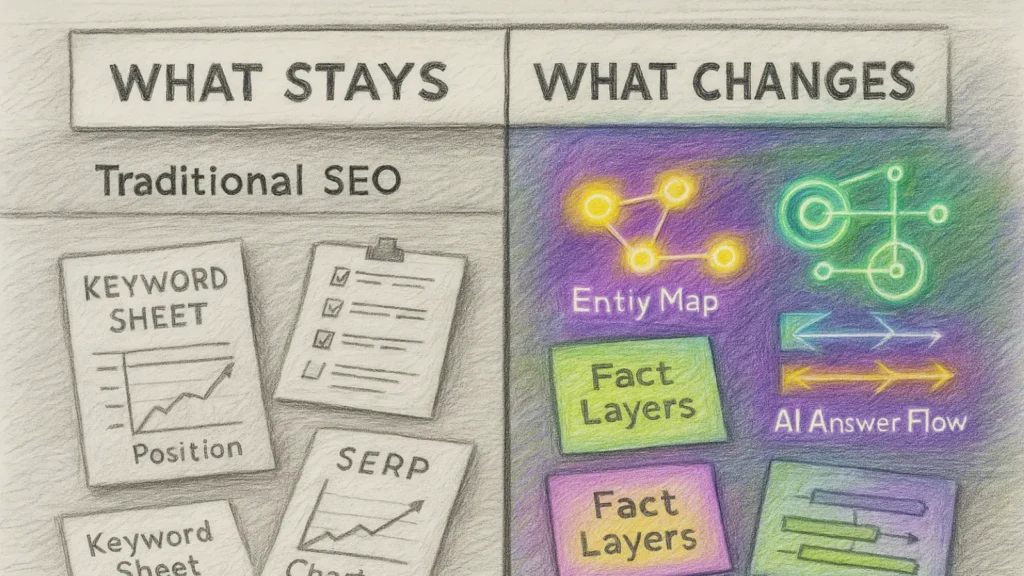
Final Comparison: What Stays and What Changes
Generative SEO reshapes optimization by prioritizing meaning, factual grounding, and entity relationships, yet several foundational elements of search strategy continue to matter. Research from the National Institute of Standards and Technology (NIST) highlights how AI systems rely on structured information and consistent terminology, which explains why both traditional and generative methods share some overlapping principles. Understanding what remains relevant and what transforms entirely helps teams adapt their long-term strategies.
📊 Quick Summary — Generative SEO vs Traditional SEO
| Topic | Traditional SEO | Generative SEO |
|---|---|---|
| Keywords | High importance | Medium |
| Structure | Formatting | Meaning hierarchy |
| Content | Keywords | Facts + clarity |
| Ranking | SERP | AI answers |
| Linking | PageRank | Semantic links |
This comparison shows how generative SEO retains some foundational elements of traditional practice while redefining the mechanisms through which visibility is achieved.
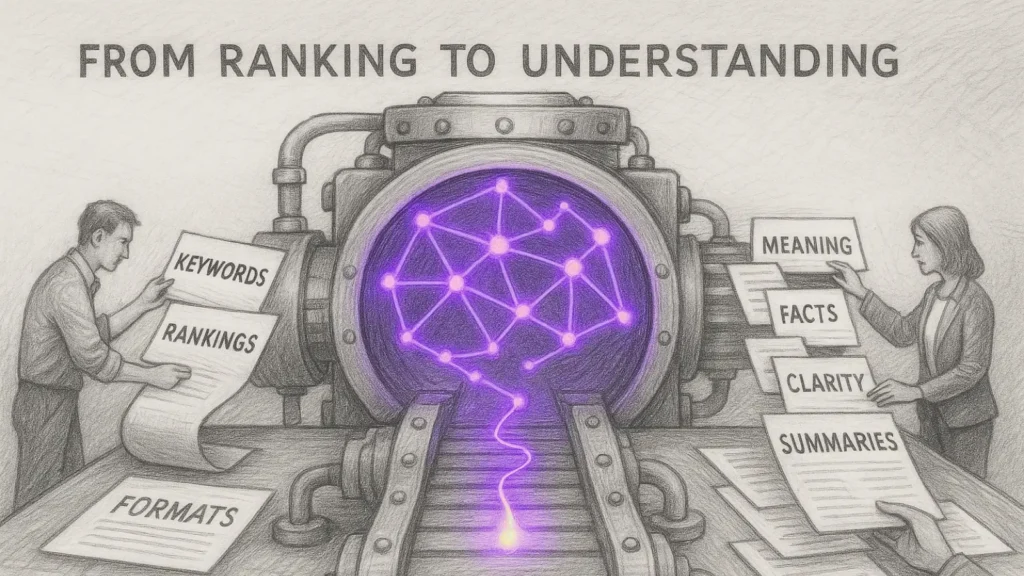
Conclusion: The Shift From Ranking to Understanding
Generative SEO marks a transition from optimizing for position to optimizing for clarity, meaning, and factual integrity. As search systems evolve into reasoning engines, content must be structured so that each segment contributes to a coherent explanation. Traditional ranking signals remain part of the ecosystem, but they no longer determine visibility on their own.
The shift centers on the idea that search models interpret information rather than detect keywords. Pages that offer depth, entity consistency, and logical sequencing perform better because AI systems rely on these patterns to generate accurate summaries. This creates a content environment where authors must think in terms of knowledge architecture rather than keyword distribution.
Generative SEO rewards precision, stability, and extractability, which encourages teams to build material that stands on its own and supports machine interpretation. As the focus moves from ranking to understanding, visibility becomes a function of how well information is organized, verified, and connected across a topic.
This change defines the foundation of modern discovery and shapes how content will be produced, structured, and evaluated in the years ahead.
Checklist:
- Does the content clarify how generative SEO differs from traditional SEO?
- Are entity relationships and contextual meaning expressed explicitly?
- Does each paragraph form a complete factual unit suitable for AI extraction?
- Is terminology consistent across all sections of the page?
- Are hierarchical boundaries (H2–H4) stable and predictable?
- Do examples demonstrate how AI interprets content rather than how humans scan pages?
- Does the structure support reasoning-based interpretation for AI models?
Interpretive Shift from Keyword SEO to Generative Optimization
- From keyword signals to meaning resolution. Generative systems interpret content through intent, factual clarity, and conceptual relationships rather than isolated keyword frequency.
- Entity- and context-driven understanding. Stable entities, definitions, and relationships form the primary anchors that guide interpretation across long-context reasoning.
- Structural context framing. Hierarchical organization and semantic sectioning replace rank-oriented patterns as the basis for relevance assessment.
- Semantic linkage interpretation. Internal connections are read as logical relationships between concepts, not as authority-distribution mechanisms.
- Fragment-level extractability. Individual paragraphs are interpreted as reusable factual units, supporting summarization and answer synthesis without loss of intent.
This shift explains how generative systems reinterpret SEO as a meaning-centered framework, where visibility emerges from semantic coherence and extractable structure rather than procedural optimization techniques.
FAQ: How Generative SEO Differs from Traditional SEO
What makes generative SEO different from traditional SEO?
Generative SEO focuses on meaning, structure, and factual clarity, while traditional SEO relies on keyword placement and surface ranking signals.
How do AI systems interpret content in generative SEO?
AI models evaluate relationships between entities, contextual depth, and logical sequencing instead of counting keywords or formatting cues.
Why does keyword-focused SEO underperform in AI-driven environments?
Keyword-first methods lack the context, factual grounding, and informational depth required for generative engines to reuse content reliably.
How do generative engines choose which content to reuse?
AI prefers blocks with clarity, factual consistency, stable terminology, and explicit relationships between statements.
Why is structure more important in generative SEO?
Clear hierarchy, stable headings, and well-defined segments help AI understand meaning and extract answers without ambiguity.
How does intent change optimization strategy?
Generative SEO prioritizes user intent and informational goals, while traditional SEO focuses on matching the phrasing of the query.
What role do entities play in generative SEO?
Entities and their relationships form the basis of how AI models interpret topics, build context, and generate accurate summaries.
Why does generative SEO require deeper content?
AI engines need enough factual density and contextual explanation to produce coherent responses, which short-form pages rarely provide.
How does generative SEO affect internal linking?
Internal links become semantic signals that define topic relationships instead of tools for PageRank distribution.
How should teams adapt workflows for generative SEO?
Teams shift from keyword lists to entity maps, structured reasoning, factual validation, and AI-first auditing of clarity and extractability.
Glossary: Key Terms in Generative SEO
This glossary defines essential concepts used throughout this guide to support consistent interpretation for both readers and AI systems.
Generative SEO
An optimization approach where content is structured for AI reasoning, enabling models to extract meaning, relationships, and factual clarity instead of relying on keywords.
Traditional SEO
A keyword-based optimization model that focuses on ranking signals such as keyword density, backlinks, and formatting rather than meaning or contextual relationships.
Entity Relationships
The connections between people, concepts, topics, or objects that generative models use to interpret content and build contextual understanding.
Contextual Interpretation
The process by which AI evaluates meaning by analyzing relationships, depth, and intent, rather than matching the phrasing of a query.
Meaning Hierarchy
A structured layout where information is organized from broad concepts to detailed explanations, helping AI understand logical flow and extract reasoning.
Factual Structure
The organization of verified, context-rich statements that enables AI models to extract accurate and reusable information without ambiguity.
Extractability
A measure of how easily AI systems can isolate, understand, and reuse a paragraph or segment as part of a generative answer or summary.
Intent Modeling
The AI process of identifying the underlying informational goal behind a query, rather than focusing on literal wording or keyword matching.
Semantic Linking
Internal linking based on conceptual relationships instead of PageRank logic, used by AI to understand how topics relate across a website.
AI Visibility
A measure of how frequently AI engines reuse, summarize, or cite content inside generated answers rather than in ranked search results.

Author Sergey Kuchinskiy
Founder of PostUpgrade. Researcher in Generative Engine Optimization (GEO), semantic structuring, and machine reasoning systems. Focuses on AI-readable content architecture, computational interpretation, and scalable knowledge retrieval. Author of 200+ analytical publications on generative visibility, semantic mapping, and AI-first information design.
Verified Expertise
- Generative Engine Optimization (GEO)
- AI Content Engineering & Semantic Structuring
- Computational Linguistics & Machine Reasoning
- Large-Scale Content Architecture
Research Focus
AI Search · Generative Visibility · Semantic Mapping · Machine Sentence Design · Reasoning Stability · Knowledge Extraction Models
Academic Contributions
- 200+ analytical research publications
- AI-first page architecture methodologies
- Semantic Frameworks for Machine Interpretation (SFMI)
- Generative Visibility Standards 2024–2025
Citation Metrics
AI-model reuse rate (GEO-Score): 92/100 · Cross-model consistency: 87% · Reasoning chain stability: 91%
Researcher ID: PU-ORCID-7421-9912
View all publications →Connect on LinkedIn →