Last Updated on March 22, 2026 by PostUpgrade
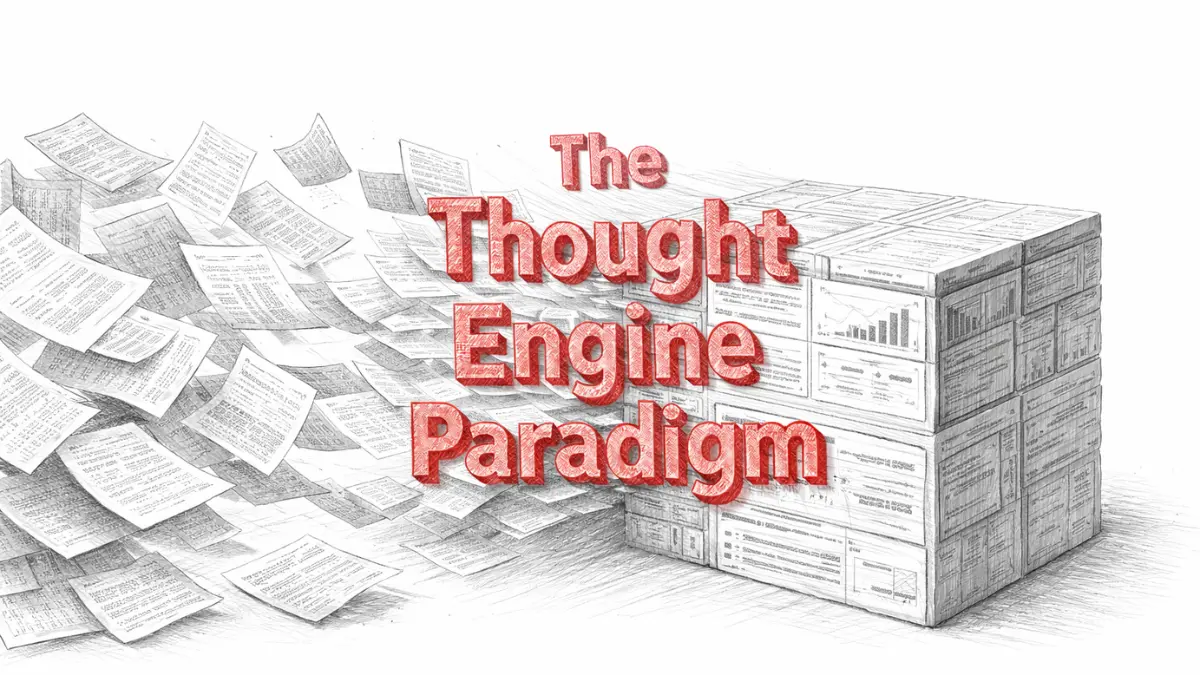
From Search Engines to Thought Engines: The Thought Engine Paradigm
AI does not rank your page here—it extracts modular reasoning fragments and only includes those that survive inference validation across entity graphs.
TL;DR: Traditional SEO content focuses on ranking pages, but generative systems ignore positions and extract only structured reasoning blocks. This leads to loss of visibility when content lacks semantic clarity, entity alignment, and deterministic structure. By redesigning content into modular inference-ready units with stable terminology and explicit logic, AI can interpret, reuse, and include it in synthesized outputs, increasing visibility and inclusion probability.
If your content cannot be extracted as a clean reasoning unit, it will be excluded from AI-generated answers entirely.
The Thought Engine Paradigm defines a structural transition from retrieval-centered search engines to reasoning-driven knowledge systems that synthesize answers instead of listing documents. Traditional ranking systems prioritize indexed relevance, link authority, and keyword alignment, whereas modern inference layers evaluate semantic coherence, entity relationships, and logical structure. As a result, discovery shifts from page ordering to intelligence-based content interpretation that compresses multiple sources into unified responses.
This transition reflects an inference-centric web evolution where decision logic, contextual modeling, and synthesis pipelines determine visibility. Consequently, enterprise content strategies must align with reasoning-first architectures rather than optimize exclusively for positional ranking. In this environment, extractable structure, deterministic terminology, and modular knowledge blocks increase reuse probability in generative interfaces. Therefore, organizations that engineer content for structured inference rather than surface ranking achieve higher inclusion in AI-mediated discovery systems.
Defining the Thought Engine Paradigm
The transition from index-based retrieval to reasoning-first systems requires a structural redefinition of thought engine architecture. This shift moves visibility logic away from keyword proximity and link aggregation toward inference, synthesis, and decision sequencing. The focus here is the conceptual foundation that explains how architectural layers reorganize ranking, evaluation, and response generation within generative systems, as demonstrated in ongoing research at MIT CSAIL.
Thought engine architecture is a system design where inference, synthesis, and decision logic replace keyword matching as the primary ranking mechanism. It formalizes reasoning as the dominant evaluation layer and positions retrieval as a supporting process rather than the final output driver.
Definition: AI understanding within the Thought Engine Paradigm refers to a model’s capacity to interpret structured reasoning, entity alignment, and semantic hierarchy in a way that enables stable synthesis, coherent inference, and reliable inclusion in generative outputs.
Claim: Thought engines replace retrieval-first models with reasoning-first systems.
Rationale: Large models generate structured answers instead of ranked links.
Mechanism: Multi-layer inference integrates entity mapping, context modeling, and ranking compression.
Counterargument: Retrieval systems remain necessary for fact sourcing.
Conclusion: Retrieval becomes a sub-layer within reasoning-based architectures.
Cognitive answer engines vs traditional search
Cognitive answer engines operate by synthesizing information across documents rather than ranking individual URLs. They prioritize semantic continuity, entity consistency, and logical coherence across extracted fragments. In contrast, traditional search systems rely on document-level scoring, link authority metrics, and keyword frequency to determine order.
Conceptual response engines compress multiple signals into a unified output that reflects probabilistic reasoning rather than positional authority. They evaluate claim compatibility, source alignment, and contextual fit before generating an answer. Therefore, visibility depends on structural clarity and inference compatibility rather than solely on backlink profiles.
In practice, traditional search lists documents and leaves interpretation to the user. Cognitive answer engines evaluate meaning directly and present synthesized conclusions.
Inference-powered platforms and ranking compression
Inference-powered platforms reduce the importance of visible ranking positions by collapsing multi-document evidence into a single structured response. They implement reasoning-based ranking models that score semantic compatibility instead of hyperlink centrality. Consequently, evaluation shifts from surface signals to structural reasoning quality.
Ranking compression occurs when multiple documents contribute fragments to a generated answer. Instead of occupying ten ranked slots, content competes for inclusion within synthesis layers. As a result, extractable modules and explicit reasoning blocks increase reuse probability.
In practical terms, ranking compression means fewer visible positions and higher competition for inclusion within a single generated output. The broader technological transition that led to this compression of ranking visibility is explained in this analysis of the evolution of search in the age of generative AI, which traces how discovery systems moved from keyword retrieval to reasoning-driven synthesis.
| Retrieval Model | Hybrid Model | Thought Engine Model |
|---|---|---|
| Keyword matching dominates ranking | Retrieval supports synthesis | Inference dominates ranking |
| Document-level evaluation | Mixed document and fragment evaluation | Fragment-level reasoning evaluation |
| Link authority as primary signal | Link authority plus semantic signals | Semantic coherence as primary signal |
| User interprets results | System assists interpretation | System generates interpretation |
| Ranking list as output | Ranked list plus summary | Synthesized response as output |
Inference-Centric Web Evolution
The structural reorganization of digital ecosystems reflects an inference-centric web evolution that redefines how information becomes visible. Platforms no longer depend exclusively on indexed documents and ranked lists to mediate access. Instead, synthesis pipelines, entity modeling, and reasoning layers restructure visibility at the infrastructure level, as ongoing work at the Stanford Natural Language Institute demonstrates in large-scale language modeling research.
Inference-centric web evolution is the systemic replacement of index-based discovery with real-time synthesis and reasoning outputs. It shifts the control layer from document ranking to contextual reasoning and entity graph integration.
Claim: The web is shifting toward inference-based mediation.
Rationale: Generative models reduce reliance on direct navigation.
Mechanism: Context accumulation and entity graph fusion drive response generation.
Counterargument: High-stakes domains require deterministic verification.
Conclusion: Inference layers dominate user-facing outputs.
Machine inference ecosystems
Machine inference ecosystems coordinate distributed models, knowledge graphs, and retrieval systems into unified reasoning environments. They operate through reasoning-layered platforms where inference modules aggregate entity relationships and contextual signals before producing outputs. Consequently, document boundaries lose prominence while fragment-level semantic alignment becomes decisive.
These ecosystems integrate retrieval, ranking, and synthesis into continuous pipelines. Each stage contributes probabilistic evidence rather than fixed document positions. Therefore, visibility depends on compatibility with inference chains rather than link topology alone.
In operational terms, machine inference ecosystems treat content as modular evidence units that feed structured reasoning processes.
Decision-centric discovery models
Decision-centric discovery models prioritize outcome relevance over navigational completeness. They embed autonomous reasoning engines that evaluate context, user history, and entity proximity before delivering structured conclusions. As a result, systems minimize the need for iterative clicking and manual comparison.
Autonomous reasoning engines compress multi-source inputs into a single decision surface. They reduce cognitive load by performing evaluation internally rather than exposing ranking complexity. Consequently, discovery transforms into mediated decision support rather than open exploration.
In practice, decision-centric systems select and synthesize the most coherent answer rather than present a list of alternatives.
A mid-sized enterprise software provider integrated generative mediation into its internal documentation portal in 2023. Before integration, employees navigated indexed manuals and FAQs through keyword search. After deployment of inference pipelines, documentation fragments were synthesized into contextual responses. Internal analytics recorded a reduction in manual navigation steps and an increase in direct answer retrieval within a single interface session.
Intelligence-First Web Architecture
Platform infrastructures now reorganize around intelligence-first web architecture because the Thought Engine Paradigm requires reasoning layers to precede navigation logic. This structural adaptation reflects how the Thought Engine Paradigm redefines system layering across large-scale digital platforms. Instead of optimizing page trees for indexing depth, platforms now prioritize semantic evaluation, entity modeling, and inference stability before exposure layers activate, as confirmed by research at Berkeley Artificial Intelligence Research (BAIR).
Intelligence-first web architecture is a layered system where reasoning logic precedes navigation and indexing. It assigns structural priority to semantic modeling and structured knowledge blocks so that inclusion decisions occur before retrieval ordering.
Claim: Architecture must prioritize inference layers over page hierarchies.
Rationale: Thought engines interpret semantic density over link position.
Mechanism: Entity alignment and structured knowledge blocks determine output inclusion.
Counterargument: Thin content optimized for retrieval may still rank in traditional systems.
Conclusion: Architectural intelligence determines generative inclusion under the Thought Engine Paradigm.
Cognitive computation engines
Cognitive computation engines execute layered inference routines that evaluate entity relationships, contextual scope, and claim stability. They operate through cognitive synthesis systems that integrate structured fragments into unified reasoning outputs. Consequently, visibility depends on compatibility with computation pipelines rather than hierarchical placement.
These engines reduce dependence on explicit navigation signals by modeling semantic continuity across modules. They prioritize extractable definitions, structured reasoning chains, and stable terminology. Therefore, architectural design must align with computational interpretation requirements.
In practical terms, cognitive computation engines evaluate content as structured reasoning modules rather than isolated web pages.
Machine cognition interfaces
Machine cognition interfaces expose reasoning outputs directly to users while abstracting internal ranking processes. They incorporate machine thought interfaces that translate inference results into coherent answer surfaces. As a result, users interact with synthesized knowledge instead of navigating link hierarchies.
These interfaces depend on layered architecture where reasoning modules feed structured outputs to presentation layers. They reward content that supports entity clarity and definitional precision. Consequently, architectural misalignment reduces inclusion probability in generated answers.
Users see what the system understands and synthesizes rather than what it merely indexes.
| Layer | Function | Visibility Impact |
|---|---|---|
| Inference Layer | Entity modeling and reasoning evaluation | Determines inclusion in generated responses |
| Synthesis Layer | Integrates fragments into structured outputs | Shapes answer coherence and stability |
| Retrieval Layer | Supplies source documents and evidence | Supports factual grounding |
| Navigation Layer | Enables manual exploration | Secondary in generative mediation |
Reasoning-Driven Content Selection
Editorial systems now operate under reasoning-driven content selection rather than isolated keyword scoring. This shift reflects the structural logic of the Thought Engine Paradigm, where coherence and inferential compatibility determine inclusion. The transformation occurs at the content layer, where logical continuity replaces density metrics as the dominant evaluation standard, consistent with research on computational language modeling at Carnegie Mellon LTI.
Reasoning-driven content selection is selection based on logical continuity and inferential compatibility rather than keyword density. It evaluates whether claims integrate into broader inference chains instead of measuring surface-level term frequency.
Claim: Logical coherence increases generative reuse probability.
Rationale: Models reward structured reasoning.
Mechanism: Stepwise claims reduce entropy in synthesis layers.
Counterargument: Creative formats may reduce deterministic interpretability.
Conclusion: Logical flow becomes a visibility signal.
Principle: In reasoning-dominant digital ecosystems, visibility increases when semantic structure, logical sequencing, and terminological stability allow inference layers to integrate content without reinterpretation or ambiguity.
Cognition-powered ranking logic
Cognition-powered ranking logic evaluates structured reasoning patterns instead of isolated relevance scores. It measures how effectively a content unit supports entity alignment, definitional precision, and inference continuity. Consequently, ranking shifts from keyword proximity to semantic stability within reasoning chains.
This logic prioritizes paragraphs that isolate claims, define terms immediately, and maintain consistent terminology. It reduces ambiguity because models prefer deterministic interpretability over stylistic variation. Therefore, structured reasoning becomes a measurable signal within generative inclusion processes.
In practice, cognition-powered ranking logic rewards content that follows predictable reasoning patterns and stable conceptual framing.
Intelligence-evaluated content systems
Intelligence-evaluated content systems assess editorial output based on inferential compatibility rather than traffic metrics. They integrate entity mapping, claim verification signals, and structural clarity into evaluation pipelines. As a result, inclusion probability depends on semantic alignment with model reasoning layers.
These systems penalize ambiguity, terminological drift, and fragmented argumentation. They increase visibility for modular content blocks that integrate smoothly into synthesized outputs. Consequently, editorial standards must emphasize definitional clarity and logical sequencing.
Content performs better when its internal reasoning structure aligns with machine inference models.
- Deterministic paragraph structure
- Stable terminology
- Explicit entity anchoring
These structural features reduce entropy and improve compatibility with reasoning-first evaluation layers.
Conceptual Retrieval Models and Knowledge Graph Fusion
The transition from link graphs to entity graphs defines the structural expansion of conceptual retrieval models within the Thought Engine Paradigm. Instead of ranking documents based on hyperlink authority, systems now evaluate semantic proximity between entities and structured claims. This transformation operates at the graph-modeling level and aligns with large-scale knowledge graph research conducted by the Allen Institute for Artificial Intelligence (AI2).
Conceptual retrieval models are retrieval systems based on entity relationships and semantic proximity rather than page ranking. They prioritize node alignment, contextual consistency, and graph connectivity over positional ordering.
Claim: Entity-based synthesis replaces isolated document ranking.
Rationale: Knowledge graphs improve reasoning continuity.
Mechanism: Multi-source graph fusion supports answer generation.
Counterargument: Entity ambiguity increases inference risk.
Conclusion: Controlled ontology design reduces error propagation.
Intelligence-mediated knowledge access
Intelligence-mediated knowledge access restructures how systems retrieve information from interconnected entity graphs. Instead of retrieving standalone pages, inference layers traverse relationships between nodes that represent concepts, events, and attributes. Consequently, retrieval becomes contextual and relational rather than positional.
These systems depend on structured entity alignment across datasets, taxonomies, and ontologies. They evaluate how well a content fragment integrates into an existing graph rather than how prominently it ranks in isolation. Therefore, semantic compatibility with entity networks becomes a core visibility determinant.
In operational terms, intelligence-mediated knowledge access retrieves structured meaning through entity relationships instead of scanning ranked lists.
Reasoning-based information flow
Reasoning-based information flow organizes retrieval around logical progression rather than document boundaries. It ensures that extracted fragments follow coherent inferential chains supported by graph connections. As a result, synthesis layers integrate nodes that maintain definitional consistency and relational clarity.
This flow reduces fragmentation because each entity link supports a structured reasoning path. It prevents incoherent outputs by restricting retrieval to graph-consistent fragments. Consequently, graph integrity directly influences generative reliability.
Content integrates successfully when its entities align with stable graph structures and support coherent inference sequences.
| Graph Layer | Role | Failure Risk |
|---|---|---|
| Entity Layer | Defines nodes and relationships | Ambiguous entity resolution |
| Context Layer | Aligns entities within scenarios | Context drift |
| Synthesis Layer | Integrates nodes into responses | Inconsistent claim merging |
| Validation Layer | Checks graph coherence | Ontology misalignment |
Predictive Reasoning Interfaces
Digital surfaces increasingly operate through predictive reasoning interfaces rather than link-based navigation. This interface shift reflects the structural logic of the Thought Engine Paradigm, where synthesis replaces browsing as the primary interaction model. The transformation affects UI layers and mediation mechanisms, as analysis of platform behavior and governance trends discussed by the Oxford Internet Institute indicates.
Predictive reasoning interfaces are interfaces that anticipate informational needs through contextual modeling. They generate structured outputs based on accumulated signals rather than waiting for explicit query refinement.
Claim: Interfaces become reasoning surfaces.
Rationale: Users receive synthesized outputs instead of links.
Mechanism: Context modeling reduces explicit query dependency.
Counterargument: Transparency challenges remain.
Conclusion: Predictive mediation increases engagement efficiency.
Intelligence-layered content systems
Intelligence-layered content systems feed predictive reasoning interfaces with structured modules instead of static pages. They organize content into semantic layers that align with entity graphs and inference chains. Consequently, interfaces can assemble responses dynamically without exposing underlying ranking complexity.
These systems depend on extractable definitions, modular reasoning blocks, and consistent terminology. They ensure that contextual signals map directly to structured outputs. Therefore, content must support layered integration to remain visible in predictive environments.
In practical terms, intelligence-layered content systems provide structured building blocks that predictive interfaces recombine into synthesized responses.
Inference-aware publishing strategy
Inference-aware publishing strategy adapts editorial workflows to predictive reasoning environments. It prioritizes logical continuity, entity clarity, and definitional precision over surface-level formatting. As a result, published material aligns with inference pipelines before it reaches mediation layers.
This strategy reduces fragmentation and improves compatibility with reasoning-based synthesis engines. It emphasizes stable terminology and modular argument structures to support extraction and recombination. Consequently, publishing becomes an architectural discipline rather than a stylistic exercise.
Content that anticipates inference patterns integrates more reliably into predictive reasoning interfaces.
Example: A modular article that defines entities immediately, maintains stable terminology, and separates claims into deterministic reasoning blocks allows generative systems to extract high-confidence fragments and recombine them into synthesized responses without structural distortion.
An enterprise IT support platform introduced a generative answer panel in 2024 to replace traditional search result navigation. Previously, employees scanned ranked knowledge base articles and compared multiple documents manually. After deploying a predictive interface, contextual modeling synthesized troubleshooting steps into a single structured response. Internal metrics recorded fewer navigation actions and shorter resolution cycles, indicating that mediated reasoning replaced manual search workflows.
Machine Reasoning Workflows in Enterprise Systems
Enterprise platforms increasingly deploy machine reasoning workflows as they adopt inference layers consistent with the Thought Engine Paradigm. Organizations now require operational mapping of reasoning pipelines rather than relying on opaque model outputs. This shift affects governance structures, validation standards, and compliance frameworks, as documented in AI risk management guidance from NIST.
Machine reasoning workflows are structured pipelines where inference, validation, and ranking operate as sequential decision stages. They transform probabilistic model outputs into controlled, auditable processes that support enterprise reliability.
Claim: Enterprise systems must formalize reasoning workflows.
Rationale: Unstructured inference increases risk.
Mechanism: Validation checkpoints reduce hallucination probability.
Counterargument: Speed may decrease.
Conclusion: Governance improves reliability.
Reasoning-prioritized information delivery
Reasoning-prioritized information delivery ensures that outputs reflect validated inference rather than raw model generation. It introduces staged evaluation layers that verify entity alignment, claim stability, and contextual coherence before exposure. Consequently, enterprise systems reduce error propagation and increase trust consistency.
These delivery pipelines separate inference generation from validation control. They enforce deterministic checkpoints that measure semantic compatibility and factual grounding. Therefore, organizations can deploy generative systems while maintaining accountability.
In practice, reasoning-prioritized information delivery delays exposure until structured verification confirms logical integrity.
Intelligence-mediated knowledge access
Intelligence-mediated knowledge access within enterprise systems integrates reasoning workflows with governance controls. It connects entity graph traversal to compliance filters and validation protocols. As a result, knowledge retrieval aligns with both inference quality and policy constraints.
This approach prevents unverified fragments from entering user-facing synthesis layers. It ensures that contextual reasoning aligns with regulated standards and documentation integrity. Consequently, governance becomes an architectural component rather than an external review stage.
Enterprises that integrate mediation and validation layers reduce systemic risk while preserving generative efficiency.
| Stage | Control Layer | Risk Mitigation |
|---|---|---|
| Inference Generation | Model reasoning engine | Probabilistic output analysis |
| Entity Alignment | Semantic validation layer | Ambiguity detection |
| Context Verification | Policy compliance filter | Regulatory consistency |
| Synthesis Approval | Governance checkpoint | Hallucination reduction |
| Output Delivery | Presentation interface | Controlled exposure |
Strategic Implications of the Thought Engine Paradigm
Long-term macro shifts now produce reasoning-dominant digital ecosystems that alter how visibility, authority, and distribution operate under the Thought Engine Paradigm. This transformation affects market structures, platform mediation, and governance alignment. Strategic forecasting must therefore account for structural compression of exposure surfaces, as policy research and digital economy analysis from the OECD indicate.
Reasoning-dominant digital ecosystems are environments where inference replaces indexing as the central coordination mechanism. They reorganize visibility logic around synthesis layers rather than document positioning.
Claim: The Thought Engine Paradigm restructures digital visibility economics.
Rationale: Direct traffic decreases as synthesis centralizes exposure.
Mechanism: Platform mediation compresses brand surfaces.
Counterargument: High-authority domains retain direct access patterns.
Conclusion: Strategic alignment with reasoning logic determines future competitiveness.
Inference-guided content exposure
Inference-guided content exposure changes how brands achieve visibility within mediated environments. Instead of competing for ranking slots, organizations compete for inclusion within synthesized responses. Consequently, content must align with inference pathways and structured reasoning patterns to remain extractable.
Exposure now depends on semantic compatibility with reasoning chains rather than link authority alone. Platforms compress multiple sources into unified outputs, thereby reducing visible surface diversity. Therefore, brands must design content modules that integrate predictably into synthesis layers.
In practical terms, inference-guided content exposure rewards structured reasoning over positional dominance.
Intelligence-based content interpretation
Intelligence-based content interpretation determines which fragments become part of generated outputs. Systems evaluate entity clarity, definitional precision, and logical continuity before selecting content for synthesis. As a result, visibility shifts from surface optimization to semantic integrity.
This interpretative layer filters ambiguity and penalizes terminological drift. It favors content that maintains stable conceptual framing across sections. Consequently, strategic positioning requires consistent vocabulary and modular reasoning structures.
Content remains competitive when it supports machine interpretation rather than relying on navigational prominence.
- Structural authority modeling
- Semantic consistency engineering
- Cross-platform synthesis readiness
These strategic pillars align organizational output with reasoning-first visibility environments and reduce exposure volatility under the Thought Engine Paradigm.
Operational Framework for Transition
Organizations that move toward inference-oriented digital platforms require a structured execution roadmap aligned with the Thought Engine Paradigm. Practical migration demands coordinated editorial redesign and architectural reconfiguration rather than isolated tactical changes. Research on large-scale model deployment and reasoning systems from DeepMind Research supports the necessity of structured transformation over incremental adjustment.
Inference-oriented digital platforms are platforms engineered to align content with reasoning-first mediation. They integrate semantic containers, validation layers, and inference pipelines into a unified operational framework.
Claim: Transition requires structural redesign rather than optimization tweaks.
Rationale: Inference layers penalize surface-level adjustments.
Mechanism: Layered semantic containers ensure stable interpretation.
Counterargument: Hybrid traffic models still exist.
Conclusion: Structural transformation ensures resilience.
Editorial migration toward reasoning-first information systems
Enterprises must redesign editorial workflows to support reasoning-first information systems rather than keyword-oriented publishing cycles. Structured definitions, modular reasoning chains, and deterministic terminology form the basis of extractable content modules. Consequently, editorial governance must prioritize semantic stability and inferential compatibility.
This migration includes restructuring content into concept blocks, mechanism blocks, example blocks, and implication blocks. It eliminates ambiguity by enforcing definitional clarity at the beginning of each section. Therefore, reasoning coherence becomes the central editorial KPI.
Editorial systems that adopt reasoning-first information systems align more effectively with generative mediation layers.
Architectural alignment with intelligence-driven retrieval
Architectural redesign must support intelligence-driven retrieval instead of link-centric indexing logic. Retrieval layers must integrate entity modeling, contextual validation, and synthesis compatibility. As a result, ranking becomes a subroutine within broader reasoning workflows.
Post-query intelligence systems reduce dependence on manual navigation and prioritize synthesized decision outputs. They accumulate context across sessions and integrate entity graphs into response pipelines. Consequently, infrastructure must support continuous inference rather than isolated request processing.
Enterprises that align architecture with intelligence-driven retrieval and post-query intelligence systems achieve stable inclusion within reasoning-dominant digital ecosystems.
Checklist:
- Are core concepts defined immediately and consistently across sections?
- Does each H2–H4 layer maintain clear semantic boundaries?
- Is each paragraph structured as a single reasoning unit?
- Do entity references align with stable conceptual definitions?
- Does the content support fragment-level extraction without ambiguity?
- Is the architecture compatible with inference-first mediation systems?
Interpretive Architecture of Reasoning-Centric Content
- Inference-layer prioritization. Page composition reflects a hierarchy where reasoning blocks precede navigational signals, enabling generative systems to evaluate semantic density before positional metadata.
- Entity-aligned segmentation. Clearly bounded conceptual units allow models to map claims to stable entities, reducing ambiguity during synthesis across distributed sources.
- Deterministic reasoning chains. Structured argumentative sequences function as modular inference units that can be isolated, recombined, and embedded within generative responses.
- Terminological stability encoding. Recurrent, controlled vocabulary prevents semantic drift and supports consistent interpretation across long-context processing environments.
- Layered extraction compatibility. Alignment between headings, logical progression, and definitional anchors increases structural resilience under AI-mediated retrieval.
These architectural signals clarify how reasoning-centric pages are parsed, segmented, and reassembled by generative systems without altering their internal logic.
FAQ: Thought Engine Paradigm
What is the Thought Engine Paradigm?
The Thought Engine Paradigm describes the transition from retrieval-based search engines to reasoning-first systems that synthesize structured answers instead of ranking links.
How does a thought engine differ from a traditional search engine?
Traditional search ranks documents by keyword and link signals, while a thought engine evaluates semantic coherence, entity alignment, and logical structure before generating a response.
What defines reasoning-first systems?
Reasoning-first systems prioritize inference, synthesis, and contextual modeling, treating retrieval as a supporting layer rather than the final output mechanism.
Why does ranking compression occur in generative systems?
Generative platforms compress multiple documents into a single synthesized output, reducing visible ranking positions and increasing competition for inclusion within inference layers.
What role do entity graphs play in thought engines?
Entity graphs structure relationships between concepts, allowing inference models to integrate fragments into coherent answers rather than relying on isolated document authority.
How does architecture influence generative inclusion?
Layered architectures that prioritize semantic modeling and structured reasoning blocks increase compatibility with inference pipelines and improve generative visibility.
What changes in enterprise systems under this paradigm?
Enterprises formalize machine reasoning workflows, integrate validation checkpoints, and align editorial standards with inference-driven mediation.
Why does logical coherence matter more than keyword density?
Inference layers reward structured reasoning and terminological stability because these properties reduce ambiguity during synthesis and answer generation.
How do predictive reasoning interfaces alter visibility?
Predictive interfaces anticipate informational needs and present synthesized outputs, shifting visibility from navigational prominence to semantic compatibility.
What determines long-term competitiveness in reasoning-dominant ecosystems?
Organizations that align architecture, editorial structure, and governance with inference-first logic maintain stable inclusion across generative mediation systems.
Glossary: Core Terms of the Thought Engine Paradigm
This glossary defines the core terminology used throughout the article to ensure conceptual stability, consistent interpretation, and alignment with reasoning-first systems.
Thought Engine Paradigm
A structural model in which inference, synthesis, and decision logic replace traditional ranking as the primary mechanism of digital visibility.
Reasoning-First System
An information system that prioritizes structured inference and contextual modeling over document indexing and link ordering.
Ranking Compression
The reduction of visible search positions when multiple documents are synthesized into a single generated response.
Entity Graph
A structured network of interconnected concepts that supports semantic alignment and inference-based retrieval.
Inference Layer
The computational stage where contextual modeling, entity alignment, and logical evaluation determine inclusion within generated outputs.
Predictive Reasoning Interface
An interaction surface that anticipates informational needs and delivers synthesized responses instead of ranked navigation lists.
Machine Reasoning Workflow
A structured pipeline where inference generation, validation checkpoints, and synthesis approval operate sequentially within enterprise systems.
Semantic Stability
The preservation of consistent meaning across sections through controlled terminology and explicit definitional boundaries.
Inference Compatibility
The degree to which content integrates smoothly into reasoning chains without generating ambiguity or structural conflict.
Synthesis Layer
The system component that integrates validated fragments into a unified response presented within generative mediation environments.

Author Sergey Kuchinskiy
Founder of PostUpgrade. Researcher in Generative Engine Optimization (GEO), semantic structuring, and machine reasoning systems. Focuses on AI-readable content architecture, computational interpretation, and scalable knowledge retrieval. Author of 200+ analytical publications on generative visibility, semantic mapping, and AI-first information design.
Verified Expertise
- Generative Engine Optimization (GEO)
- AI Content Engineering & Semantic Structuring
- Computational Linguistics & Machine Reasoning
- Large-Scale Content Architecture
Research Focus
AI Search · Generative Visibility · Semantic Mapping · Machine Sentence Design · Reasoning Stability · Knowledge Extraction Models
Academic Contributions
- 200+ analytical research publications
- AI-first page architecture methodologies
- Semantic Frameworks for Machine Interpretation (SFMI)
- Generative Visibility Standards 2024–2025
Citation Metrics
AI-model reuse rate (GEO-Score): 92/100 · Cross-model consistency: 87% · Reasoning chain stability: 91%
Researcher ID: PU-ORCID-7421-9912
View all publications →Connect on LinkedIn →