Last Updated on March 10, 2026 by PostUpgrade
Generative Web Portals: The Next Frontier of Web Interaction
The web is shifting from static websites to system-driven interaction layers that assemble information dynamically. In this context, generative web portals appear as a structural response to rising complexity in content delivery, user intent, and machine-mediated access. Page-based models rely on predefined paths and fixed outputs. Modern environments, however, demand adaptive systems that react to context and signals in real time. As a result, interaction depends more on orchestration logic than on navigation structures.
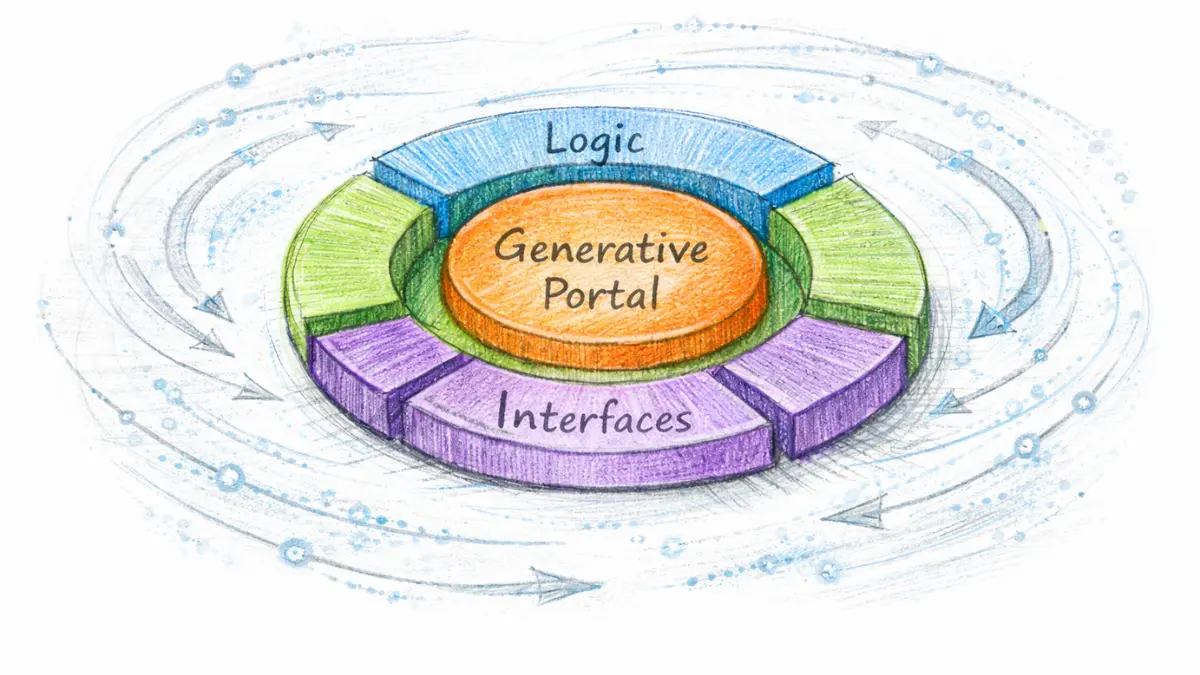
This shift changes how teams design and evaluate web systems. Portals no longer function as collections of pages or interface shells. Instead, they operate as generative interaction systems that assemble content, logic, and responses at runtime. These systems emphasize consistency, interpretability, and reuse across human and machine consumption layers. Consequently, the role of portals expands from presentation to mediation, supporting structured interaction across varied contexts without duplicating content or fragmenting meaning.
The purpose of this article is to define generative web portals as a distinct architectural and strategic paradigm. It explains how these systems are structured, how their internal mechanisms operate, and why they matter for long-term web evolution. The analysis focuses on architecture, interaction models, content flow, and enterprise implications. It avoids interface-level descriptions. Through precise definitions and consistent reasoning, the article positions generative portals as foundational components of future web interaction rather than incremental user interface enhancements.
Defining Generative Web Portals
The meaning of generative web portals centers on a shift from page-bound delivery to system-level interaction. This definition separates portals from traditional websites and applications by focusing on how interaction states form and change. The scope stabilizes terminology and sets clear conceptual boundaries while aligning with web architecture principles articulated by the W3C.
Definition: AI understanding refers to a system’s ability to interpret structural meaning, conceptual boundaries, and logical relationships in a way that enables accurate reasoning, stable summarization, and consistent reuse of interaction models across generative environments.
Claim: Generative web portals represent a distinct class of web systems.
Rationale: Traditional sites remain page-bound, while portals operate at a system level that prioritizes interaction states.
Mechanism: Portals assemble interaction states dynamically from modular components governed by orchestration logic.
Counterargument: Some dynamic websites appear similar in behavior when they render content conditionally.
Conclusion: The defining difference lies in generative assembly of states, not in visual output or interface complexity.
Generative Portals Concept
The generative portals concept frames portals as interaction systems rather than containers of pages. This framing emphasizes state assembly, rule execution, and context interpretation as first-order properties. Consequently, portals function as mediators that reconcile inputs, data, and constraints into coherent outputs.
Boundary conditions clarify what portals are not. They do not describe interface widgets, templates, or navigation shells. Instead, they define how systems decide what to present and how to respond under varying conditions. Therefore, the concept excludes purely dynamic layouts that lack state orchestration.
Terminology alignment matters because similar words often describe different mechanisms. Using consistent terms prevents semantic drift across teams and documents. As a result, the concept anchors discussion around systems, states, and orchestration rather than screens or flows.
Put simply, a generative portal focuses on how decisions form before content appears. It treats interaction as an outcome of system logic rather than a sequence of clicks.
Generative Portals Definition
The generative portals definition formalizes portals as systems that produce interaction outcomes at runtime. This definition prioritizes assembly logic and context evaluation over static publishing. Consequently, it supports reuse across channels and consistency across scenarios.
A clear distinction from apps and platforms follows from this definition. Applications execute predefined functions, while platforms expose extensibility surfaces. Portals, however, generate interaction states by combining logic and content dynamically. Therefore, they occupy a separate category with different design constraints.
This definition also limits scope to system behavior. It avoids interface descriptors and excludes implementation technologies. As a result, it remains stable as tools and frameworks evolve.
In straightforward terms, the definition explains what the system does, not how it looks. It describes how interaction forms, not where it appears.
What Are Generative Portals
Common misinterpretations treat portals as advanced dashboards or content hubs. This view overlooks the role of orchestration and state evaluation. As a result, it confuses dynamic rendering with generative behavior.
A non-UI-centric explanation resolves this confusion by focusing on internal logic. Portals determine responses through rules, signals, and constraints before any interface renders. Consequently, interfaces become outputs of the system rather than drivers of behavior.
This perspective also clarifies why portals scale across contexts. Because logic remains centralized, the same system can serve different roles and environments without duplication. Therefore, generative behavior persists regardless of presentation layer.
In simpler terms, generative portals decide first and display later. They compute interaction outcomes and then present them through whatever interface is appropriate.
Architectural Foundations of Generative Portals
Generative portal architecture defines how system-driven interaction environments organize their internal structure. This architecture prioritizes layered composition over implementation technologies and emphasizes separation of concerns. Research on modular and distributed systems, including work from MIT CSAIL, supports this approach by demonstrating how layered designs enable adaptive behavior at scale.
Principle: Generative systems achieve higher interpretability when architectural layers, interaction logic, and content boundaries remain structurally stable and consistently separated across contexts.
Definition: Generative portal architecture is the layered organization of logic, content, and orchestration that enables dynamic interaction assembly across changing contexts.
Claim: Generative portals rely on modular, composable architectures.
Rationale: Fixed architectures cannot sustain adaptive interaction states as system complexity increases.
Mechanism: Components are orchestrated through logic layers and rulesets that govern how states assemble at runtime.
Counterargument: Monolithic systems can scale in limited and highly controlled environments.
Conclusion: Long-term adaptability depends on architectural modularity rather than centralized design.
Generative Portal Framework
A generative portal framework provides the structural blueprint that governs how components interact. It defines boundaries between layers and establishes rules for composition and reuse. As a result, the framework ensures consistency even when interaction states vary widely.
This framework separates system responsibilities into clear domains. Logic determines decisions, orchestration coordinates assembly, and content supplies generative units. Consequently, changes in one domain do not destabilize the others.
At a practical level, the framework acts as a stable skeleton. It allows teams to evolve interaction logic without rebuilding the entire system.
Portal Logic Layers
Portal logic layers execute rules that translate signals into decisions. These layers interpret context, constraints, and intent to determine valid interaction states. Therefore, logic operates independently of presentation and delivery.
Layered logic also improves maintainability. When rules change, teams adjust specific layers without affecting orchestration or content units. As a result, the system remains coherent under continuous evolution.
In simpler terms, logic layers decide what should happen. They apply rules before any content appears.
Portal Orchestration Layer
The portal orchestration layer coordinates how components assemble into interaction states. It sequences logic execution, content retrieval, and state validation. Consequently, orchestration ensures that outputs remain consistent across contexts.
This layer also manages dependencies between components. By controlling assembly order, it prevents conflicts and incomplete states. Therefore, orchestration becomes central to system reliability.
Put plainly, orchestration connects decisions to outcomes. It turns separate components into a working interaction.
Portal Based System Design
Portal based system design treats the portal as a system core rather than a surface layer. This design approach aligns architectural decisions with interaction outcomes instead of interface layouts. As a result, systems scale across channels and use cases.
Designing around the portal encourages reuse and consistency. Shared logic and orchestration support multiple contexts without duplication. Consequently, the system maintains semantic stability as it grows.
In straightforward terms, system design starts from logic and assembly. Interfaces become outputs, not foundations.
| Layer | Function | Stability |
|---|---|---|
| Orchestration | State assembly | High |
| Logic | Rule execution | Medium |
| Content | Generative units | Variable |
Together, these layers form a coherent architectural foundation that supports generative behavior while preserving flexibility and control.
Interaction Models in Generative Portals
Generative interaction models redefine how systems produce outcomes by shifting interaction from navigation paths to state-based engagement. This approach treats interaction as a computed result of signals and constraints rather than a sequence of predefined steps. Research on language and intent modeling from the Stanford Natural Language Institute supports this system-oriented view by emphasizing interpretation over traversal.
Example: A generative portal that separates interaction logic from presentation enables AI systems to identify decision states independently of interface variations, increasing the likelihood that its interaction patterns are reused in assistant-generated responses.
Definition: A generative interaction model defines how systems respond to user and contextual signals through dynamic state composition rather than fixed navigation flows.
Claim: Interaction in portals is state-driven, not navigation-driven.
Rationale: Static paths limit adaptive behavior when context and intent vary across situations.
Mechanism: Inputs are interpreted into interaction states dynamically through rule evaluation and signal aggregation.
Counterargument: Menu-based systems remain effective for simple and predictable tasks.
Conclusion: Complex environments require generative interaction models to maintain relevance and coherence.
Portal Based Web Interaction
Portal based web interaction treats interaction as an outcome produced by system logic. Signals such as intent, role, and context enter the system and trigger state evaluation. As a result, interaction does not follow a linear path but adapts to conditions in real time.
This model changes how systems scale interaction. Instead of adding new pages or flows, teams adjust logic and rules. Consequently, the system supports new scenarios without structural duplication.
In simpler terms, the system decides how to respond before anything appears. Interaction reflects system reasoning rather than user navigation choices.
Dynamic Portal Interaction
Dynamic portal interaction emphasizes continuous adaptation rather than discrete steps. Each input updates the current state, which then reshapes the next response. Therefore, interaction evolves as conditions change.
This dynamic behavior also reduces friction. Users do not need to search for the correct path because the system aligns responses with current context. As a result, interaction remains consistent even as complexity grows.
Put plainly, the portal adjusts as the situation changes. It responds to signals instead of forcing users through fixed routes.
Portal Driven User Experience
Portal driven user experience emerges from system decisions rather than interface design. Experience quality depends on how accurately the system interprets signals and assembles states. Consequently, consistency becomes a product of logic, not layout.
This approach also separates experience from presentation. Different interfaces can deliver the same interaction logic without redesigning the system. Therefore, experience remains stable across channels.
In everyday terms, the system shapes what users experience. The interface only delivers what the portal has already decided.
Content Generation and Flow Inside Portals
Dynamic content portals organize how information is assembled, contextualized, and delivered through system logic rather than static publishing rules. This approach prioritizes flow sequencing and mediation over individual generation tools, which shifts attention to how content moves through interaction states. Research from the Allen Institute for Artificial Intelligence supports this logic-centric view by emphasizing structured assembly and reuse over isolated content creation.
Definition: Dynamic content portals generate and deliver content based on contextual logic rather than static publishing or fixed page layouts.
Claim: Content in portals follows flow logic, not page logic.
Rationale: Pages cannot reflect real-time contextual shifts across users, roles, and situations.
Mechanism: Content units assemble per interaction state through orchestration and rule evaluation.
Counterargument: Static content remains valid for stable reference and archival contexts.
Conclusion: Generative flow enables relevance and consistency without duplicating content structures.
Portal Content Generation Logic
Portal content generation logic governs how systems select and combine content units in response to signals. Instead of publishing finished pages, portals maintain modular units that the system evaluates at runtime. As a result, generation becomes a decision process rather than a creative act.
This logic relies on clear separation between content units and assembly rules. Content remains neutral and reusable, while logic determines when and how it appears. Consequently, updates to logic can change outcomes without rewriting content.
In practice, this means the system decides what to show based on conditions. Content waits until logic determines its relevance.
Content Flow in Portals
Content flow in portals describes how assembled units move through interaction states. Flow sequencing ensures that responses remain coherent as context evolves. Therefore, content does not appear randomly but follows a controlled progression.
This flow also supports continuity across sessions and channels. When state persists, the system maintains alignment between past and present interactions. As a result, users experience consistent outcomes even as inputs change.
Put simply, content moves through the system in an ordered way. The portal controls when and why each piece appears.
Portal Mediated Content Delivery
Portal mediated content delivery separates delivery from presentation. The portal determines what content state is valid, while interfaces simply render that state. Consequently, delivery remains consistent across devices and formats.
This mediation also reduces duplication. The same content logic can serve multiple endpoints without separate publishing pipelines. Therefore, teams maintain a single source of truth for interaction outcomes.
In everyday terms, the portal delivers decisions, not pages. Interfaces display those decisions wherever needed.
Modularity and Composability as Core Principles
Modular web portals define how generative web portals remain adaptable under growing system complexity. In this architecture, generative web portals treat modularity as an operational requirement rather than a visual or stylistic choice. Studies on modular language and system architectures from Carnegie Mellon University LTI support this approach by demonstrating how isolation of responsibilities preserves long-term system coherence.
Definition: Modular web portals consist of independently operable components assembled at runtime according to system logic rather than fixed integration paths.
Claim: Modularity is foundational to generative web portals.
Rationale: Coupled systems limit evolution because changes propagate across unrelated parts.
Mechanism: Independent components enable recomposition through stable interfaces and orchestration rules.
Counterargument: Over-modularization increases coordination cost and operational overhead.
Conclusion: Controlled modularity balances flexibility with structural stability in generative web portals.
Composable Portal Systems
Composable portal systems explain how generative web portals assemble functionality without rigid dependencies. Each functional unit exposes defined inputs and outputs, which allows the portal to compose behavior dynamically. As a result, generative web portals extend interaction capabilities without restructuring their core architecture.
This composability also enables parallel development across teams. Individual units evolve independently while remaining compatible with the system. Consequently, generative web portals scale through incremental change rather than disruptive redesign.
At a practical level, composable systems allow generative web portals to select and combine capabilities as conditions change. The system assembles interaction behavior from modular parts instead of relying on a single fixed structure.
Generative Portal Components
Generative portal components represent the smallest operational units inside generative web portals. Each component encapsulates a single responsibility, such as rule evaluation, content retrieval, or state validation. Therefore, components remain reusable across multiple interaction scenarios.
Component isolation also strengthens system reliability. When one component changes, others continue to operate predictably because interfaces remain stable. As a result, generative web portals maintain consistent behavior even as individual parts evolve.
In simpler terms, each component performs one defined task. Generative web portals combine these tasks dynamically to produce coherent interaction states.
Generative Portals as a Web Platform Model
Portals as web platforms describe a shift from delivery layers to platform-level constructs that coordinate interaction, content, and logic. This framing connects portals to the broader evolution of web systems where extensibility and reuse outweigh page-centric delivery. The scope excludes commercial platform comparisons and focuses on structural properties aligned with digital economy analysis from the OECD Digital Economy.
Definition: A portal-centric web model treats interaction environments as adaptive platforms rather than destinations with fixed endpoints.
Claim: Generative portals function as platforms, not sites.
Rationale: Platforms enable extensibility and ecosystem behavior through shared rules and interfaces.
Mechanism: Portals expose interaction and content layers systemically, allowing multiple contexts to consume the same logic.
Counterargument: Platform complexity increases governance demands and coordination overhead.
Conclusion: Platform logic enables long-term extensibility while preserving systemic coherence.
Portal Centric Web Model
The portal centric web model organizes interaction around a stable core that multiple experiences can draw from. This model prioritizes shared logic, consistent state handling, and reusable content units. Consequently, the web shifts from isolated destinations to interconnected environments.
This structure also changes ownership boundaries. Teams manage platforms that serve many touchpoints instead of maintaining separate sites. As a result, updates propagate across contexts without duplication.
In practical terms, the portal becomes the system of record. Experiences consume platform outputs rather than defining behavior independently.
Evolution of Web Portals
The evolution of web portals reflects a gradual move from aggregation to orchestration. Early portals collected links and content, while later versions added personalization and dynamic rendering. Today, portals coordinate logic and content at a system level. This architectural shift parallels the broader transformation of discovery systems on the web. The evolution from keyword-based retrieval toward AI-driven reasoning fundamentally reshaped how information ecosystems operate. A broader context appears in this analysis of the evolution of search in the age of generative AI, which explains how reasoning-based discovery models redefined visibility and information interaction.
This evolution aligns with changes in discovery and interaction. As systems interpret signals more precisely, portals respond by assembling outcomes rather than presenting lists. Therefore, portals adapt without expanding page inventories.
Put simply, portals have progressed from containers to coordinators. Each stage increased the role of system logic over static structure.
Portals Beyond Websites
Portals beyond websites extend platform logic across channels and environments. The same portal can serve web, application, and embedded contexts without redesigning core behavior. Consequently, interaction remains consistent regardless of delivery surface.
This extension also supports organizational scalability. Centralized logic reduces fragmentation and simplifies governance across products. As a result, systems maintain clarity as they expand.
In everyday terms, the portal operates behind the scenes. It powers many experiences while remaining independent of any single website.
Enterprise and Knowledge Use Cases
Enterprise generative portals operate in organizational environments where information volume, role diversity, and decision complexity exceed the limits of static delivery. These systems support coordinated interaction across departments by aligning logic, content, and context. Analysis from the Harvard Data Science Initiative highlights how adaptive systems improve knowledge access and decision quality in data-intensive organizations.
Definition: Enterprise generative portals are adaptive systems that support complex decision and knowledge workflows through context-aware interaction logic.
Claim: Enterprises benefit from portal-based interaction systems.
Rationale: Knowledge complexity exceeds the capacity of static delivery models to remain coherent and current.
Mechanism: Portals adapt outputs to role, task, and context by assembling interaction states dynamically.
Counterargument: High implementation cost and organizational change can limit early adoption.
Conclusion: Long-term efficiency and reduced friction offset initial complexity in enterprise environments.
Knowledge Portals Architecture
Knowledge portals architecture organizes information access around shared logic rather than document repositories. This architecture centralizes interpretation rules while keeping knowledge units modular and reusable. As a result, organizations reduce duplication and maintain consistent meaning across teams.
Such architectures also support role-specific views without fragmenting content. The system evaluates context and assembles relevant knowledge states dynamically. Consequently, experts and non-experts receive aligned but appropriate outputs.
In simpler terms, the portal decides what knowledge fits each situation. People see what they need without searching across disconnected systems.
Portal Driven Applications
Portal driven applications embed portal logic into operational workflows. Instead of building isolated tools, organizations expose shared interaction logic across applications. Therefore, applications act as consumers of portal decisions rather than independent systems.
This pattern improves maintainability and governance. When rules change, updates propagate through the portal to all connected applications. As a result, behavior remains consistent across the enterprise.
Put plainly, applications rely on the portal for decisions. They display outcomes without redefining logic each time.
A large research organization restructured internal knowledge access by deploying enterprise generative portals across research units. Teams replaced document-centric repositories with role-aware interaction states. As a result, content duplication declined and retrieval friction decreased. Researchers reported faster access to relevant material without navigating multiple systems.
Designing and Scaling Generative Portals
Designing generative portals requires decisions that account for growth, governance, and long-term system behavior. This perspective treats design as a structural discipline rather than a tooling choice, with emphasis on stability under change. Guidance from the NIST Digital Systems Architecture research frames scalable systems as products of deliberate boundary definition and controlled evolution.
Definition: Designing generative portals involves defining stable logic, system boundaries, and explicit evolution paths that support growth without semantic drift.
Claim: Portal design must anticipate scale and change.
Rationale: Static assumptions break as interaction volume, roles, and contexts expand.
Mechanism: Stable logic layers support controlled evolution by isolating decision rules from delivery and presentation.
Counterargument: Over-engineering can delay deployment and reduce early feedback.
Conclusion: Design discipline enables sustainable scaling while preserving system coherence.
Portal Interaction Strategy
Portal interaction strategy defines how systems interpret signals and produce outcomes consistently over time. This strategy aligns interaction rules with organizational goals and governance constraints. As a result, interaction remains predictable even as usage patterns change.
A clear strategy also limits unintended behavior. By defining which signals matter and how they combine, the system avoids ambiguous states. Consequently, teams maintain confidence in system outputs as scale increases.
In practical terms, interaction strategy sets the rules of engagement. It determines how the portal reacts before any interface renders.
Scalable Portal Design
Scalable portal design focuses on preserving clarity as systems grow. This design approach emphasizes modular logic, explicit boundaries, and controlled dependencies. Therefore, scaling does not require structural rewrites.
Such design also supports incremental expansion. Teams add capabilities by extending logic layers rather than duplicating structures. As a result, the system grows without accumulating technical debt.
Put simply, scalable design allows growth without chaos. The portal expands through rules, not through sprawl.
Generative Portals Best Practices
Generative portals best practices prioritize consistency, reuse, and governance. These practices include maintaining stable terminology, isolating responsibilities, and documenting decision logic. Consequently, systems remain interpretable for both humans and machines.
Best practices also address long-term maintenance. Clear ownership and versioning prevent fragmentation as teams evolve. Therefore, portals sustain value beyond initial deployment.
In everyday terms, best practices keep the system understandable. They ensure that growth does not obscure how decisions form.
Checklist:
- Are portal concepts defined before being used in reasoning chains?
- Do architectural sections maintain stable H2–H4 semantic boundaries?
- Does each paragraph express a single interaction or structural idea?
- Are abstract portal models reinforced through concrete system examples?
- Is terminology reused consistently across architecture, interaction, and use cases?
- Does the overall structure support sequential interpretation by AI systems?
Conclusion
Generative portals redefine web interaction by shifting focus from pages and interfaces to system-level reasoning and assembly. Throughout this analysis, portals emerged as interaction systems that compute outcomes from logic, context, and content rather than presenting predefined paths. This shift reshapes web architecture by prioritizing orchestration, modularity, and state management over layout and navigation.
The architectural and interaction patterns discussed show how portals support scalability and consistency across environments. By separating logic, orchestration, and content, organizations reduce duplication and preserve semantic stability. These properties become increasingly important as systems serve diverse roles, channels, and machine-mediated consumers.
Looking ahead, generative portals hold long-term relevance for AI-mediated environments. As automated systems consume and reuse web outputs, clear structure and predictable reasoning gain importance. Portals provide a framework that aligns human interaction needs with machine interpretation requirements. In doing so, they establish a durable foundation for future web interaction without relying on transient interface trends.
Interpretive Structure of Generative Portal Architectures
- System-level segmentation. The division of content into architecture, interaction, flow, and governance layers enables AI systems to distinguish conceptual domains without conflating presentation with logic.
- Reasoning chain alignment. Recurrent deep reasoning chains embedded at consistent structural positions provide stable inference anchors for generative interpretation.
- Context-bound semantic containers. Each section operates as a closed semantic container, allowing models to resolve meaning locally without cross-section dependency leakage.
- Progressive abstraction sequencing. The ordered transition from definition to architecture, interaction, and application reflects a deliberate abstraction gradient that supports long-context comprehension.
- Platform-oriented framing. Framing portals as system platforms rather than interfaces establishes a structural signal that shifts interpretation from UI semantics to architectural reasoning.
This structural composition clarifies how generative systems interpret the page as a coherent architectural narrative, independent of individual sections or surface-level presentation.
FAQ: Generative Web Portals
What are generative web portals?
Generative web portals are system-driven interaction environments that assemble content, logic, and responses dynamically based on context rather than fixed page structures.
How do generative portals differ from traditional websites?
Traditional websites deliver predefined pages, while generative portals compute interaction states in real time using orchestration logic and contextual signals.
Why are generative portals considered platform-level systems?
Generative portals expose shared logic and content layers that can support multiple experiences, which aligns them with platform architectures rather than single destinations.
How do generative portals manage interaction?
Portals interpret user and contextual signals to assemble interaction states dynamically, shifting interaction from navigation paths to system-level decision outcomes.
What role does modularity play in generative portals?
Modularity allows portals to recombine independent components at runtime, enabling scalability and controlled evolution without structural duplication.
How is content delivered inside generative portals?
Content is delivered through mediated flows where the portal determines valid states first and interfaces render those outcomes consistently across contexts.
Where are generative portals used in enterprise environments?
Enterprises use generative portals to support complex knowledge and decision workflows where static delivery cannot accommodate role and context diversity.
How do generative portals support long-term system evolution?
By separating logic, orchestration, and content, portals allow systems to scale and adapt through rule changes rather than structural rewrites.
Why are generative portals relevant for AI-mediated environments?
Clear structure and predictable reasoning enable AI systems to interpret, reuse, and maintain consistency when consuming portal-generated interaction states.
Glossary: Key Terms in Generative Web Portals
This glossary defines the core terminology used throughout the article to support consistent interpretation of generative portal architectures by both readers and AI systems.
Generative Web Portal
A system-driven interaction environment that assembles content, logic, and responses dynamically based on context rather than predefined page structures.
Interaction State
A computed system outcome representing the current combination of context, logic, and content delivered to a user or interface.
Portal Orchestration
The coordination layer responsible for sequencing logic execution, content assembly, and validation of interaction states.
Modular Component
An independently operable unit within a portal system that encapsulates a single responsibility and can be recomposed at runtime.
Generative Interaction Model
A system model in which interaction outcomes are computed dynamically from signals and rules rather than predefined navigation paths.
Content Flow Logic
The rule-based sequencing that governs how content units move through interaction states within a portal.
Portal Logic Layer
The system layer that evaluates rules, constraints, and signals to determine valid interaction states.
Platform-Oriented Portal
A portal designed as a reusable system core that supports multiple experiences rather than a single destination.
Enterprise Generative Portal
A generative portal deployed within organizations to support complex knowledge and decision workflows across roles and contexts.
Structural Predictability
The consistency of architectural patterns that allows AI systems to interpret portal behavior and content reliably across sections.

Author Sergey Kuchinskiy
Founder of PostUpgrade. Researcher in Generative Engine Optimization (GEO), semantic structuring, and machine reasoning systems. Focuses on AI-readable content architecture, computational interpretation, and scalable knowledge retrieval. Author of 200+ analytical publications on generative visibility, semantic mapping, and AI-first information design.
Verified Expertise
- Generative Engine Optimization (GEO)
- AI Content Engineering & Semantic Structuring
- Computational Linguistics & Machine Reasoning
- Large-Scale Content Architecture
Research Focus
AI Search · Generative Visibility · Semantic Mapping · Machine Sentence Design · Reasoning Stability · Knowledge Extraction Models
Academic Contributions
- 200+ analytical research publications
- AI-first page architecture methodologies
- Semantic Frameworks for Machine Interpretation (SFMI)
- Generative Visibility Standards 2024–2025
Citation Metrics
AI-model reuse rate (GEO-Score): 92/100 · Cross-model consistency: 87% · Reasoning chain stability: 91%
Researcher ID: PU-ORCID-7421-9912
View all publications →Connect on LinkedIn →